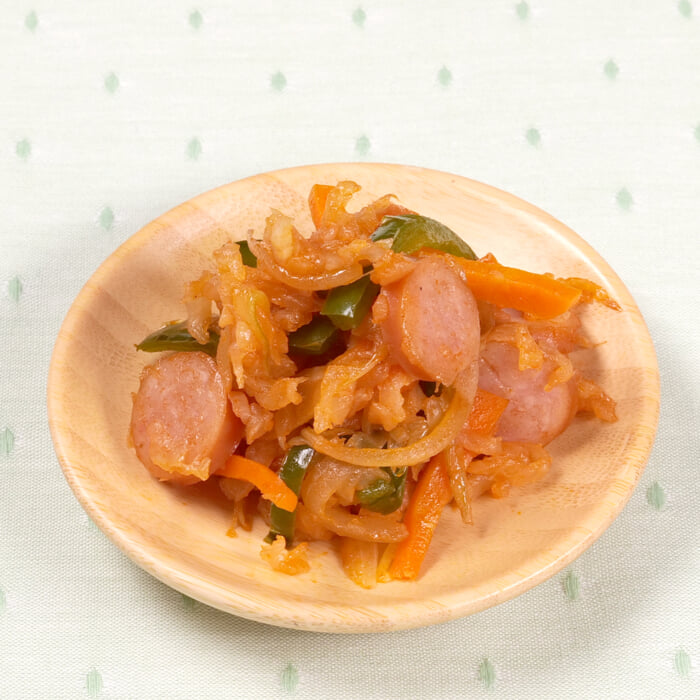
Kiriboshi Daikon Napolitan
切干ナポリタン · Kiriboshi Napolitan
 By Aoi, licensed nutritionist · From a Japanese preschool lunch menu
Napolitan is Japan's beloved ketchup spaghetti, and this side dish borrows its flavors but swaps the noodles for kiriboshi daikon, dried shredded daikon that turns pleasantly chewy once rehydrated. Kiriboshi daikon is usually served in a gentle soy-simmered dish, which can be a hard sell for little ones, but coat it in ketchup with sausage rounds, carrot, bell pepper and onion and children happily dig in. The dried daikon is soaked and then boiled from cold water so it cooks through and softens evenly before it hits the pan, and the vegetables are stir-fried until fully wilted so they are soft enough for small mouths. It is a clever way to get an old-fashioned, fiber-rich ingredient onto a modern kids' plate.
Added. Open the recipe helper (bottom right) → ☰ Menu → 🛒 Shopping list to see the ingredients for your family size.
Printing uses the number of adults and children set under Ingredients, so set those first.
Ingredients
Amounts for 1 child (1 serving). An adult counts as 2 servings.
One serving here is 1.5× the portion served to a child in a Japanese preschool, sized for Western appetites. An adult counts as two servings. Tap an ingredient to check it off.
Ingredients
- 6.8 gkiriboshi daikon (dried shredded daikon)Sun-dried strips of daikon radish with a concentrated sweetness and chewy texture, soaked before cooking. Substitute: Fresh daikon or carrot cut into matchsticks.
- 6.8 gcarrot
- 6.8 ggreen bell pepper
- 13.5 gonion
- 13.5 gwiener sausages
Seasonings
- 2.3 gvegetable oil
- 6.8 gketchup
- 0.8 gchuno sauce (Japanese medium-thick brown sauce)A sweet, tangy, fruit-and-vegetable-based brown sauce that sits between thin Worcestershire and thick tonkatsu sauce. Substitute: Tonkatsu sauce, or Worcestershire sauce mixed with a little ketchup.
- 0.1 gsalt
About the Japanese ingredients in this recipe
- kiriboshi daikon (dried shredded daikon) (切干しだいこん)
- Sun-dried strips of daikon radish with a concentrated sweetness and chewy texture, soaked before cooking. Substitute: Fresh daikon or carrot cut into matchsticks.
- chuno sauce (Japanese medium-thick brown sauce) (中濃ソース)
- A sweet, tangy, fruit-and-vegetable-based brown sauce that sits between thin Worcestershire and thick tonkatsu sauce. Substitute: Tonkatsu sauce, or Worcestershire sauce mixed with a little ketchup.
Directions
- 1
Soak the kiriboshi daikon in water for 10 minutes to rehydrate, then cut it into 3 cm lengths. Put it in a pot of cold water, bring to a boil, and boil for 10 minutes.
- 2
Cut the carrot and green bell pepper into thin 4 cm strips. Halve the onion crosswise and cut it into thin slices.
- 3
Slice the wiener sausages into rounds.
- 4
Heat the oil in a frying pan, add the cut vegetables (carrot, bell pepper and onion), and stir-fry well over medium heat until they are soft and wilted.
- 5
Add the kiriboshi daikon and sausages and stir-fry over low heat. To finish, add the seasonings and toss quickly to coat.
Nutrition
| Per | 1 serving | 1 adult serving | Your total |
|---|---|---|---|
| Energy | 100.5 kcal | 201 kcal | 100.5 kcal |
| Protein | 2.4 g | 4.8 g | 2.4 g |
| Fat | 6.5 g | 12.9 g | 6.5 g |
| Carbohydrates | 9.3 g | 18.6 g | 9.3 g |
| Fiber | 2.1 g | 4.2 g | 2.1 g |
| Salt equivalent | 0.5 g | 0.9 g | 0.5 g |
| Calcium | 42 mg | 84 mg | 42 mg |
| Iron | 0.2 mg | 0.3 mg | 0.2 mg |
| Potassium | 343.5 mg | 687 mg | 343.5 mg |
| Energy | Protein | Fat | Carbs | Fiber | Salt equiv. | Calcium | Iron | Potassium | |
|---|---|---|---|---|---|---|---|---|---|
| 1 serving | 100.5 kcal | 2.4 g | 6.5 g | 9.3 g | 2.1 g | 0.5 g | 42 mg | 0.2 mg | 343.5 mg |
| 1 adult serving | 201 kcal | 4.8 g | 12.9 g | 18.6 g | 4.2 g | 0.9 g | 84 mg | 0.3 mg | 687 mg |
Values are per serving (1.5× the Japanese preschool portion); an adult serving is double. They were calculated by a licensed Japanese nutritionist using the Standard Tables of Food Composition in Japan. "Salt equivalent" is sodium × 2.54, the standard Japanese measure. Allergen flags cover egg, milk and wheat only and come from the nutritionist's records. Soy sauce and miso are made with wheat but are usually allowed on Japanese wheat-free school menus, so check with your doctor.