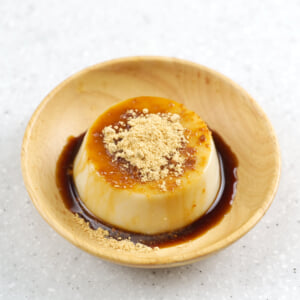
Kinako Pudding (Roasted Soybean Flour Pudding)
きな粉プリン · Kinako Purin
 By Aoi, licensed nutritionist · From a Japanese preschool lunch menu
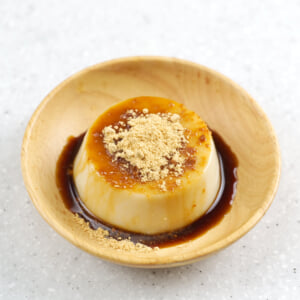
Kinako is roasted soybean flour, the toasty, nutty powder you may know from kinako mochi or warabi mochi. Here it flavors a soft milk pudding that is set with kanten (agar) rather than gelatin, so it firms up cleanly in the fridge and holds its shape on a small spoon. A quick sauce of kokuto, the dark unrefined cane sugar from Okinawa, adds a gentle molasses note that children love, and for the littlest ones we simply leave it off.
Contains kokuto (Japanese brown sugar), which should not be given to babies under 1 year old.
Added. Open the recipe helper (bottom right) → ☰ Menu → 🛒 Shopping list to see the ingredients for your family size.
Printing uses the number of adults and children set under Ingredients, so set those first.
Ingredients
Amounts for 1 child (1 serving). An adult counts as 2 servings.
One serving here is 1.5× the portion served to a child in a Japanese preschool, sized for Western appetites. An adult counts as two servings. Tap an ingredient to check it off.
Ingredients
- 0.9 gkanten (agar) powderA plant-based gelling agent made from seaweed that sets firmly, even at room temperature. Substitute: Agar-agar powder from an Asian grocery or health food store; gelatin can be used but gives a softer set and must be chilled.
- 9 gkinako (roasted soybean flour)A nutty, lightly sweet powder made from roasted ground soybeans, often dusted over mochi or rice. Substitute: No close substitute - look for kinako (sometimes sold as roasted soybean flour) at a Japanese or Asian grocery, or online.
- 90 gmilk
Seasonings
- 30 gwater
- 10.1 gsugar
- 9 gkokuto (Japanese brown sugar)An unrefined dark cane sugar from Okinawa with a deep, molasses-like flavor. Substitute: Dark brown sugar or muscovado.
- 4.5 gwater
About the Japanese ingredients in this recipe
- kanten (agar) powder (かんてん(粉))
- A plant-based gelling agent made from seaweed that sets firmly, even at room temperature. Substitute: Agar-agar powder from an Asian grocery or health food store; gelatin can be used but gives a softer set and must be chilled.
- kinako (roasted soybean flour) (きな粉)
- A nutty, lightly sweet powder made from roasted ground soybeans, often dusted over mochi or rice. Substitute: No close substitute - look for kinako (sometimes sold as roasted soybean flour) at a Japanese or Asian grocery, or online.
- kokuto (Japanese brown sugar) (黒砂糖)
- An unrefined dark cane sugar from Okinawa with a deep, molasses-like flavor. Substitute: Dark brown sugar or muscovado.
Directions
- 1
Put the kinako in a bowl, add just a splash of the milk, and stir until the kinako dissolves into a smooth paste.
- 2
Put the kanten powder and water in a pot and heat, stirring, until the kanten dissolves. Add the sugar and mix well, then gradually stir in the room-temperature milk and the kinako paste from step 1.
- 3
Pour into a tray or individual cups and chill in the refrigerator until set.
- 4
Put the kokuto and water in a small pot and heat to make the sauce.
- 5
Spoon the kokuto sauce over the set pudding.
Note: For children in the final weaning stage (around 12 to 18 months), serve the pudding without the kokuto sauce.
Nutrition
| Per | 1 serving | 1 adult serving | Your total |
|---|---|---|---|
| Energy | 166.5 kcal | 333 kcal | 166.5 kcal |
| Protein | 6.5 g | 12.9 g | 6.5 g |
| Fat | 5.7 g | 11.4 g | 5.7 g |
| Carbohydrates | 24.5 g | 48.9 g | 24.5 g |
| Salt equivalent | 0.2 g | 0.3 g | 0.2 g |
| Calcium | 138 mg | 276 mg | 138 mg |
| Iron | 1 mg | 2.1 mg | 1 mg |
| Energy | Protein | Fat | Carbs | Salt equiv. | Calcium | Iron | |
|---|---|---|---|---|---|---|---|
| 1 serving | 166.5 kcal | 6.5 g | 5.7 g | 24.5 g | 0.2 g | 138 mg | 1 mg |
| 1 adult serving | 333 kcal | 12.9 g | 11.4 g | 48.9 g | 0.3 g | 276 mg | 2.1 mg |
Values are per serving (1.5× the Japanese preschool portion); an adult serving is double. They were calculated by a licensed Japanese nutritionist using the Standard Tables of Food Composition in Japan. "Salt equivalent" is sodium × 2.54, the standard Japanese measure. Allergen flags cover egg, milk and wheat only and come from the nutritionist's records. Soy sauce and miso are made with wheat but are usually allowed on Japanese wheat-free school menus, so check with your doctor.