Koinobori Cookies (Carp Streamer Cookies)
鯉のぼりクッキー · Koinobori Kukkī
 By Aoi, licensed nutritionist · From a Japanese preschool lunch menu
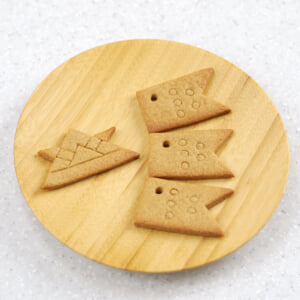
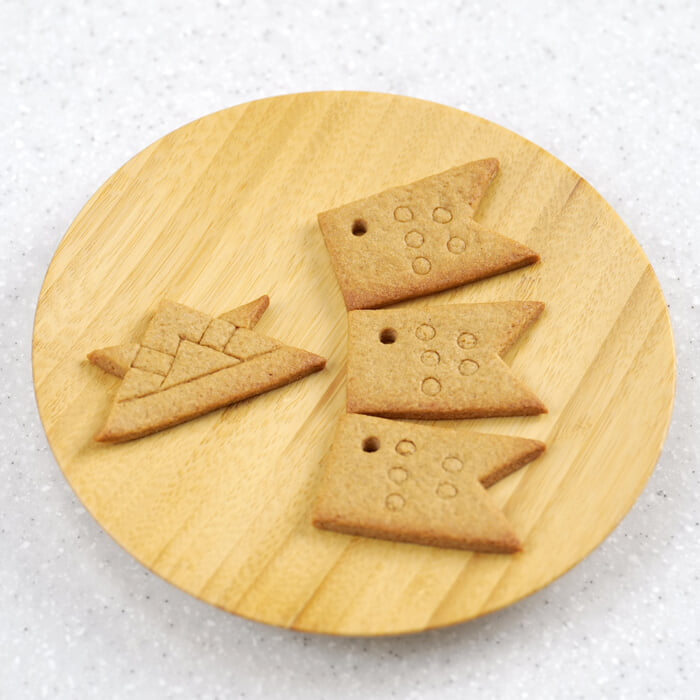
Koinobori are the carp-shaped streamers that fly over Japanese homes and preschools in early May for Children's Day, and these little cookies turn them into an afternoon snack. The dough is simply flour and kinako (roasted soybean flour) bound with oil and milk, so there is no egg or butter, and the nutty kinako gives them a gentle, toasty sweetness that children love. Cutting the tail and pressing on scales with a drinking straw is the fun part, and it is easy enough for small hands to help with. A quick straw hole for the eye and each cookie has its own cheerful face.
Added. Open the recipe helper (bottom right) → ☰ Menu → 🛒 Shopping list to see the ingredients for your family size.
Printing uses the number of adults and children set under Ingredients, so set those first.
Ingredients
Amounts for 1 child (1 serving). An adult counts as 2 servings.
One serving here is 1.5× the portion served to a child in a Japanese preschool, sized for Western appetites. An adult counts as two servings. Tap an ingredient to check it off.
Ingredients
- 27 gflour
- 9 gkinako (roasted soybean flour)A nutty, lightly sweet powder made from roasted ground soybeans, often dusted over mochi or rice. Substitute: No close substitute - look for kinako (sometimes sold as roasted soybean flour) at a Japanese or Asian grocery, or online.
Seasonings
- 11.3 gsugar
- 7.5 gvegetable oil
- 13.5 gmilk
About the Japanese ingredients in this recipe
- kinako (roasted soybean flour) (きな粉)
- A nutty, lightly sweet powder made from roasted ground soybeans, often dusted over mochi or rice. Substitute: No close substitute - look for kinako (sometimes sold as roasted soybean flour) at a Japanese or Asian grocery, or online.
Directions
- 1
Put the flour and kinako in a bowl and whisk them together.
- 2
Stir in the sugar, then add the vegetable oil and milk and bring the dough together into a single ball.
- 3
Flatten the dough and cut it into rectangles with a knife, then cut a triangle off one short end of each rectangle to form the carp's tail.
- 4
Arrange the cookies on a baking sheet lined with parchment paper. Punch out an eye in each one with a drinking straw, then press the end of the straw into the dough to make the scales.
- 5
Bake in an oven preheated to 160°C (320°F) for about 20 minutes.
Nutrition
| Per | 1 serving | 1 adult serving | Your total |
|---|---|---|---|
| Energy | 252 kcal | 504 kcal | 252 kcal |
| Protein | 6 g | 12 g | 6 g |
| Fat | 10.6 g | 21.3 g | 10.6 g |
| Carbohydrates | 34.7 g | 69.3 g | 34.7 g |
| Fiber | 2.4 g | 4.8 g | 2.4 g |
| Salt equivalent | 0 g | 0 g | 0 g |
| Calcium | 37.5 mg | 75 mg | 37.5 mg |
| Iron | 0.9 mg | 1.8 mg | 0.9 mg |
| Potassium | 231 mg | 462 mg | 231 mg |
| Energy | Protein | Fat | Carbs | Fiber | Salt equiv. | Calcium | Iron | Potassium | |
|---|---|---|---|---|---|---|---|---|---|
| 1 serving | 252 kcal | 6 g | 10.6 g | 34.7 g | 2.4 g | 0 g | 37.5 mg | 0.9 mg | 231 mg |
| 1 adult serving | 504 kcal | 12 g | 21.3 g | 69.3 g | 4.8 g | 0 g | 75 mg | 1.8 mg | 462 mg |
Values are per serving (1.5× the Japanese preschool portion); an adult serving is double. They were calculated by a licensed Japanese nutritionist using the Standard Tables of Food Composition in Japan. "Salt equivalent" is sodium × 2.54, the standard Japanese measure. Allergen flags cover egg, milk and wheat only and come from the nutritionist's records. Soy sauce and miso are made with wheat but are usually allowed on Japanese wheat-free school menus, so check with your doctor.