Soy Milk Pudding
豆乳プリン · Tonyu Purin
 By Aoi, licensed nutritionist · From a Japanese preschool lunch menu
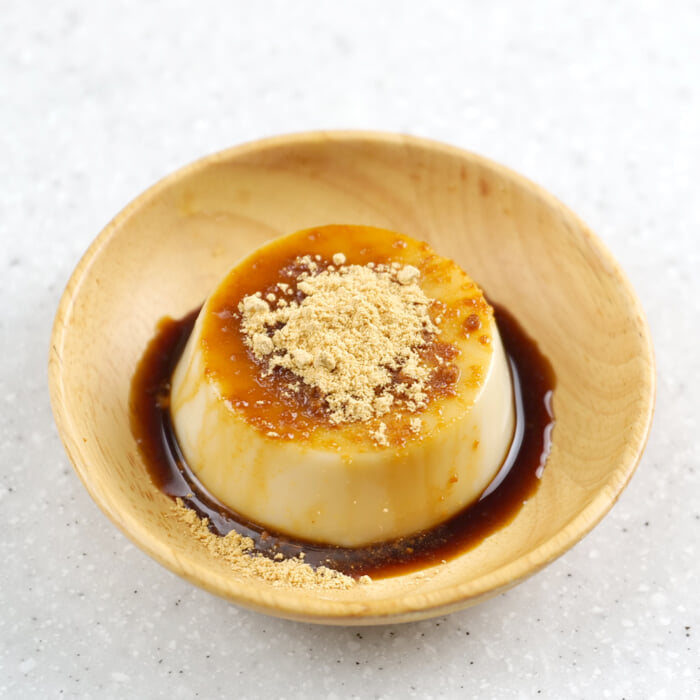
This soy milk pudding is a soft, wobbly snack we make in the preschool kitchen when we want a dessert with no eggs or dairy. Sweetened soy milk is set with gelatin, then finished with a quick kokuto (Japanese brown sugar) syrup and a dusting of kinako, the roasted soybean flour that pairs so well with dark sugar in Japanese sweets. The flavor is mild and nutty rather than rich, so even little ones who are unsure about custard-style puddings tend to finish every spoonful.
Contains kokuto (Japanese brown sugar), which should not be given to babies under 1 year old.
Added. Open the recipe helper (bottom right) → ☰ Menu → 🛒 Shopping list to see the ingredients for your family size.
Printing uses the number of adults and children set under Ingredients, so set those first.
Ingredients
Amounts for 1 child (1 serving). An adult counts as 2 servings.
One serving here is 1.5× the portion served to a child in a Japanese preschool, sized for Western appetites. An adult counts as two servings. Tap an ingredient to check it off.
Ingredients
- 2.2 ggelatin
- 18 gwater
- 90 gsweetened soy milk (Japanese chosei tonyu)Japanese 'prepared' soy milk that is lightly sweetened and flavored to taste milder than plain soy milk. Substitute: Regular (original, lightly sweetened) soy milk from the supermarket.
- 3 gkinako (roasted soybean flour)A nutty, lightly sweet powder made from roasted ground soybeans, often dusted over mochi or rice. Substitute: No close substitute - look for kinako (sometimes sold as roasted soybean flour) at a Japanese or Asian grocery, or online.
Seasonings
- 9 gsugar
- 4.5 gkokuto (Japanese brown sugar)An unrefined dark cane sugar from Okinawa with a deep, molasses-like flavor. Substitute: Dark brown sugar or muscovado.
- 2.3 gwater (for the sauce)
About the Japanese ingredients in this recipe
- sweetened soy milk (Japanese chosei tonyu) (調製豆乳)
- Japanese 'prepared' soy milk that is lightly sweetened and flavored to taste milder than plain soy milk. Substitute: Regular (original, lightly sweetened) soy milk from the supermarket.
- kokuto (Japanese brown sugar) (黒砂糖)
- An unrefined dark cane sugar from Okinawa with a deep, molasses-like flavor. Substitute: Dark brown sugar or muscovado.
- kinako (roasted soybean flour) (きな粉)
- A nutty, lightly sweet powder made from roasted ground soybeans, often dusted over mochi or rice. Substitute: No close substitute - look for kinako (sometimes sold as roasted soybean flour) at a Japanese or Asian grocery, or online.
Directions
- 1
Sprinkle the gelatin into the boiling water and stir well until it dissolves.
- 2
Once the gelatin has dissolved, stir in the sugar, then add the soy milk (brought to room temperature) and mix well.
- 3
Pour into pudding cups and chill in the refrigerator for at least 1 hour, until set.
- 4
Put the kokuto and the water for the sauce in a microwave-safe container, microwave at 1200W for about 10 to 15 seconds (20 to 30 seconds at 600W), and let cool slightly.
- 5
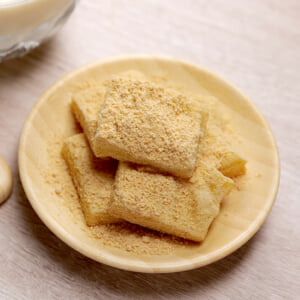
Spoon the kokuto sauce over the set puddings and sprinkle with kinako.
Nutrition
| Per | 1 serving | 1 adult serving | Your total |
|---|---|---|---|
| Energy | 127.5 kcal | 255 kcal | 127.5 kcal |
| Protein | 6 g | 12 g | 6 g |
| Fat | 4.1 g | 8.1 g | 4.1 g |
| Carbohydrates | 18.3 g | 36.6 g | 18.3 g |
| Fiber | 1.7 g | 3.3 g | 1.7 g |
| Salt equivalent | 0.2 g | 0.3 g | 0.2 g |
| Calcium | 45 mg | 90 mg | 45 mg |
| Iron | 1.5 mg | 3 mg | 1.5 mg |
| Potassium | 262.5 mg | 525 mg | 262.5 mg |
| Energy | Protein | Fat | Carbs | Fiber | Salt equiv. | Calcium | Iron | Potassium | |
|---|---|---|---|---|---|---|---|---|---|
| 1 serving | 127.5 kcal | 6 g | 4.1 g | 18.3 g | 1.7 g | 0.2 g | 45 mg | 1.5 mg | 262.5 mg |
| 1 adult serving | 255 kcal | 12 g | 8.1 g | 36.6 g | 3.3 g | 0.3 g | 90 mg | 3 mg | 525 mg |
Values are per serving (1.5× the Japanese preschool portion); an adult serving is double. They were calculated by a licensed Japanese nutritionist using the Standard Tables of Food Composition in Japan. "Salt equivalent" is sodium × 2.54, the standard Japanese measure. Allergen flags cover egg, milk and wheat only and come from the nutritionist's records. Soy sauce and miso are made with wheat but are usually allowed on Japanese wheat-free school menus, so check with your doctor.