Soy Milk Mochi
豆乳もち · Tonyu Mochi
 By Aoi, licensed nutritionist · From a Japanese preschool lunch menu
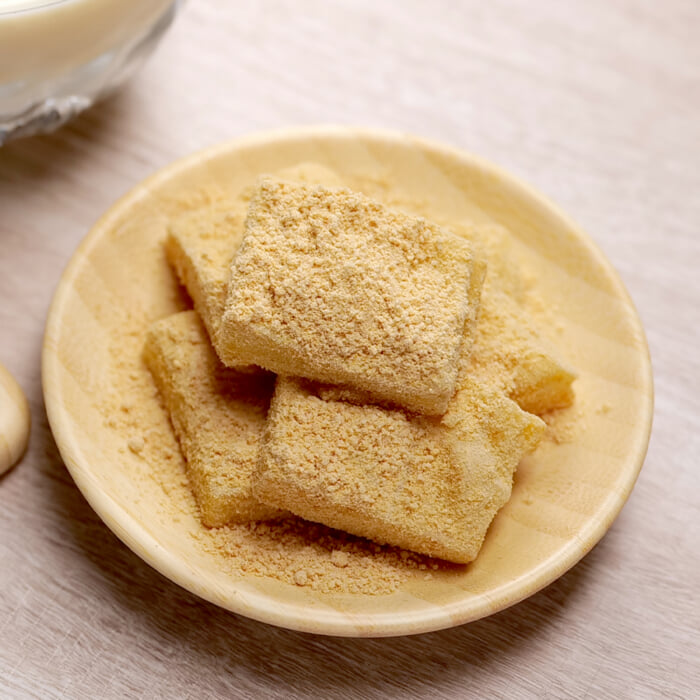
Soy milk mochi is a soft, jiggly snack that you cook in a saucepan in just a few minutes: soy milk, sugar and potato starch are stirred over low heat until they thicken into a smooth, chewy mass, then chilled, cut into cubes and rolled in sweet kinako. Because it is made with starch rather than pounded rice, it stays tender and is much easier for small children to eat than traditional mochi. The gentle sweetness and nutty aroma of kinako make it a favorite afternoon treat, and it uses no egg or dairy.
Added. Open the recipe helper (bottom right) → ☰ Menu → 🛒 Shopping list to see the ingredients for your family size.
Printing uses the number of adults and children set under Ingredients, so set those first.
Ingredients
Amounts for 1 child (1 serving). An adult counts as 2 servings.
One serving here is 1.5× the portion served to a child in a Japanese preschool, sized for Western appetites. An adult counts as two servings. Tap an ingredient to check it off.
Ingredients
- 75 gsweetened soy milk (Japanese chosei tonyu)Japanese 'prepared' soy milk that is lightly sweetened and flavored to taste milder than plain soy milk. Substitute: Regular (original, lightly sweetened) soy milk from the supermarket.
- 11.3 gpotato starch (katakuriko)Japanese potato starch used for thickening sauces and coating fried foods. Substitute: Cornstarch: start with the same amount and add a little more if it is still thin. It thickens a little less than potato starch and needs a couple of minutes at a gentle bubble to reach full thickness.
- 6 gkinako (roasted soybean flour)A nutty, lightly sweet powder made from roasted ground soybeans, often dusted over mochi or rice. Substitute: No close substitute - look for kinako (sometimes sold as roasted soybean flour) at a Japanese or Asian grocery, or online.
Seasonings
- 2.6 gsugar
- 4.5 gsugar (for the kinako)
About the Japanese ingredients in this recipe
- sweetened soy milk (Japanese chosei tonyu) (調製豆乳)
- Japanese 'prepared' soy milk that is lightly sweetened and flavored to taste milder than plain soy milk. Substitute: Regular (original, lightly sweetened) soy milk from the supermarket.
- potato starch (katakuriko) (かたくり粉)
- Japanese potato starch used for thickening sauces and coating fried foods. Substitute: Cornstarch: start with the same amount and add a little more if it is still thin. It thickens a little less than potato starch and needs a couple of minutes at a gentle bubble to reach full thickness. Read the guide: Katakuriko (Japanese Potato Starch) and What to Use Instead → Guide: japanese-school-lunch.com/articles/katakuriko-potato-starch/
- kinako (roasted soybean flour) (きな粉)
- A nutty, lightly sweet powder made from roasted ground soybeans, often dusted over mochi or rice. Substitute: No close substitute - look for kinako (sometimes sold as roasted soybean flour) at a Japanese or Asian grocery, or online.
Directions
- 1
Put the soy milk, sugar and potato starch in a saucepan and stir until fully dissolved. Set over low heat and cook for about 1 minute, stirring constantly and scraping the bottom of the pan.
- 2
As the mixture gradually starts to thicken, keep stirring and cook over low heat for about 1 more minute.
- 3
Once it has firmed up to a mochi-like consistency, transfer it to a tray moistened with water. Spread it out with a rubber spatula to a thickness of about 1 cm and smooth the surface.
- 4
Let it cool to room temperature, then chill in the refrigerator for at least 30 minutes.
- 5
In a bowl, mix together the kinako and the sugar.
- 6
Sprinkle a little of the kinako mixture from step 5 onto a cutting board, then remove the chilled mochi from step 4 from the tray and place it on top. Dust the top with more kinako and cut into 2.5 cm squares with a knife.
- 7
Arrange on a plate and sprinkle with more kinako.
Nutrition
| Per | 1 serving | 1 adult serving | Your total |
|---|---|---|---|
| Energy | 139.5 kcal | 279 kcal | 139.5 kcal |
| Protein | 4.7 g | 9.3 g | 4.7 g |
| Fat | 4.2 g | 8.4 g | 4.2 g |
| Carbohydrates | 21.5 g | 42.9 g | 21.5 g |
| Fiber | 2 g | 3.9 g | 2 g |
| Salt equivalent | 0.2 g | 0.3 g | 0.2 g |
| Calcium | 37.5 mg | 75 mg | 37.5 mg |
| Iron | 1.4 mg | 2.7 mg | 1.4 mg |
| Potassium | 252 mg | 504 mg | 252 mg |
| Energy | Protein | Fat | Carbs | Fiber | Salt equiv. | Calcium | Iron | Potassium | |
|---|---|---|---|---|---|---|---|---|---|
| 1 serving | 139.5 kcal | 4.7 g | 4.2 g | 21.5 g | 2 g | 0.2 g | 37.5 mg | 1.4 mg | 252 mg |
| 1 adult serving | 279 kcal | 9.3 g | 8.4 g | 42.9 g | 3.9 g | 0.3 g | 75 mg | 2.7 mg | 504 mg |
Values are per serving (1.5× the Japanese preschool portion); an adult serving is double. They were calculated by a licensed Japanese nutritionist using the Standard Tables of Food Composition in Japan. "Salt equivalent" is sodium × 2.54, the standard Japanese measure. Allergen flags cover egg, milk and wheat only and come from the nutritionist's records. Soy sauce and miso are made with wheat but are usually allowed on Japanese wheat-free school menus, so check with your doctor.