Kinako Fu Rusk
きな粉ラスク · Kinako Rasuku
 By Aoi, licensed nutritionist · From a Japanese preschool lunch menu
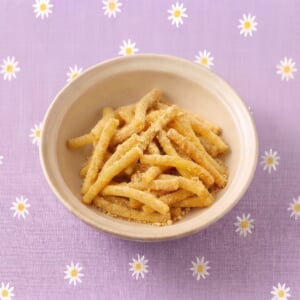
These little rusks are made not from bread but from yaki-fu, the light, airy baked wheat gluten used in Japanese soups. Tossed in melted butter and sugar, then baked until crisp and rolled in kinako (roasted soybean flour), they turn into a nutty, lightly sweet snack that crunches and then melts in the mouth. Because fu is so porous, it soaks up the butter quickly, which is why the whole batch gets coated at once rather than piece by piece - children love how light and crunchy they are, and they disappear fast at snack time.
Added. Open the recipe helper (bottom right) → ☰ Menu → 🛒 Shopping list to see the ingredients for your family size.
Printing uses the number of adults and children set under Ingredients, so set those first.
Ingredients
Amounts for 1 child (1 serving). An adult counts as 2 servings.
One serving here is 1.5× the portion served to a child in a Japanese preschool, sized for Western appetites. An adult counts as two servings. Tap an ingredient to check it off.
Ingredients
- 6 gyaki-fu (baked wheat gluten)Light, dry rounds of baked wheat gluten that soak up broth in soups and simmered dishes (contains wheat). Substitute: Leave it out or add cubes of soft tofu; small pieces of bread also work (contains wheat).
- 1.5 gkinako (roasted soybean flour)A nutty, lightly sweet powder made from roasted ground soybeans, often dusted over mochi or rice. Substitute: No close substitute - look for kinako (sometimes sold as roasted soybean flour) at a Japanese or Asian grocery, or online.
Seasonings
- 6 gunsalted butter
- 3.6 gsugar
About the Japanese ingredients in this recipe
- yaki-fu (baked wheat gluten) (焼ふ)
- Light, dry rounds of baked wheat gluten that soak up broth in soups and simmered dishes (contains wheat). Substitute: Leave it out or add cubes of soft tofu; small pieces of bread also work (contains wheat).
- kinako (roasted soybean flour) (きな粉)
- A nutty, lightly sweet powder made from roasted ground soybeans, often dusted over mochi or rice. Substitute: No close substitute - look for kinako (sometimes sold as roasted soybean flour) at a Japanese or Asian grocery, or online.
Directions
- 1
Pour the melted butter over all of the fu and toss so it is evenly absorbed. (If you pour it in one spot, some pieces will soak up the butter and others will not, so drizzle it over everything and mix right away.)
- 2
Mix in the sugar.
- 3
Arrange the fu from step 2 on a baking sheet lined with parchment paper and bake in a 180°C (350°F) oven for about 5 minutes, until crisp.
- 4
While still hot, toss with the kinako to coat.
Nutrition
| Per | 1 serving | 1 adult serving | Your total |
|---|---|---|---|
| Energy | 84 kcal | 168 kcal | 84 kcal |
| Protein | 2.4 g | 4.8 g | 2.4 g |
| Fat | 5.4 g | 10.8 g | 5.4 g |
| Carbohydrates | 7.1 g | 14.1 g | 7.1 g |
| Salt equivalent | 0 g | 0 g | 0 g |
| Calcium | 6 mg | 12 mg | 6 mg |
| Iron | 0.5 mg | 0.9 mg | 0.5 mg |
| Energy | Protein | Fat | Carbs | Salt equiv. | Calcium | Iron | |
|---|---|---|---|---|---|---|---|
| 1 serving | 84 kcal | 2.4 g | 5.4 g | 7.1 g | 0 g | 6 mg | 0.5 mg |
| 1 adult serving | 168 kcal | 4.8 g | 10.8 g | 14.1 g | 0 g | 12 mg | 0.9 mg |
Values are per serving (1.5× the Japanese preschool portion); an adult serving is double. They were calculated by a licensed Japanese nutritionist using the Standard Tables of Food Composition in Japan. "Salt equivalent" is sodium × 2.54, the standard Japanese measure. Allergen flags cover egg, milk and wheat only and come from the nutritionist's records. Soy sauce and miso are made with wheat but are usually allowed on Japanese wheat-free school menus, so check with your doctor.