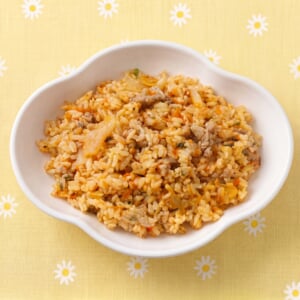
Kimutaku Gohan (Kimchi and Takuan Fried Rice)
キムタクごはん · Kimutaku Gohan
 By Aoi, licensed nutritionist · From a Japanese preschool lunch menu
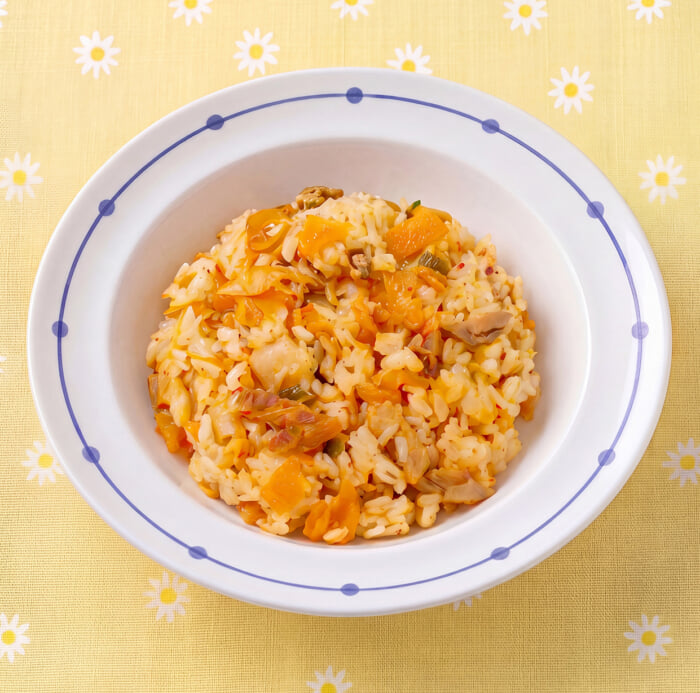
Kimutaku gohan gets its name from its two star ingredients, kimchi ("kimu") and takuan pickled daikon ("taku"). It was born in a school lunch kitchen in Nagano Prefecture, where a nutritionist came up with it to get children eating pickles, and it went on to become one of the most talked-about kyushoku dishes in Japan. Pork is browned in sesame oil, the pickles go in for tang and crunch, and the warm rice is stirred right in the pan so it soaks up every bit of flavor. Because kimchi and tsubozuke are fairly salty and spicy, this is one for elementary schoolers and up rather than the preschool table.
School-age & up. Best for elementary-school-age children and older.
Wheat-free, but uses soy sauce (made with wheat). Japanese school-lunch allergy menus usually allow it, so check with your doctor. How to read the labels
Added. Open the recipe helper (bottom right) → ☰ Menu → 🛒 Shopping list to see the ingredients for your family size.
Printing uses the number of adults and children set under Ingredients, so set those first.
Ingredients
Amounts for 1 child (1 serving). An adult counts as 2 servings.
One serving here is 1.5× the portion served to a child in a Japanese preschool, sized for Western appetites. An adult counts as two servings. Tap an ingredient to check it off.
Ingredients
- 24 gkimchi (adjust the amount to taste to control the spiciness)
- 24 gtakuan (tsubozuke pickled daikon)Tsubozuke is a crunchy pickled daikon radish seasoned with soy sauce and a touch of sweetness. Substitute: Any sweet pickled daikon (takuan), or chopped sweet pickles.
- 9 gJapanese long onion (naga-negi)A long, thick scallion with a mild, sweet flavor when cooked, used in Japanese soups and stir-fries. Substitute: Leek (white and light green parts) or thick scallions.
- 36 gthinly sliced pork (komagire)Small, thin offcuts of pork sold in Japan for quick stir-fries and simmered dishes. Substitute: Thinly sliced pork shoulder or loin cut into bite-size pieces.
- 2.4 gsesame oil
- 0.5 gsalt
- a pinchpepper
- 1.8 gsoy sauce
To Finish
- 192 gwarm cooked rice
About the Japanese ingredients in this recipe
- takuan (tsubozuke pickled daikon) (たくあん(つぼ漬け))
- Tsubozuke is a crunchy pickled daikon radish seasoned with soy sauce and a touch of sweetness. Substitute: Any sweet pickled daikon (takuan), or chopped sweet pickles.
- Japanese long onion (naga-negi) (長ねぎ)
- A long, thick scallion with a mild, sweet flavor when cooked, used in Japanese soups and stir-fries. Substitute: Leek (white and light green parts) or thick scallions.
- thinly sliced pork (komagire) (豚こま切れ肉)
- Small, thin offcuts of pork sold in Japan for quick stir-fries and simmered dishes. Substitute: Thinly sliced pork shoulder or loin cut into bite-size pieces.
Directions
Video is in Japanese — the steps below are synced to it, so tap ▶ on a step to jump to that moment.
- 1
Coarsely chop the kimchi and tsubozuke. Cut the long onion into half-moons.
- 2
Cut the pork into 1 cm strips. Heat the sesame oil in a frying pan and cook the pork over medium heat until it is lightly browned and fragrant. Once it is cooked through, season with salt and pepper.
- 3
Add the long onion, kimchi and tsubozuke and stir-fry over medium heat for about 2 to 3 minutes.
- 4
Add the soy sauce and stir-fry briefly.
- 5
Add the warm rice and mix everything together, letting the rice soak up all the savory flavor clinging to the pan.
Tips for Making It Delicious
- Kimchi and tsubozuke are quite spicy and salty, so this recipe is not suited to toddlers. Enjoy it as a dish for elementary schoolers through adults.
- It is also delicious made with bacon in place of the pork.
- Mixing the rice into the pan lets the savory flavor soak right into the rice.
How to Freeze
Wrap single portions in plastic wrap and freeze. To eat, reheat in the microwave still in the wrap.
Keeps for about 2 weeks (best eaten as soon as possible).
Nutrition
Nutrition values include the rice.
| Per | 1 serving | 1 adult serving | Your total |
|---|---|---|---|
| Energy | 400.5 kcal | 801 kcal | 400.5 kcal |
| Protein | 13.7 g | 27.3 g | 13.7 g |
| Fat | 6.6 g | 13.2 g | 6.6 g |
| Carbohydrates | 75.2 g | 150.3 g | 75.2 g |
| Fiber | 4.7 g | 9.3 g | 4.7 g |
| Salt equivalent | 2.3 g | 4.5 g | 2.3 g |
| Calcium | 43.5 mg | 87 mg | 43.5 mg |
| Iron | 0.9 mg | 1.8 mg | 0.9 mg |
| Potassium | 415.5 mg | 831 mg | 415.5 mg |
| Phosphorus | 195 mg | 390 mg | 195 mg |
| Energy | Protein | Fat | Carbs | Fiber | Salt equiv. | Calcium | Iron | Potassium | Phosphorus | |
|---|---|---|---|---|---|---|---|---|---|---|
| 1 serving | 400.5 kcal | 13.7 g | 6.6 g | 75.2 g | 4.7 g | 2.3 g | 43.5 mg | 0.9 mg | 415.5 mg | 195 mg |
| 1 adult serving | 801 kcal | 27.3 g | 13.2 g | 150.3 g | 9.3 g | 4.5 g | 87 mg | 1.8 mg | 831 mg | 390 mg |
Values are per serving (1.5× the Japanese preschool portion); an adult serving is double. They were calculated by a licensed Japanese nutritionist using the Standard Tables of Food Composition in Japan. "Salt equivalent" is sodium × 2.54, the standard Japanese measure. Allergen flags cover egg, milk and wheat only and come from the nutritionist's records. Soy sauce and miso are made with wheat but are usually allowed on Japanese wheat-free school menus, so check with your doctor.