Kimchi Soup (Elementary School Portion)
キムチスープ
 By Aoi, licensed nutritionist · From a Japanese elementary school lunch menu
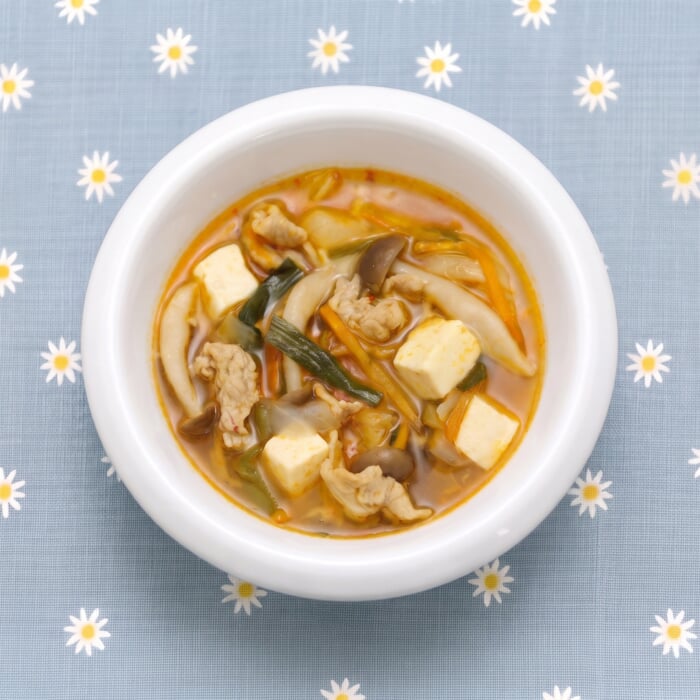
Kimchi soup is a Korean-inspired dish that has become a regular on school lunch menus in Japan. Carrot, onion, shimeji, and garlic chives are sautéed first to draw out their sweetness, then simmered with pork and silken tofu in a chicken-and-miso broth. The kimchi is stirred in only at the very end, so the soup stays mild enough for elementary-school children while still carrying that gentle tang and warmth, and you can easily set aside a kimchi-free portion for younger siblings. It is made without egg or dairy.
Toddlers to adults. Portion out the children's share before the final seasoning, then season the rest for adults.
Wheat-free, but uses soy sauce and miso (made with wheat). Japanese school-lunch allergy menus usually allow them, so check with your doctor. How to read the labels
Added. Open the recipe helper (bottom right) → ☰ Menu → 🛒 Shopping list to see the ingredients for your family size.
Printing uses the number of adults and children set under Ingredients, so set those first.
Ingredients
Amounts for 1 child (1 serving). An adult counts as 2 servings.
One serving here is 1.5× the portion served to a child in a Japanese elementary school, sized for Western appetites. An adult counts as two servings. Tap an ingredient to check it off.
- 30 gthinly sliced pork (komagire)Small, thin offcuts of pork sold in Japan for quick stir-fries and simmered dishes. Substitute: Thinly sliced pork shoulder or loin cut into bite-size pieces.
- 15 gcarrot
- 15 gonion
- 7.5 ggarlic chives (nira)Flat-leaved chives with a mild garlic flavor, sold in bunches at Asian markets. Substitute: Scallion greens with a little minced garlic.
- 15 gshimeji mushroomsSmall brown-capped mushrooms sold in clusters, with a mild, nutty flavor. Substitute: Oyster or button mushrooms.
- 30 gsilken tofu
- 22.5 gkimchi
- 2.3 gsesame oil
- 1.5 gsakeSake (Japanese rice wine) is used in small amounts to soften the smell of fish and meat and add depth. Japanese "cooking sake" often contains added salt. Some alcohol can remain after short cooking. If you prefer no alcohol for children, use the substitute. Substitute: The same amount of water (the taste will be a little simpler), or dry white wine.
- 225 mlwater
- 1.4 gchicken stock powder (Chinese-style)Japanese granulated chicken bone soup base used for Chinese-style soups and stir-fries. Substitute: Chicken bouillon granules or powder.
- 0.3 gsoy sauce
- 3.6 gmisoFermented soybean paste. Salty and savory, it is Japan's everyday seasoning for miso soup and many simmered dishes. Substitute: Any light (white or awase) miso. Misos differ in saltiness, so start with a little less and taste. Some misos are made with barley or wheat, so check the label if you avoid them.
About the Japanese ingredients in this recipe
- thinly sliced pork (komagire) (豚こま切れ肉)
- Small, thin offcuts of pork sold in Japan for quick stir-fries and simmered dishes. Substitute: Thinly sliced pork shoulder or loin cut into bite-size pieces.
- garlic chives (nira) (にら)
- Flat-leaved chives with a mild garlic flavor, sold in bunches at Asian markets. Substitute: Scallion greens with a little minced garlic.
- shimeji mushrooms (しめじ)
- Small brown-capped mushrooms sold in clusters, with a mild, nutty flavor. Substitute: Oyster or button mushrooms.
- sake (酒)
- Sake (Japanese rice wine) is used in small amounts to soften the smell of fish and meat and add depth. Japanese "cooking sake" often contains added salt. Some alcohol can remain after short cooking. If you prefer no alcohol for children, use the substitute. Substitute: The same amount of water (the taste will be a little simpler), or dry white wine.
- chicken stock powder (Chinese-style) (鶏ガラスープの素)
- Japanese granulated chicken bone soup base used for Chinese-style soups and stir-fries. Substitute: Chicken bouillon granules or powder.
- miso (みそ)
- Fermented soybean paste. Salty and savory, it is Japan's everyday seasoning for miso soup and many simmered dishes. Substitute: Any light (white or awase) miso. Misos differ in saltiness, so start with a little less and taste. Some misos are made with barley or wheat, so check the label if you avoid them.
Directions
Video is in Japanese — the steps below are synced to it, so tap ▶ on a step to jump to that moment.
- 1
Cut the carrot into thin matchsticks, thinly slice the onion, cut the garlic chives into 3 cm lengths, and separate the shimeji mushrooms into small clusters. Cut the tofu into 1 cm cubes and the pork into 2 cm-wide pieces, and roughly chop the kimchi. (For children of elementary-school age and younger, cutting the shimeji, caps included, into 1 cm pieces makes them easier to eat.)
- 2
Heat the sesame oil in a pot, add the carrot and onion, and stir-fry over medium heat for about 3 to 5 minutes. Add the pork and sake and stir-fry until the pork is cooked through. (Sautéing the vegetables well brings out their sweetness and gives the soup a deep, rich flavor. If they look like they might scorch, add a splash of water as you go.)
- 3
Add the water and chicken stock powder. Once it comes to a boil, add the garlic chives and shimeji and simmer over low heat for about 10 minutes.
- 4
Add the tofu, the soy sauce, and the miso dissolved in a little of the soup, and simmer briefly. Add the kimchi, simmer briefly, and turn off the heat. (If you are also making a toddler version, ladle out their portion before adding the kimchi and season it with a pinch of salt (not included in the ingredient amounts), tasting as you go. For elementary-school age and up, add the kimchi and simmer briefly.)
Tips for Best Results
・Kimchi varies in saltiness and spiciness depending on the brand, so taste as you go and adjust the amount of soy sauce and miso.
・Stir-frying the pork with sake removes any gaminess and keeps it tender. To keep the aroma of the miso and kimchi from cooking off, only simmer briefly at the end.
Freezing Instructions
Remove the tofu, since its texture changes when frozen. Let the soup cool, then put single-meal portions into freezer bags and freeze. To eat, reheat in the microwave.
Keeps for: about 2 weeks (best eaten as soon as possible).
Nutrition
| Per | 1 serving | 1 adult serving | Your total |
|---|---|---|---|
| Energy | 117 kcal | 234 kcal | 117 kcal |
| Protein | 9.5 g | 18.9 g | 9.5 g |
| Fat | 6.8 g | 13.5 g | 6.8 g |
| Carbohydrates | 6.5 g | 12.9 g | 6.5 g |
| Fiber | 2.3 g | 4.5 g | 2.3 g |
| Salt equivalent | 1.2 g | 2.4 g | 1.2 g |
| Calcium | 49.5 mg | 99 mg | 49.5 mg |
| Iron | 1 mg | 2.1 mg | 1 mg |
| Potassium | 394.5 mg | 789 mg | 394.5 mg |
| Phosphorus | 124.5 mg | 249 mg | 124.5 mg |
| Energy | Protein | Fat | Carbs | Fiber | Salt equiv. | Calcium | Iron | Potassium | Phosphorus | |
|---|---|---|---|---|---|---|---|---|---|---|
| 1 serving | 117 kcal | 9.5 g | 6.8 g | 6.5 g | 2.3 g | 1.2 g | 49.5 mg | 1 mg | 394.5 mg | 124.5 mg |
| 1 adult serving | 234 kcal | 18.9 g | 13.5 g | 12.9 g | 4.5 g | 2.4 g | 99 mg | 2.1 mg | 789 mg | 249 mg |
Values are per serving (1.5× the Japanese elementary-school portion); an adult serving is double. They were calculated by a licensed Japanese nutritionist using the Standard Tables of Food Composition in Japan. "Salt equivalent" is sodium × 2.54, the standard Japanese measure. Allergen flags cover egg, milk and wheat only and come from the nutritionist's records. Soy sauce and miso are made with wheat but are usually allowed on Japanese wheat-free school menus, so check with your doctor.