Keihan (Amami Chicken Rice) (Elementary School Portion)
【小学校】鶏飯(けいはん) · Keihan
 By Aoi, licensed nutritionist · From a Japanese elementary school lunch menu
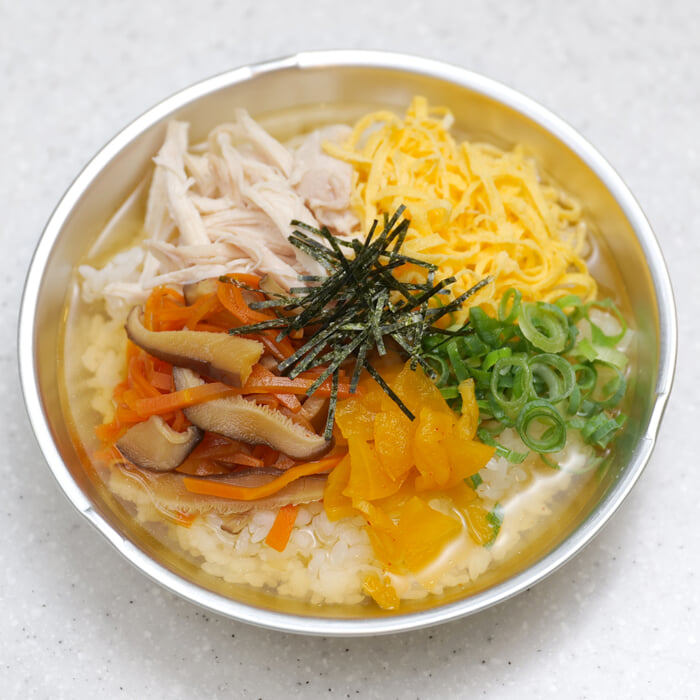
Keihan is a specialty of the Amami Islands in Kagoshima Prefecture: a bowl of rice topped with shredded poached chicken, sweet-simmered shiitake and carrot, thin strands of egg, pickles, green onions and nori, finished with a ladle of hot chicken broth poured over everything. The broth is made from poaching the chicken, so nothing goes to waste and it tastes gently of ginger and soy. Children love it because it eats almost like a soup, the toppings are soft and the rice slips down easily, so even slow eaters finish their bowls. This version keeps the pot work to a minimum by cooking the shiitake and carrot topping and the egg strands in the microwave.
Wheat-free, but uses soy sauce (made with wheat). Japanese school-lunch allergy menus usually allow it, so check with your doctor. How to read the labels
Added. Open the recipe helper (bottom right) → ☰ Menu → 🛒 Shopping list to see the ingredients for your family size.
Printing uses the number of adults and children set under Ingredients, so set those first.
Ingredients
Amounts for 1 child (1 serving). An adult counts as 2 servings.
One serving here is 1.5× the portion served to a child in a Japanese elementary school, sized for Western appetites. An adult counts as two servings. Tap an ingredient to check it off.
Ingredients
- 36.6 gchicken breast (skinless)
- 22.2 gcarrot
- 2.8 gdried shiitake mushrooms
- 36.6 gegg
- 12.1 gzha cai (Sichuan pickled mustard stem)A salty, crunchy Chinese pickle made from mustard stem, sold in jars or vacuum packs at Asian grocers. Substitute: Finely chopped sour pickles or rinsed sauerkraut.
- 4.4 ggreen onions
- 0.3 gshredded noriRoasted seaweed sheets cut into fine strips, used as a topping. Substitute: Cut a sheet of roasted nori into thin strips with scissors.
- 233.1 gwarm cooked rice
Seasonings
- 414 gwater
- 0.3 gginger paste (tube)Grated ginger sold ready to use in a squeeze tube, a staple in Japanese kitchens. Japanese school lunch kitchens grate fresh ginger for its aroma, but for cooking at home Aoi says the tube works just fine. Tube pastes often contain added salt, oil and other ingredients, so check the label. Substitute: Use freshly grated ginger in the same amount. 1 teaspoon of paste is about 5 g.
- 2.1 gsakeSake (Japanese rice wine) is used in small amounts to soften the smell of fish and meat and add depth. Japanese "cooking sake" often contains added salt. Some alcohol can remain after short cooking. If you prefer no alcohol for children, use the substitute. Substitute: The same amount of water (the taste will be a little simpler), or dry white wine.
- 2.8 gchicken stock powder (Chinese-style)Japanese granulated chicken bone soup base used for Chinese-style soups and stir-fries. Substitute: Chicken bouillon granules or powder.
- 0.2 gsalt
- 5.7 gsoy sauce
- 6.3 gmirinMirin is a sweet Japanese rice seasoning that adds gentle sweetness and a glossy finish. Hon-mirin (true mirin) contains about 14% alcohol; "mirin-style seasoning" has little or no alcohol. Some alcohol can remain after short cooking. If you prefer no alcohol for children, use the substitute. Substitute: For each tablespoon of mirin, use 1 tablespoon water plus 1 to 2 teaspoons sugar.
- 0.9 gsugar
About the Japanese ingredients in this recipe
- ginger paste (tube) (しょうがチューブ)
- Grated ginger sold ready to use in a squeeze tube, a staple in Japanese kitchens. Japanese school lunch kitchens grate fresh ginger for its aroma, but for cooking at home Aoi says the tube works just fine. Tube pastes often contain added salt, oil and other ingredients, so check the label. Substitute: Use freshly grated ginger in the same amount. 1 teaspoon of paste is about 5 g.
- sake (酒)
- Sake (Japanese rice wine) is used in small amounts to soften the smell of fish and meat and add depth. Japanese "cooking sake" often contains added salt. Some alcohol can remain after short cooking. If you prefer no alcohol for children, use the substitute. Substitute: The same amount of water (the taste will be a little simpler), or dry white wine.
- chicken stock powder (Chinese-style) (鶏ガラスープの素)
- Japanese granulated chicken bone soup base used for Chinese-style soups and stir-fries. Substitute: Chicken bouillon granules or powder.
- mirin (みりん)
- Mirin is a sweet Japanese rice seasoning that adds gentle sweetness and a glossy finish. Hon-mirin (true mirin) contains about 14% alcohol; "mirin-style seasoning" has little or no alcohol. Some alcohol can remain after short cooking. If you prefer no alcohol for children, use the substitute. Substitute: For each tablespoon of mirin, use 1 tablespoon water plus 1 to 2 teaspoons sugar.
- zha cai (Sichuan pickled mustard stem) (ザーサイ)
- A salty, crunchy Chinese pickle made from mustard stem, sold in jars or vacuum packs at Asian grocers. Substitute: Finely chopped sour pickles or rinsed sauerkraut.
- shredded nori (刻みのり)
- Roasted seaweed sheets cut into fine strips, used as a topping. Substitute: Cut a sheet of roasted nori into thin strips with scissors.
Directions
- 1
Chicken & broth: Put the chicken breast, water, ginger paste, sake, chicken stock powder and salt in a pot and bring to a boil. Skim off any scum, then simmer over medium heat for about 5 minutes. Cover and let the chicken cool in the pot. Once cool, lift out the chicken and shred it finely by hand.
- 2
Add the soy sauce and mirin to the poaching liquid left in the pot and bring it back to a boil to make the broth.
- 3
Sweet-and-savory shiitake and carrot: Put the dried shiitake and water in a microwave-safe container, cover loosely with plastic wrap and microwave at 1200W for about 1 minute 30 seconds to rehydrate. Cut the carrot into thin matchsticks and add it to the container with the shiitake. At this point, check that the liquid comes just under halfway up the ingredients. If there is too much, spoon some out; if there is too little, add a splash of water.
- 4
Add the soy sauce, mirin and sugar and stir everything together. Cover with plastic wrap, leaving a small gap for steam, and microwave at 1200W for about 3 1/2 to 4 minutes. Give it a light stir, then let it cool so the flavors soak in.
- 5
Microwave egg strands: Crack the egg into a bowl and beat it, cutting through the whites so they blend in. Line a flat plate with plastic wrap, smoothing out any air bubbles, and pour the egg over it in a thin layer. Microwave at 1200W for about 1 minute, until set. If any parts are still runny, heat in 5-second bursts until set, then cut into thin strands.
- 6
Spoon the warm rice into bowls and arrange the toppings on top (shredded chicken, sweet-and-savory shiitake and carrot, egg strands, zha cai, green onions and shredded nori), then pour the hot broth over everything.
At school lunch, the toppings are mixed into the rice first and then the broth is poured over. Eat it whichever way is easiest for you. If you are making this for children of elementary school age or younger, simmer the chopped green onions in the broth before pouring it on top, and leave off the pickles.
Nutrition
| Per | 1 serving | 1 adult serving | Your total |
|---|---|---|---|
| Energy | 501 kcal | 1002 kcal | 501 kcal |
| Protein | 20.7 g | 41.4 g | 20.7 g |
| Fat | 5.1 g | 10.2 g | 5.1 g |
| Carbohydrates | 95.9 g | 191.7 g | 95.9 g |
| Fiber | 6.3 g | 12.6 g | 6.3 g |
| Salt equivalent | 2.8 g | 5.7 g | 2.8 g |
| Calcium | 54 mg | 108 mg | 54 mg |
| Iron | 1.2 mg | 2.4 mg | 1.2 mg |
| Potassium | 513 mg | 1026 mg | 513 mg |
| Energy | Protein | Fat | Carbs | Fiber | Salt equiv. | Calcium | Iron | Potassium | |
|---|---|---|---|---|---|---|---|---|---|
| 1 serving | 501 kcal | 20.7 g | 5.1 g | 95.9 g | 6.3 g | 2.8 g | 54 mg | 1.2 mg | 513 mg |
| 1 adult serving | 1002 kcal | 41.4 g | 10.2 g | 191.7 g | 12.6 g | 5.7 g | 108 mg | 2.4 mg | 1026 mg |
Values are per serving (1.5× the Japanese elementary-school portion); an adult serving is double. They were calculated by a licensed Japanese nutritionist using the Standard Tables of Food Composition in Japan. "Salt equivalent" is sodium × 2.54, the standard Japanese measure. Allergen flags cover egg, milk and wheat only and come from the nutritionist's records. Soy sauce and miso are made with wheat but are usually allowed on Japanese wheat-free school menus, so check with your doctor.
This is the elementary-school portion of Keihan (Amami Chicken Rice Soup) (larger quantities, same method).