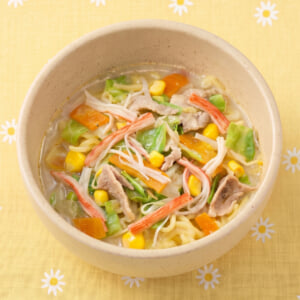
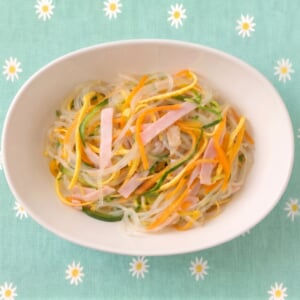
Hiyashi Chuka (Chilled Ramen Noodle Salad)
冷やし中華 · Hiyashi Chuka
 By Aoi, licensed nutritionist · From a Japanese preschool lunch menu
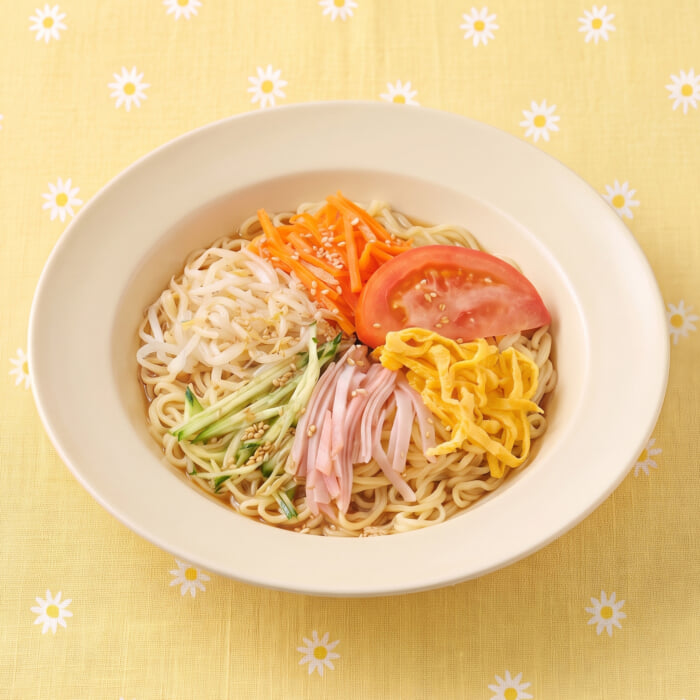
Hiyashi chuka is the dish Japan turns to when the weather gets hot: cold ramen noodles piled with colorful toppings and finished with a cool, tangy soy-and-sesame sauce. Children love the rainbow of matchstick carrot, cucumber, ham, tomato and golden shredded egg on top, and the noodles slip down easily even on days when appetites are small. Warming the sauce briefly softens the sharpness of the vinegar so it tastes gentle rather than sour, and the microwave shredded egg crepe saves you standing over a frying pan. There are also notes for making a milder toddler version alongside the main recipe.
Toddlers to adults. Portion out the children's share before the final seasoning, then season the rest for adults.
Added. Open the recipe helper (bottom right) → ☰ Menu → 🛒 Shopping list to see the ingredients for your family size.
Printing uses the number of adults and children set under Ingredients, so set those first.
Ingredients
Amounts for 1 child (1 serving). An adult counts as 2 servings.
One serving here is 1.5× the portion served to a child in a Japanese preschool, sized for Western appetites. An adult counts as two servings. Tap an ingredient to check it off.
Ingredients
- 21 gcarrot
- 30 gcucumber
- 21 gham
- 30 gbean sprouts
- 15 gtomato
Shredded Egg Crepe
- 24 gegg
- 0.9 gsugar (for the shredded egg crepe)
Sauce
- 1.5 gchicken stock powder (Chinese-style)Japanese granulated chicken bone soup base used for Chinese-style soups and stir-fries. Substitute: Chicken bouillon granules or powder.
- 9.9 gsoy sauce
- 9.9 gvinegar
- 3 gsugar (for the sauce)
- 2.1 gsesame oil
- 1.5 gwhite sesame seeds
- 81 mlwater
Ingredients
- 0.8 ball(s)fresh ramen noodlesFresh Chinese-style wheat noodles sold refrigerated in Japan for ramen and stir-fried noodles. Substitute: Dried ramen noodles (discard the seasoning packet) or thin spaghetti.
About the Japanese ingredients in this recipe
- chicken stock powder (Chinese-style) (鶏ガラスープの素)
- Japanese granulated chicken bone soup base used for Chinese-style soups and stir-fries. Substitute: Chicken bouillon granules or powder.
- fresh ramen noodles (生中華麺)
- Fresh Chinese-style wheat noodles sold refrigerated in Japan for ramen and stir-fried noodles. Substitute: Dried ramen noodles (discard the seasoning packet) or thin spaghetti.
Directions
Video is in Japanese — the steps below are synced to it, so tap ▶ on a step to jump to that moment.
- 1
Combine the sauce ingredients (A) in a small saucepan and warm briefly over low heat. Once it has cooled to room temperature, chill in the refrigerator. Note: If you are also making a toddler version, make a separate sauce in another pan with the same ingredients, using double the amount of water only, and prepare it the same way.
- 2
Cut the carrot, cucumber, and ham into thin matchsticks, and cut the tomato into thin wedges.
- 3
Put the carrot and bean sprouts in a microwave-safe bowl and add 1 tbsp water (not included in the ingredient amounts). Cover loosely with plastic wrap, leaving a gap for steam to escape, and microwave at 1200W for about 3 minutes. Transfer to a colander, cool under running water, and squeeze out the excess water. Note: If you are also making a toddler version, boil the carrot and bean sprouts in boiling water for about 2 minutes, then add the cucumber and ham and boil for about 1 minute more.
- 4
Make the shredded egg crepe. Beat the egg, add the sugar, and mix well. Line a microwave-safe dish with plastic wrap, pour in the egg in a thin layer, and microwave at 1200W for about 1 minute. Cut into 4 pieces, stack them, and slice into thin strips.
- 5
Boil the fresh ramen noodles and cool them under running water, then lower the colander into a bowl of ice water to chill them further. Drain well and arrange on plates, top with the vegetables, ham, and egg, and pour the sauce over.
Tips for Best Results
・Gently heating the sauce helps the flavors meld and mellows the sharpness of the vinegar.
・For the thinnest egg crepe, cook one egg at a time. You can also make it in a frying pan. If any part is still runny, microwave in 10-second bursts until set.
Freezing Instructions
Freeze only the sauce: pour it into freezer bags in single portions, flatten them thin, and freeze. To serve, heat in the microwave and let cool.
Keeps for about 2 weeks (best enjoyed as soon as possible).
Nutrition
Nutrition values do not include the noodles.
Nutrition values include the sauce.
| Per | 1 serving | 1 adult serving | Your total |
|---|---|---|---|
| Energy | 149.3 kcal | 298.5 kcal | 149.3 kcal |
| Protein | 8.9 g | 17.7 g | 8.9 g |
| Fat | 8.4 g | 16.8 g | 8.4 g |
| Carbohydrates | 9.9 g | 19.8 g | 9.9 g |
| Fiber | 1.7 g | 3.3 g | 1.7 g |
| Salt equivalent | 2 g | 3.9 g | 2 g |
| Calcium | 51 mg | 102 mg | 51 mg |
| Iron | 1 mg | 2.1 mg | 1 mg |
| Potassium | 312.8 mg | 625.5 mg | 312.8 mg |
| Phosphorus | 150.8 mg | 301.5 mg | 150.8 mg |
| Energy | Protein | Fat | Carbs | Fiber | Salt equiv. | Calcium | Iron | Potassium | Phosphorus | |
|---|---|---|---|---|---|---|---|---|---|---|
| 1 serving | 149.3 kcal | 8.9 g | 8.4 g | 9.9 g | 1.7 g | 2 g | 51 mg | 1 mg | 312.8 mg | 150.8 mg |
| 1 adult serving | 298.5 kcal | 17.7 g | 16.8 g | 19.8 g | 3.3 g | 3.9 g | 102 mg | 2.1 mg | 625.5 mg | 301.5 mg |
Values are per serving (1.5× the Japanese preschool portion); an adult serving is double. They were calculated by a licensed Japanese nutritionist using the Standard Tables of Food Composition in Japan. "Salt equivalent" is sodium × 2.54, the standard Japanese measure. Allergen flags cover egg, milk and wheat only and come from the nutritionist's records. Soy sauce and miso are made with wheat but are usually allowed on Japanese wheat-free school menus, so check with your doctor.