Miso Ramen
みそラーメン · Miso Ramen
 By Aoi, licensed nutritionist · From a Japanese preschool lunch menu
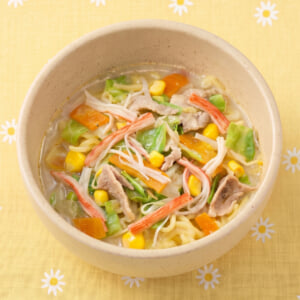
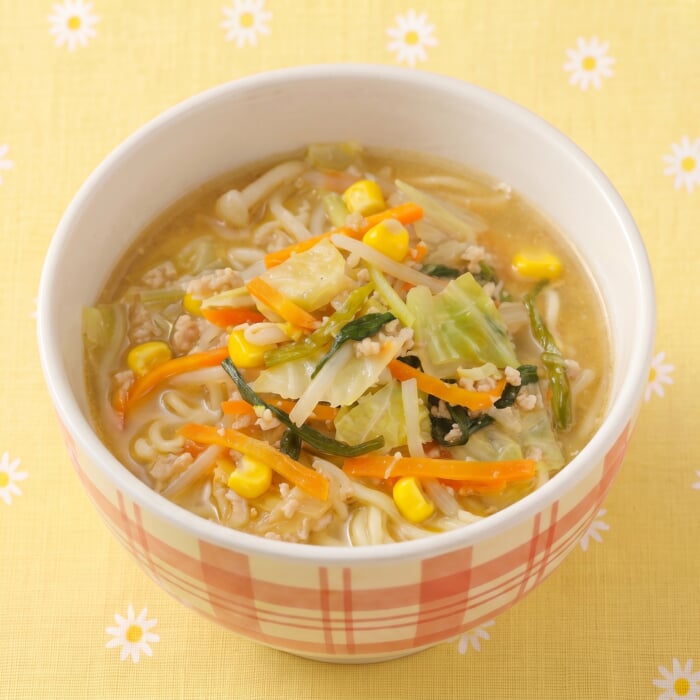
Miso ramen, best known as a Sapporo specialty, is one of the most-requested lunches at preschool. The soup here is built on a quick stir-fry of ground pork, miso and garlic, then loaded with vegetables - carrot, cabbage, bean sprouts, garlic chives and sweet corn - so children get a full meal in one bowl. Seasoning is kept mild, and the soup is thinned with a little hot water for the youngest eaters, so even toddlers can enjoy it.
Toddlers to adults. The whole family can eat this exactly as written.
Added. Open the recipe helper (bottom right) → ☰ Menu → 🛒 Shopping list to see the ingredients for your family size.
Printing uses the number of adults and children set under Ingredients, so set those first.
Ingredients
Amounts for 1 child (1 serving). An adult counts as 2 servings.
One serving here is 1.5× the portion served to a child in a Japanese preschool, sized for Western appetites. An adult counts as two servings. Tap an ingredient to check it off.
Ingredients
- 90 gfresh ramen noodlesFresh Chinese-style wheat noodles sold refrigerated in Japan for ramen and stir-fried noodles. Substitute: Dried ramen noodles (discard the seasoning packet) or thin spaghetti.
- 36 gground pork
- 9 gcarrot
- 24 gcabbage
- 18 gbean sprouts
- 9 ggarlic chives (nira)Flat-leaved chives with a mild garlic flavor, sold in bunches at Asian markets. Substitute: Scallion greens with a little minced garlic.
- 9 gJapanese long onion (naga-negi)A long, thick scallion with a mild, sweet flavor when cooked, used in Japanese soups and stir-fries. Substitute: Leek (white and light green parts) or thick scallions.
- 12 gwhole kernel corn (canned or frozen)
For Stir-Frying
- 2.4 gsesame oil
- 0.6 ggarlic paste (tube)Grated garlic sold ready to use in a squeeze tube, a staple in Japanese kitchens. Japanese school lunch kitchens grate fresh garlic for its aroma, but for cooking at home Aoi says the tube works just fine. Tube pastes often contain added salt, oil and other ingredients, so check the label. Substitute: Use freshly grated garlic in the same amount. 1 teaspoon of paste is about 5 g.
- 12 gmisoFermented soybean paste. Salty and savory, it is Japan's everyday seasoning for miso soup and many simmered dishes. Substitute: Any light (white or awase) miso. Misos differ in saltiness, so start with a little less and taste. Some misos are made with barley or wheat, so check the label if you avoid them.
Soup
- 240 mlwater
- 1 gchicken stock powder (Chinese-style)Japanese granulated chicken bone soup base used for Chinese-style soups and stir-fries. Substitute: Chicken bouillon granules or powder.
- 4.8 gsoy sauce
- 0.5 gsugar
About the Japanese ingredients in this recipe
- fresh ramen noodles (生中華麺)
- Fresh Chinese-style wheat noodles sold refrigerated in Japan for ramen and stir-fried noodles. Substitute: Dried ramen noodles (discard the seasoning packet) or thin spaghetti.
- garlic chives (nira) (にら)
- Flat-leaved chives with a mild garlic flavor, sold in bunches at Asian markets. Substitute: Scallion greens with a little minced garlic.
- Japanese long onion (naga-negi) (長ねぎ)
- A long, thick scallion with a mild, sweet flavor when cooked, used in Japanese soups and stir-fries. Substitute: Leek (white and light green parts) or thick scallions.
- garlic paste (tube) (にんにくチューブ)
- Grated garlic sold ready to use in a squeeze tube, a staple in Japanese kitchens. Japanese school lunch kitchens grate fresh garlic for its aroma, but for cooking at home Aoi says the tube works just fine. Tube pastes often contain added salt, oil and other ingredients, so check the label. Substitute: Use freshly grated garlic in the same amount. 1 teaspoon of paste is about 5 g.
- miso (みそ)
- Fermented soybean paste. Salty and savory, it is Japan's everyday seasoning for miso soup and many simmered dishes. Substitute: Any light (white or awase) miso. Misos differ in saltiness, so start with a little less and taste. Some misos are made with barley or wheat, so check the label if you avoid them.
- chicken stock powder (Chinese-style) (鶏ガラスープの素)
- Japanese granulated chicken bone soup base used for Chinese-style soups and stir-fries. Substitute: Chicken bouillon granules or powder.
Directions
Video is in Japanese — the steps below are synced to it, so tap ▶ on a step to jump to that moment.
- 1
Cut the carrot into thin strips, the cabbage into rough 2cm pieces, the garlic chives into 3cm lengths, and the long onion into half-moons.
- 2
Put the sesame oil and garlic paste in a frying pan and warm over low heat, then add the long onion, ground pork and miso and stir-fry until the pork is cooked through.
- 3
Add the carrot, cabbage, bean sprouts and garlic chives and stir-fry over medium heat for about 3 minutes.
- 4
Add the water and chicken stock powder, bring to a boil, then simmer over low heat for about 5 minutes.
- 5
Add the soy sauce, sugar and corn and simmer over low heat for about 3 minutes.
- 6
Just before cooking the noodles, rinse them under running lukewarm water to wash off the salt, then immediately cook them in boiling water. Note: Boil the noodles right after rinsing - if they sit, they tend to clump together.
- 7
Put the noodles in bowls and pour the soup from step 5 over them. Note: For toddlers, after serving, thin the soup by adding 4 to 5 tbsp of hot water per 100ml of soup, tasting as you go.
Tips for Best Results
• Fresh ramen noodles carry a lot of salt, so rinse them in lukewarm water before boiling to wash it off. If only adults are eating, you can skip the rinse.
How to Freeze
Pour the soup into freezer bags in single portions, spread thin and freeze. To eat, reheat in the microwave and pour over freshly boiled noodles.
Keeps for: about 2 weeks (best eaten as soon as possible).
Nutrition
Nutrition values include the soup.
Nutrition values do not include the noodles.
| Per | 1 serving | 1 adult serving | Your total |
|---|---|---|---|
| Energy | 149.3 kcal | 298.5 kcal | 149.3 kcal |
| Protein | 9.3 g | 18.6 g | 9.3 g |
| Fat | 9.3 g | 18.6 g | 9.3 g |
| Carbohydrates | 9.7 g | 19.4 g | 9.7 g |
| Fiber | 2.6 g | 5.3 g | 2.6 g |
| Salt equivalent | 2.3 g | 4.7 g | 2.3 g |
| Calcium | 37.5 mg | 75 mg | 37.5 mg |
| Iron | 0.8 mg | 1.7 mg | 0.8 mg |
| Potassium | 342 mg | 684 mg | 342 mg |
| Phosphorus | 96 mg | 192 mg | 96 mg |
| Energy | Protein | Fat | Carbs | Fiber | Salt equiv. | Calcium | Iron | Potassium | Phosphorus | |
|---|---|---|---|---|---|---|---|---|---|---|
| 1 serving | 149.3 kcal | 9.3 g | 9.3 g | 9.7 g | 2.6 g | 2.3 g | 37.5 mg | 0.8 mg | 342 mg | 96 mg |
| 1 adult serving | 298.5 kcal | 18.6 g | 18.6 g | 19.4 g | 5.3 g | 4.7 g | 75 mg | 1.7 mg | 684 mg | 192 mg |
Values are per serving (1.5× the Japanese preschool portion); an adult serving is double. They were calculated by a licensed Japanese nutritionist using the Standard Tables of Food Composition in Japan. "Salt equivalent" is sodium × 2.54, the standard Japanese measure. Allergen flags cover egg, milk and wheat only and come from the nutritionist's records. Soy sauce and miso are made with wheat but are usually allowed on Japanese wheat-free school menus, so check with your doctor.