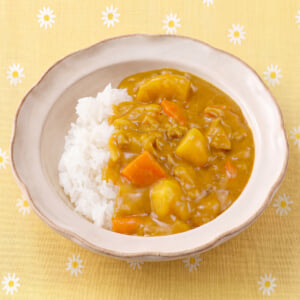
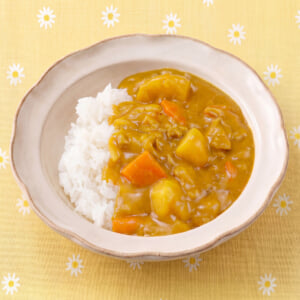
Country-Style Potato Stew
じゃがいものカントリー煮 · Jagaimo no Kantorī-ni
 By Aoi, licensed nutritionist · From a Japanese preschool lunch menu
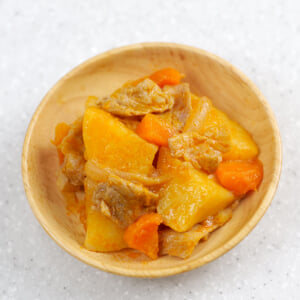
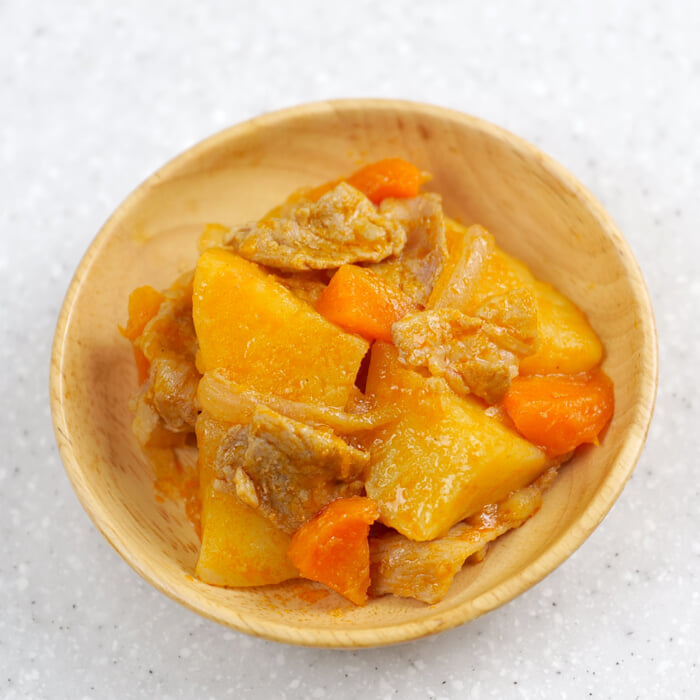
"Country-ni" is a Western-style simmered dish you will find on Japanese school lunch menus: potatoes, carrot, onion and thin slices of pork cooked in butter, then simmered in a gentle sauce of ketchup, Worcestershire sauce and consommé. It sits somewhere between nikujaga and a light stew, and the sweet, familiar ketchup flavor is exactly what makes little ones reach for their spoons. The vegetables are cut small so they soften through and fit easily on a child's spoon. Like most simmered dishes, it tastes even better once it has cooled a little and the flavors have soaked into the potatoes.
Added. Open the recipe helper (bottom right) → ☰ Menu → 🛒 Shopping list to see the ingredients for your family size.
Printing uses the number of adults and children set under Ingredients, so set those first.
Ingredients
Amounts for 1 child (1 serving). An adult counts as 2 servings.
One serving here is 1.5× the portion served to a child in a Japanese preschool, sized for Western appetites. An adult counts as two servings. Tap an ingredient to check it off.
Ingredients
- 75 gpotato
- 25.5 gthinly sliced pork (komagire)Small, thin offcuts of pork sold in Japan for quick stir-fries and simmered dishes. Substitute: Thinly sliced pork shoulder or loin cut into bite-size pieces.
- 22.5 gcarrot
- 22.5 gonion
Seasonings
- 3 gunsalted butter
- 45 gwater
- 2 gsugar
- 0.5 gconsommé bouillon (granules or cube)Japanese-style Western soup stock powder or cubes, similar to chicken or vegetable bouillon. Substitute: Chicken or vegetable bouillon granules or a bouillon cube.
- 7.5 gketchup
- 3 gWorcestershire sauce
About the Japanese ingredients in this recipe
- thinly sliced pork (komagire) (豚こま切れ肉)
- Small, thin offcuts of pork sold in Japan for quick stir-fries and simmered dishes. Substitute: Thinly sliced pork shoulder or loin cut into bite-size pieces.
- consommé bouillon (granules or cube) (コンソメ)
- Japanese-style Western soup stock powder or cubes, similar to chicken or vegetable bouillon. Substitute: Chicken or vegetable bouillon granules or a bouillon cube.
- Worcestershire sauce (ウスターソース)
- Read the guide: Bull-Dog Worcestershire Sauce: Japan's Everyday Brown Sauce → Guide: japanese-school-lunch.com/articles/bull-dog-worcestershire-sauce/
Directions
- 1
Cut the potatoes into 2 cm-wide quarter-rounds (ichō-giri), the carrot into small irregular chunks (rangiri), and the onion into thin slices, halved in length.
- 2
Cut the pork into 1 to 2 cm-wide strips. Heat the butter in a frying pan, add the carrot and onion, and sauté over medium heat for 5 minutes.
- 3
Add the pork and sauté until cooked through, then add the potatoes and sauté over low heat for 2 minutes.
- 4
Add the water and bring to a boil, then add the sugar, cover with a drop lid (otoshibuta), and simmer over low heat for 5 minutes. Add the consommé, ketchup, and Worcestershire sauce, cover with the drop lid again, and simmer over low heat for 20 minutes. (The flavors soak in as the stew cools, so we recommend letting it cool once before eating.)
Nutrition
| Per | 1 serving | 1 adult serving | Your total |
|---|---|---|---|
| Energy | 144 kcal | 288 kcal | 144 kcal |
| Protein | 7.2 g | 14.4 g | 7.2 g |
| Fat | 5.3 g | 10.5 g | 5.3 g |
| Carbohydrates | 22 g | 44.1 g | 22 g |
| Fiber | 7.8 g | 15.6 g | 7.8 g |
| Salt equivalent | 0.8 g | 1.5 g | 0.8 g |
| Calcium | 18 mg | 36 mg | 18 mg |
| Iron | 0.5 mg | 0.9 mg | 0.5 mg |
| Potassium | 535.5 mg | 1071 mg | 535.5 mg |
| Energy | Protein | Fat | Carbs | Fiber | Salt equiv. | Calcium | Iron | Potassium | |
|---|---|---|---|---|---|---|---|---|---|
| 1 serving | 144 kcal | 7.2 g | 5.3 g | 22 g | 7.8 g | 0.8 g | 18 mg | 0.5 mg | 535.5 mg |
| 1 adult serving | 288 kcal | 14.4 g | 10.5 g | 44.1 g | 15.6 g | 1.5 g | 36 mg | 0.9 mg | 1071 mg |
Values are per serving (1.5× the Japanese preschool portion); an adult serving is double. They were calculated by a licensed Japanese nutritionist using the Standard Tables of Food Composition in Japan. "Salt equivalent" is sodium × 2.54, the standard Japanese measure. Allergen flags cover egg, milk and wheat only and come from the nutritionist's records. Soy sauce and miso are made with wheat but are usually allowed on Japanese wheat-free school menus, so check with your doctor.