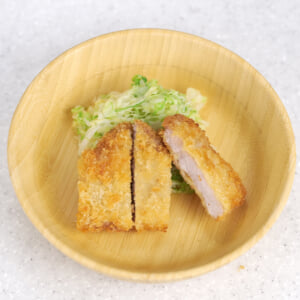
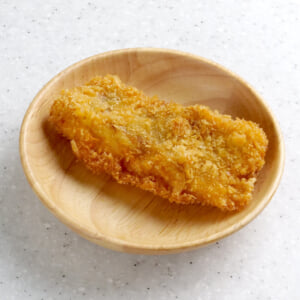
Breaded Fried Hake (Elementary School Portion)
【小学校】メルルーサのフライ · Merurūsa no Furai
 By Aoi, licensed nutritionist · From a Japanese elementary school lunch menu
Hake (merluza) is a mild, tender white fish that shows up again and again on Japanese school lunch menus, usually as frozen fillets that can go straight from the freezer into the batter. Coated in a thick egg batter and panko, it fries up crisp on the outside and flaky inside, and the homemade tartar sauce with chopped boiled egg is what makes children reach for seconds. The sauce is made with Mayodore, an egg-free mayonnaise-style dressing widely used in Japanese school kitchens; regular mayonnaise works just as well if you do not need to avoid egg in the dressing (note that the sauce itself still contains boiled egg).
Added. Open the recipe helper (bottom right) → ☰ Menu → 🛒 Shopping list to see the ingredients for your family size.
Printing uses the number of adults and children set under Ingredients, so set those first.
Ingredients
Amounts for 1 child (1 serving). An adult counts as 2 servings.
One serving here is 1.5× the portion served to a child in a Japanese elementary school, sized for Western appetites. An adult counts as two servings. Tap an ingredient to check it off.
Ingredients
- 88.8 gfrozen hake filletsHake (merluza) is a mild, soft white fish with few bones that is a staple in Japanese school lunches. Substitute: Cod, pollock, or any mild white fish fillet.
- 14.1 gegg
- 0.9 gwater
- 11.7 gpanko
- 29.4 gegg
Seasonings
- to tastepepper
- 5.3 gflour
- 11.7 gvegetable oil
- 11.7 gegg-free mayonnaise (Mayodore)A Japanese egg-free mayonnaise-style dressing. Substitute: Any egg-free or vegan mayonnaise.
- 0.3 gsugar
- 1.4 gvinegar
- to tastesalt
- to tastedried parsley
About the Japanese ingredients in this recipe
- frozen hake fillets (冷凍メルルーサ)
- Hake (merluza) is a mild, soft white fish with few bones that is a staple in Japanese school lunches. Substitute: Cod, pollock, or any mild white fish fillet.
- egg-free mayonnaise (Mayodore) (マヨドレ)
- A Japanese egg-free mayonnaise-style dressing. Substitute: Any egg-free or vegan mayonnaise.
Directions
- 1
Season both sides of the hake with pepper while it is still frozen.
- 2
In a bowl, mix the beaten egg and flour, then add water a little at a time, checking the consistency as you go (aim for a thick, heavy batter so the coating clings well).
- 3
Coat both sides of the hake in the batter from step 2, then press panko firmly onto the surface so it sticks well (pressing on the panko with a hand that has no batter on it helps keep the coating from peeling off).
- 4
Heat the oil to 170°C (340°F) and add the hake. After about 2 to 3 minutes, start turning the pieces over, and fry for about 8 minutes in total.
- 5
Arrange on plates and spoon the tartar sauce over the top.
- 6
1. Fill a pot with enough water to cover the eggs and bring to a boil. Once boiling, reduce to low heat, gently lower in the eggs straight from the refrigerator using a ladle, and boil for 12 minutes.
2. As soon as they are done, transfer the eggs to ice water and leave for about 5 minutes to cool.
3. Tap the eggs on a flat surface to make fine cracks all over, then peel them under running water. Pat the surface dry with paper towels.
4. Mash (or finely chop) the eggs, then add the mayonnaise, sugar, vinegar, salt and pepper, and parsley and mix well. Chill in the refrigerator.
The salt and pepper in the tartar sauce are only tiny amounts, so taste as you go and adjust.
Nutrition
| Per | 1 serving | 1 adult serving | Your total |
|---|---|---|---|
| Energy | 357.3 kcal | 714.6 kcal | 357.3 kcal |
| Protein | 22.5 g | 45 g | 22.5 g |
| Fat | 24.2 g | 48.3 g | 24.2 g |
| Carbohydrates | 13.2 g | 26.4 g | 13.2 g |
| Fiber | 0.9 g | 1.8 g | 0.9 g |
| Salt equivalent | 0.9 g | 1.8 g | 0.9 g |
| Calcium | 35.4 mg | 70.8 mg | 35.4 mg |
| Iron | 0.9 mg | 1.8 mg | 0.9 mg |
| Potassium | 367.4 mg | 734.7 mg | 367.4 mg |
| Energy | Protein | Fat | Carbs | Fiber | Salt equiv. | Calcium | Iron | Potassium | |
|---|---|---|---|---|---|---|---|---|---|
| 1 serving | 357.3 kcal | 22.5 g | 24.2 g | 13.2 g | 0.9 g | 0.9 g | 35.4 mg | 0.9 mg | 367.4 mg |
| 1 adult serving | 714.6 kcal | 45 g | 48.3 g | 26.4 g | 1.8 g | 1.8 g | 70.8 mg | 1.8 mg | 734.7 mg |
Values are per serving (1.5× the Japanese elementary-school portion); an adult serving is double. They were calculated by a licensed Japanese nutritionist using the Standard Tables of Food Composition in Japan. "Salt equivalent" is sodium × 2.54, the standard Japanese measure. Allergen flags cover egg, milk and wheat only and come from the nutritionist's records. Soy sauce and miso are made with wheat but are usually allowed on Japanese wheat-free school menus, so check with your doctor.