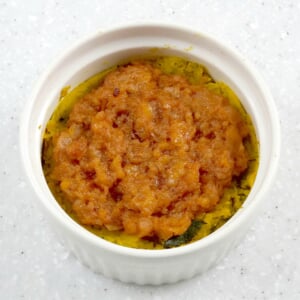
Baked Omelet with Meat Sauce
オムレツのミートソースがけ
 By Aoi, licensed nutritionist · From a Japanese preschool lunch menu
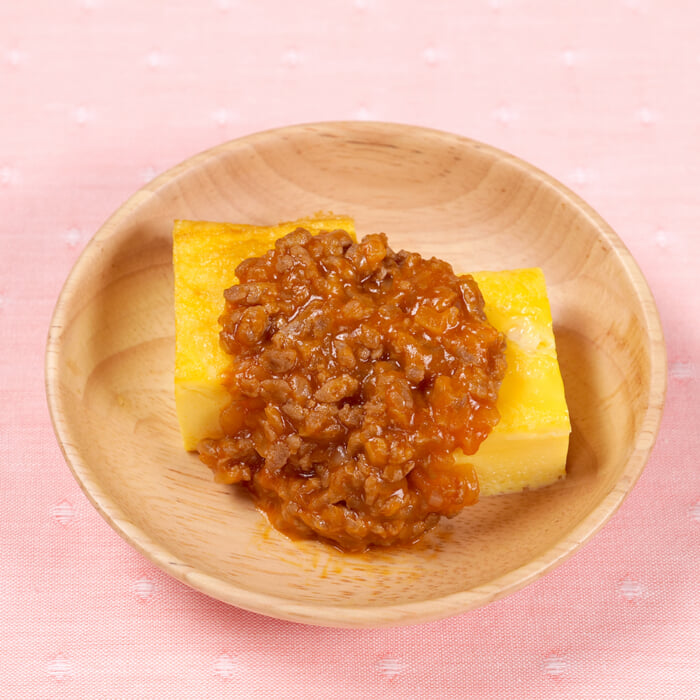
This is omuretsu no mīto sōsu gake, a preschool lunch favorite: a soft, gently seasoned egg omelet baked on a sheet pan, then cut into portions and topped with a quick meat sauce made from ground pork, onion and ketchup. Baking the eggs in the oven instead of a frying pan gives an even, tender texture with no flipping or rolling, which is how we make omelets for a whole roomful of children at once. The mild, ketchup-sweet sauce is one that kids reach for again and again, and the whole dish comes together with pantry staples.
Added. Open the recipe helper (bottom right) → ☰ Menu → 🛒 Shopping list to see the ingredients for your family size.
Printing uses the number of adults and children set under Ingredients, so set those first.
Ingredients
Amounts for 1 child (1 serving). An adult counts as 2 servings.
One serving here is 1.5× the portion served to a child in a Japanese preschool, sized for Western appetites. An adult counts as two servings. Tap an ingredient to check it off.
Ingredients
- 72 gegg
- 15 gonion
- 13.5 gground pork
Seasonings
- 13.5 mlmilk
- 0.1 gsalt
- 1.5 gvegetable oil
- 1.4 gflour
- 27 mlwater
- 8.3 gketchup
Directions
Video is in Japanese and may show a different version of this dish (other ingredients or steps). Follow the ingredients and steps on this page, especially when cooking for allergies.
- 1
Beat the eggs, then mix in the milk and salt. Pour onto a baking sheet lined with parchment paper and bake in an oven preheated to 180°C (350°F) for about 20 minutes.
- 2
Finely chop the onion. Heat the oil in a frying pan and sauté the onion.
- 3
Add the ground pork and sauté, then turn off the heat and sprinkle in the flour. Once no dry flour remains, add the water and ketchup and cook into a meat sauce.
- 4
Cut the baked omelet from step 1 into portions and spoon the meat sauce from step 3 over the top.
Nutrition
| Per | 1 serving | 1 adult serving | Your total |
|---|---|---|---|
| Energy | 169.5 kcal | 339 kcal | 169.5 kcal |
| Protein | 12.1 g | 24.3 g | 12.1 g |
| Fat | 11.6 g | 23.1 g | 11.6 g |
| Carbohydrates | 5.4 g | 10.8 g | 5.4 g |
| Fiber | 0.5 g | 0.9 g | 0.5 g |
| Salt equivalent | 0.8 g | 1.5 g | 0.8 g |
| Calcium | 54 mg | 108 mg | 54 mg |
| Iron | 1.2 mg | 2.4 mg | 1.2 mg |
| Potassium | 208.5 mg | 417 mg | 208.5 mg |
| Energy | Protein | Fat | Carbs | Fiber | Salt equiv. | Calcium | Iron | Potassium | |
|---|---|---|---|---|---|---|---|---|---|
| 1 serving | 169.5 kcal | 12.1 g | 11.6 g | 5.4 g | 0.5 g | 0.8 g | 54 mg | 1.2 mg | 208.5 mg |
| 1 adult serving | 339 kcal | 24.3 g | 23.1 g | 10.8 g | 0.9 g | 1.5 g | 108 mg | 2.4 mg | 417 mg |
Values are per serving (1.5× the Japanese preschool portion); an adult serving is double. They were calculated by a licensed Japanese nutritionist using the Standard Tables of Food Composition in Japan. "Salt equivalent" is sodium × 2.54, the standard Japanese measure. Allergen flags cover egg, milk and wheat only and come from the nutritionist's records. Soy sauce and miso are made with wheat but are usually allowed on Japanese wheat-free school menus, so check with your doctor.