600 W in Japanese Recipes: How to Convert Microwave Times
電子レンジの出力(600W・500W)
 By Aoi, licensed nutritionist · September 26, 2026 · 5 min read
Why Japanese recipes say 600 W or 500 W, how to convert the times for your own microwave, and common microwave wattages in other countries.
Japanese recipes, mine included, give microwave times for a set power, such as "600 W for about 10 minutes." Many microwaves outside Japan are more powerful, so the same time can overcook the food. Here is what the number means and how to convert it.
What it is
The W figure is the microwave's output power. Panasonic says 500 W to 600 W is typical for home use in Japan, and Hitachi notes that frozen and convenience-store foods are often labeled with times for 600 W or 500 W. When my recipes give a wattage, it is 600 W.
Panasonic, Sharp and CATA's UK appliance blog all give the same formula:
Your time = recipe time × recipe watts ÷ your microwave's watts
So 10 minutes at 600 W becomes 12 minutes at 500 W, or about 5½ minutes at 1,100 W. Panasonic calls the result a guide, and Sharp suggests rounding down and checking as the food heats.
How I use it in the video
- 3:05 The sliced onion goes into a large bowl for the microwave.
- 3:10 I cut the carrot into pieces of about the same size, so they cook evenly (3:28).
- 3:41 I mix the onion and carrot so they heat evenly, then add 1 Tbsp of water so they don't scorch (3:45).
- 3:56 I cover the bowl loosely with microwave-safe plastic wrap, leaving a gap for steam and keeping the wrap off the food.
- 3:59 600 W for about 10 minutes. I prep the other ingredients meanwhile.
- 4:41 Done. The onion should be soft and translucent. Lightly draining the water at the bottom makes the stir-frying easier (4:49).
- 4:57 I put the oil and vegetables into the pot before turning on the heat. They hold water from the microwave, so hot oil would spatter (5:05).
By the formula, this step takes about 5–6 minutes at 1,100 W or 7–8 minutes at 800 W. Go by the onion, not the clock.
Tips
- Use the output, not the power the microwave draws. Some listings show the electricity used, which is higher. Panasonic's NE-FL1E lists 1,400 W power consumption, but you can set it to 600 W at most (1,000 W runs only briefly, in its automatic reheat menus). The bigger number would make your time too short.
- If your microwave has a 600 W or 500 W setting, use it with the Japanese time, as Sharp advises for packaged foods. TableMark, a Japanese frozen-food maker, recommends this for its products because high power heats unevenly. For a 1,000 W or 1,500 W microwave that can't be switched, it suggests trying half the stated time, then adding 10 seconds at a time if the food is still cold.
- Round down, then check. If the onion isn't soft and translucent yet, give it a little longer.
- A double batch of onion and carrot doesn't need double the time. My recipe says about 15 minutes at 600 W for a double batch, not 20. Check that the onion is soft and translucent all the way through, and give it a little longer if it isn't.
Microwave power around the world
Below are the wattages seen most often in each place's recipes, food packaging or popular models (checked September 2026). Models vary, so use your own number if you know it.
| Where you live | Common wattage | 10 min at 600 W becomes about |
|---|---|---|
| Japan | 600 W or 500 W | 10 min (12 min at 500 W) |
| U.S. | 1,000–1,100 W | 5½–6 min |
| Canada | 900–1,100 W | 5½–6½ min |
| UK | 800–900 W on packaging | 6½–7½ min |
| France, Spain, Italy, Poland, Russia, Turkey | about 800 W | 7½ min |
| Germany | about 800 W (some recipe sites use 600 W) | 7½ min |
| Sweden | 750 W in ICA's recipes | 8 min |
| Netherlands, India | 700–900 W | 6½–8½ min |
| Mexico | 700–1,000 W | 6–8½ min |
| Brazil | 700–900 W | 6½–8½ min |
| South Korea, Taiwan, mainland China, Philippines, Pakistan, Bangladesh, Saudi Arabia, Egypt | about 700 W | 8½ min |
| Hong Kong, Malaysia, Thailand, Vietnam | about 800 W | 7½ min |
| Indonesia | often 400–450 W; some 700–800 W | 13–15 min; 7½–8½ min |
On this site, recipe times are already converted for a 1,200 W microwave: my curry says about 5 minutes at 1,200 W (10 minutes at 600 W). If your microwave is less powerful, give it proportionally longer: multiply by 1.1 at 1,100 W, 1.2 at 1,000 W, 1.5 at 800 W or about 1.7 at 700 W.
Related recipes
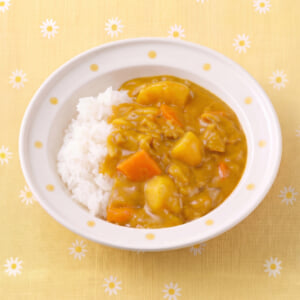
- Japanese Curry Rice with Store-Bought Roux (the recipe from my video)
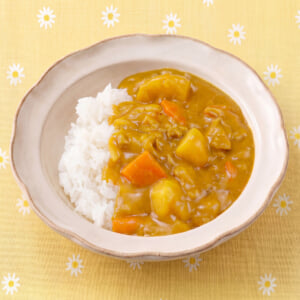
- Curry Rice (from scratch with curry powder; the onion and carrot also start in the microwave)
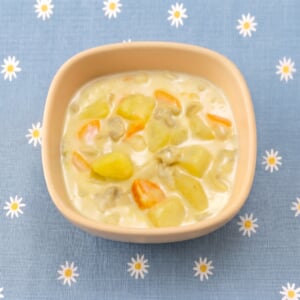
- Curry Stew (the milky school-lunch dish I mention at 12:35)
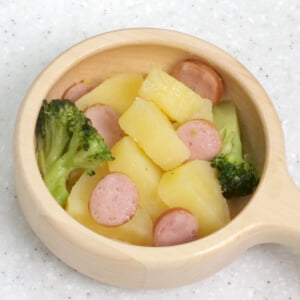
- Broccoli and Potatoes (a side dish cooked entirely in the microwave)
- How to read the recipes on this site
Sources and further reading
- Panasonic: What microwave wattage means, with the conversion formula (Japanese)
- Panasonic: NE-FL1E specifications (Japanese)
- Hitachi: How to switch the microwave output, and what each wattage is for (Japanese)
- Sharp: Heating food labeled with a wattage and time (Japanese)
- TableMark: Microwaves other than 500 W or 600 W (Japanese)
- Food Network Kitchen: A recipe with times for 1,100 W and 700 W
- Tasting Table: Average microwave wattage
- Achetez le meilleur: Choosing a microwave, most models 900–1,100 W (Canadian French)
- CATA: UK microwave categories and conversion chart
- OCU: Microwave power and size (Spanish)
- mikrowellenkochen.de: Recipe times for 600 W (German)
- ICA: A recipe at 750 W (Swedish)
- CJ OnStyle: Heating Hetbahn rice, based on 700 W (Korean)
- Sharp Indonesia: R-223MA, 450 W output (Indonesian)