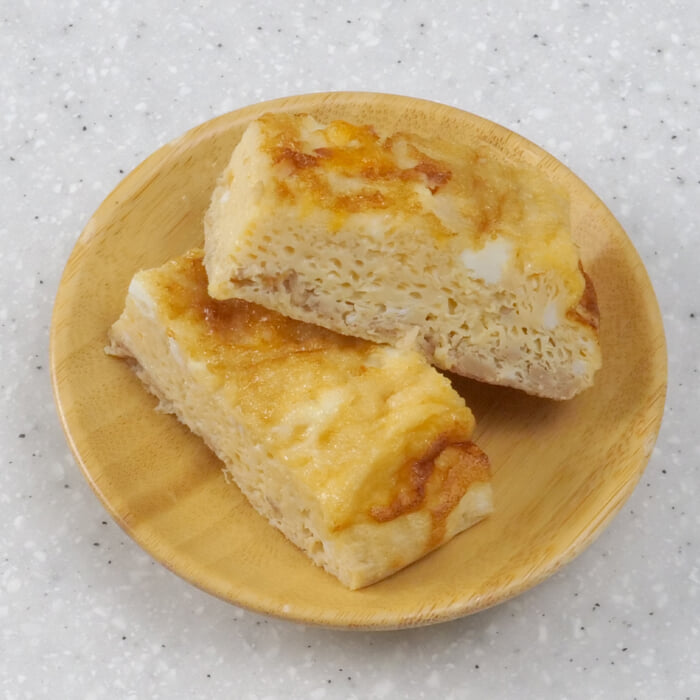
Tuna Tamagoyaki (Baked Japanese Omelet)
ツナ入り卵焼き · Tsuna-iri Tamagoyaki
 By Aoi, licensed nutritionist · From a Japanese preschool lunch menu
Tamagoyaki, the sweet-savory Japanese omelet, is a lunchbox classic in Japan. This preschool-kitchen version folds in canned tuna and slow-sautéed onion, then bakes in the oven instead of a pan, so there is no rolling to master and every portion comes out evenly cooked and tender. The dashi, tuna and caramelized onion layer up plenty of umami, while the touch of liquid keeps the egg soft enough for even the youngest eaters. It is just as good warm at the table as it is cooled and tucked into a bento.
Added. Open the recipe helper (bottom right) → ☰ Menu → 🛒 Shopping list to see the ingredients for your family size.
Printing uses the number of adults and children set under Ingredients, so set those first.
Ingredients
Amounts for 1 child (1 serving). An adult counts as 2 servings.
One serving here is 1.5× the portion served to a child in a Japanese preschool, sized for Western appetites. An adult counts as two servings. Tap an ingredient to check it off.
Ingredients
- 18 gonion
- 16.5 gcanned tuna (in oil)
- 75 gegg
Seasonings
- 1.5 gvegetable oil
- 2.6 gsugar
- 0.5 gsalt
- 2.6 gmirinMirin is a sweet Japanese rice seasoning that adds gentle sweetness and a glossy finish. Hon-mirin (true mirin) contains about 14% alcohol; "mirin-style seasoning" has little or no alcohol. Some alcohol can remain after short cooking. If you prefer no alcohol for children, use the substitute. Substitute: For each tablespoon of mirin, use 1 tablespoon water plus 1 to 2 teaspoons sugar.
- 7.5 gdashi stockJapanese soup stock, usually made from kombu (dried kelp) and/or bonito flakes; the base of most Japanese soups and simmered dishes. Substitute: Instant dashi granules dissolved in water, or a mild unsalted chicken or vegetable stock.
About the Japanese ingredients in this recipe
- mirin (みりん)
- Mirin is a sweet Japanese rice seasoning that adds gentle sweetness and a glossy finish. Hon-mirin (true mirin) contains about 14% alcohol; "mirin-style seasoning" has little or no alcohol. Some alcohol can remain after short cooking. If you prefer no alcohol for children, use the substitute. Substitute: For each tablespoon of mirin, use 1 tablespoon water plus 1 to 2 teaspoons sugar.
- dashi stock (だし汁)
- Japanese soup stock, usually made from kombu (dried kelp) and/or bonito flakes; the base of most Japanese soups and simmered dishes. Substitute: Instant dashi granules dissolved in water, or a mild unsalted chicken or vegetable stock.
Directions
Video is in Japanese and may show a different version of this dish (other ingredients or steps). Follow the ingredients and steps on this page, especially when cooking for allergies.
- 1
Finely chop the onion. Place it in a microwave-safe dish, cover with plastic wrap, and microwave at 1200W for about 1 minute 30 seconds (3 minutes at 600W). Heat the oil in a frying pan and sauté the onion over medium heat for about 2 minutes, until golden brown.
- 2
Drain the oil from the canned tuna.
- 3
Crack the eggs into a bowl and beat them (keeping the tips of your chopsticks against the bottom of the bowl and moving them as if cutting through the egg whites gives a smoother, prettier finish). Add the onion, tuna, seasonings, and dashi stock, and mix well.
- 4
Pour the mixture into a heatproof dish lined with parchment paper and bake in an oven preheated to 180°C (350°F) for about 20 minutes.
Cooking Notes
Adding canned tuna, sautéed onion, and dashi stock to the egg boosts the umami. Mixing in a small amount of liquid keeps the finished omelet soft and tender.
Nutrition
| Per | 1 serving | 1 adult serving | Your total |
|---|---|---|---|
| Energy | 184.5 kcal | 369 kcal | 184.5 kcal |
| Protein | 12.3 g | 24.6 g | 12.3 g |
| Fat | 12.8 g | 25.5 g | 12.8 g |
| Carbohydrates | 5.7 g | 11.4 g | 5.7 g |
| Salt equivalent | 0.9 g | 1.8 g | 0.9 g |
| Calcium | 39 mg | 78 mg | 39 mg |
| Iron | 1.2 mg | 2.4 mg | 1.2 mg |
| Energy | Protein | Fat | Carbs | Salt equiv. | Calcium | Iron | |
|---|---|---|---|---|---|---|---|
| 1 serving | 184.5 kcal | 12.3 g | 12.8 g | 5.7 g | 0.9 g | 39 mg | 1.2 mg |
| 1 adult serving | 369 kcal | 24.6 g | 25.5 g | 11.4 g | 1.8 g | 78 mg | 2.4 mg |
Values are per serving (1.5× the Japanese preschool portion); an adult serving is double. They were calculated by a licensed Japanese nutritionist using the Standard Tables of Food Composition in Japan. "Salt equivalent" is sodium × 2.54, the standard Japanese measure. Allergen flags cover egg, milk and wheat only and come from the nutritionist's records. Soy sauce and miso are made with wheat but are usually allowed on Japanese wheat-free school menus, so check with your doctor.
Ingredients in this recipe
You might also like
All recipes →
Vegetable-Packed Tamagoyaki (Baked Omelet)
Atsuyaki Tamago (Thick Japanese Omelet)
Hijiki Tamagoyaki (Baked Japanese Omelet with Hijiki)
Tamagoyaki with Shirasu (Baked Japanese Omelet)
Teriyaki Tofu Hamburg Steak (Wheat-Free)