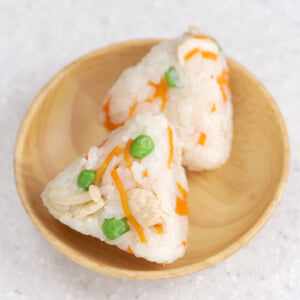
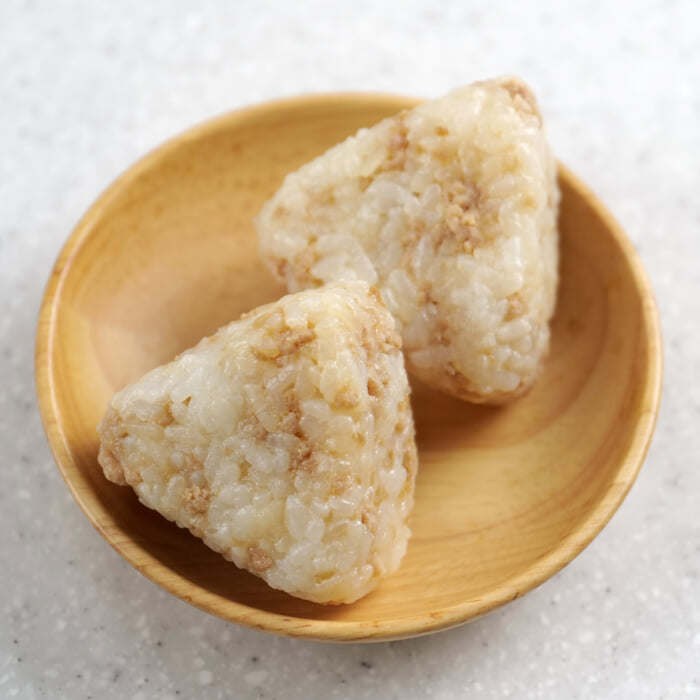
Soboro Onigiri (Rice Balls with Seasoned Ground Chicken)
そぼろおにぎり · Soboro Onigiri
 By Aoi, licensed nutritionist · From a Japanese preschool lunch menu
Soboro is ground meat simmered in a little sugar and soy sauce until it crumbles into savory bits, and it is one of the most reliable ways to get chicken into small children. Here it is stirred straight into warm rice and shaped into onigiri, so every bite tastes gently sweet and salty without any big pieces to chew through. Because the soboro is mixed all the way through instead of sitting on top, nothing falls out when little hands grab the rice ball - which is exactly why it works so well in the preschool kitchen.
Wheat-free, but uses soy sauce (made with wheat). Japanese school-lunch allergy menus usually allow it, so check with your doctor. How to read the labels
Added. Open the recipe helper (bottom right) → ☰ Menu → 🛒 Shopping list to see the ingredients for your family size.
Printing uses the number of adults and children set under Ingredients, so set those first.
Ingredients
Amounts for 1 child (1 serving). An adult counts as 2 servings.
One serving here is 1.5× the portion served to a child in a Japanese preschool, sized for Western appetites. An adult counts as two servings. Tap an ingredient to check it off.
Ingredients
- 60 griceJapanese short-grain white rice (japonica), which cooks up soft and slightly sticky. The amount listed is for uncooked rice. Substitute: Sushi rice, or another short-grain or medium-grain rice such as Calrose.
- 30 gground chicken
Seasonings
- 1.5 gsugar
- 4.1 gsoy sauce
About the Japanese ingredients in this recipe
- rice (米)
- Japanese short-grain white rice (japonica), which cooks up soft and slightly sticky. The amount listed is for uncooked rice. Substitute: Sushi rice, or another short-grain or medium-grain rice such as Calrose.
Directions
- 1
Put the ground chicken and the seasonings in a frying pan and cook over low heat, stirring and breaking up the meat, until the chicken is cooked through.
- 2
Mix the chicken into warm cooked rice and shape into rice balls.
Nutrition
| Per | 1 serving | 1 adult serving | Your total |
|---|---|---|---|
| Energy | 265.5 kcal | 531 kcal | 265.5 kcal |
| Protein | 9.1 g | 18.3 g | 9.1 g |
| Fat | 4.2 g | 8.4 g | 4.2 g |
| Carbohydrates | 48.3 g | 96.6 g | 48.3 g |
| Fiber | 0.3 g | 0.6 g | 0.3 g |
| Salt equivalent | 0.6 g | 1.2 g | 0.6 g |
| Calcium | 7.5 mg | 15 mg | 7.5 mg |
| Iron | 0.8 mg | 1.5 mg | 0.8 mg |
| Potassium | 145.5 mg | 291 mg | 145.5 mg |
| Energy | Protein | Fat | Carbs | Fiber | Salt equiv. | Calcium | Iron | Potassium | |
|---|---|---|---|---|---|---|---|---|---|
| 1 serving | 265.5 kcal | 9.1 g | 4.2 g | 48.3 g | 0.3 g | 0.6 g | 7.5 mg | 0.8 mg | 145.5 mg |
| 1 adult serving | 531 kcal | 18.3 g | 8.4 g | 96.6 g | 0.6 g | 1.2 g | 15 mg | 1.5 mg | 291 mg |
Values are per serving (1.5× the Japanese preschool portion); an adult serving is double. They were calculated by a licensed Japanese nutritionist using the Standard Tables of Food Composition in Japan. "Salt equivalent" is sodium × 2.54, the standard Japanese measure. Allergen flags cover egg, milk and wheat only and come from the nutritionist's records. Soy sauce and miso are made with wheat but are usually allowed on Japanese wheat-free school menus, so check with your doctor.