Seaweed Salad (Elementary School Portion)
海藻サラダ · Kaiso Salad
 By Aoi, licensed nutritionist · From a Japanese elementary school lunch menu
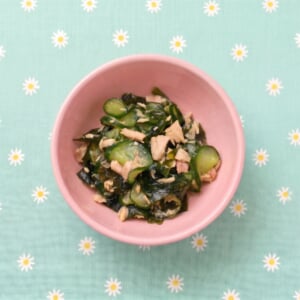
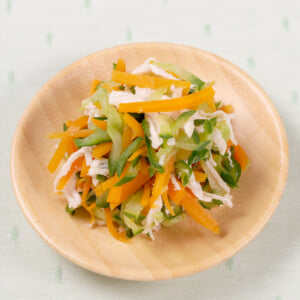
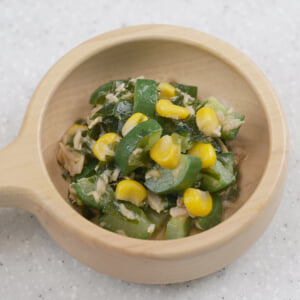
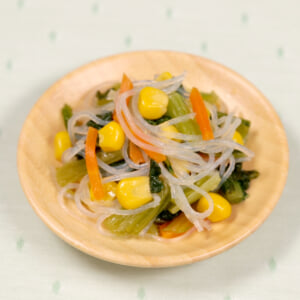
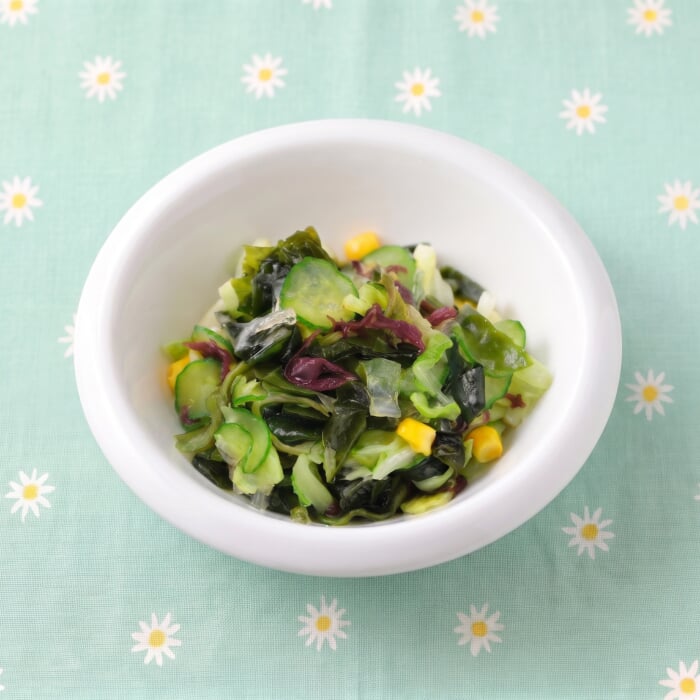
Kaiso salad is a classic on Japanese school lunch menus: rehydrated mixed seaweed tossed with blanched cabbage, thin cucumber rounds and sweet corn in a sweet-and-sour, Chinese-style sesame dressing. The dressing is warmed briefly in the microwave to soften the sharpness of the vinegar, which makes it mellow enough that even little ones take to it. The vegetables are blanched just long enough to keep a little bite, so every forkful has a bit of crunch alongside the slippery seaweed. Made without egg or milk.
Toddlers to adults. The whole family can eat this exactly as written.
Wheat-free, but uses soy sauce (made with wheat). Japanese school-lunch allergy menus usually allow it, so check with your doctor. How to read the labels
Added. Open the recipe helper (bottom right) → ☰ Menu → 🛒 Shopping list to see the ingredients for your family size.
Printing uses the number of adults and children set under Ingredients, so set those first.
Ingredients
Amounts for 1 child (1 serving). An adult counts as 2 servings.
One serving here is 1.5× the portion served to a child in a Japanese elementary school, sized for Western appetites. An adult counts as two servings. Tap an ingredient to check it off.
Ingredients
- to tastedried mixed seaweed (kaiso mix)A dried blend of wakame and other colorful seaweeds that rehydrates in a few minutes and is used mainly in salads. Substitute: Dried wakame on its own works.
- 45 gcabbage
- 24 gcucumber
- 15 gwhole kernel corn (canned)
Sauce Mixture (A)
- 2.4 gsugar
- 2.1 gsesame oil
- 4.8 gvinegar
- 2.1 gsoy sauce
- 0.6 gsalt
About the Japanese ingredients in this recipe
- dried mixed seaweed (kaiso mix) (海藻ミックス)
- A dried blend of wakame and other colorful seaweeds that rehydrates in a few minutes and is used mainly in salads. Substitute: Dried wakame on its own works.
Directions
Video is in Japanese — the steps below are synced to it, so tap ▶ on a step to jump to that moment.
- 1
Put the ingredients for A in a heatproof container and mix well. Cover loosely with plastic wrap, leaving a gap for steam, and microwave at 1200W for about 15 seconds (30 seconds at 600W). Let cool slightly. (Heating takes the edge off the vinegar and gives a mellow dressing that clings nicely to the vegetables.)
- 2
Soak the dried mixed seaweed in boiling water for about 3 minutes to rehydrate it. Rinse under running water to cool, then squeeze out the water. (Seaweed mixes that contain agar will dissolve if boiled, so soak them only.)
- 3
Cut the cabbage into rough 3-4 cm pieces and slice the cucumber into thin rounds. Boil them together in boiling water for about 1 minute, rinse under running water to cool, then squeeze out the water.
- 4
Toss the dressing, the seaweed and the vegetables with the drained corn. Chill in the refrigerator to let the flavors meld.
Tips for Making It Well
- The sweet-and-sour, Chinese-style dressing is that nostalgic school-lunch flavor. The key is to blanch the vegetables only briefly so they keep their texture.
- The colors can dull if the salad sits for a while after tossing. If there will be a gap before eating, mix in the dressing just before serving.
Freezing
This salad does not freeze well. Keep it in the refrigerator and eat it by the next day.
Nutrition
| Per | 1 serving | 1 adult serving | Your total |
|---|---|---|---|
| Energy | 61.5 kcal | 123 kcal | 61.5 kcal |
| Protein | 1.8 g | 3.6 g | 1.8 g |
| Fat | 2.4 g | 4.8 g | 2.4 g |
| Carbohydrates | 9.6 g | 19.2 g | 9.6 g |
| Fiber | 2.7 g | 5.4 g | 2.7 g |
| Salt equivalent | 1.7 g | 3.3 g | 1.7 g |
| Calcium | 52.5 mg | 105 mg | 52.5 mg |
| Iron | 0.5 mg | 0.9 mg | 0.5 mg |
| Potassium | 172.5 mg | 345 mg | 172.5 mg |
| Phosphorus | 39 mg | 78 mg | 39 mg |
| Energy | Protein | Fat | Carbs | Fiber | Salt equiv. | Calcium | Iron | Potassium | Phosphorus | |
|---|---|---|---|---|---|---|---|---|---|---|
| 1 serving | 61.5 kcal | 1.8 g | 2.4 g | 9.6 g | 2.7 g | 1.7 g | 52.5 mg | 0.5 mg | 172.5 mg | 39 mg |
| 1 adult serving | 123 kcal | 3.6 g | 4.8 g | 19.2 g | 5.4 g | 3.3 g | 105 mg | 0.9 mg | 345 mg | 78 mg |
Values are per serving (1.5× the Japanese elementary-school portion); an adult serving is double. They were calculated by a licensed Japanese nutritionist using the Standard Tables of Food Composition in Japan. "Salt equivalent" is sodium × 2.54, the standard Japanese measure. Allergen flags cover egg, milk and wheat only and come from the nutritionist's records. Soy sauce and miso are made with wheat but are usually allowed on Japanese wheat-free school menus, so check with your doctor.