Broccoli and Potato Sauté
ブロッコリーポテト(卵乳なし)
 By Aoi, licensed nutritionist · From a Japanese preschool lunch menu
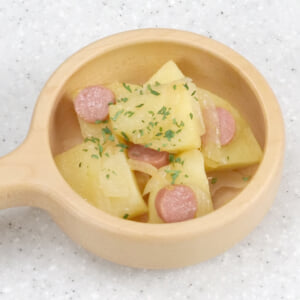
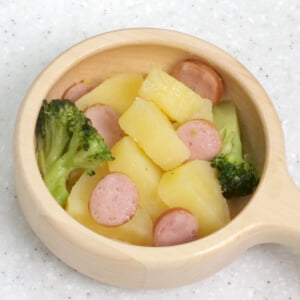
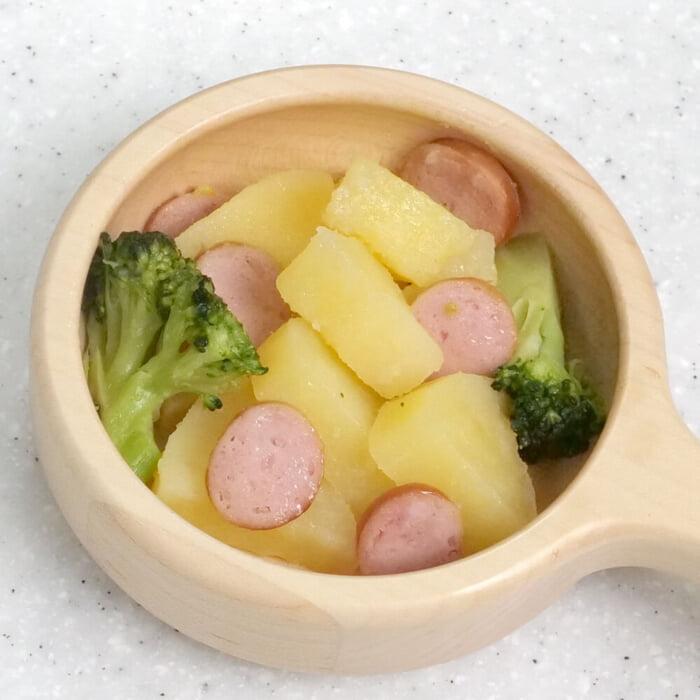
Soft chunks of potato, tender broccoli florets and thin slices of sausage, tossed together in a frying pan with just a little salt and consommé. The potato and broccoli are boiled first, so they are soft enough for small children to chew easily, and the sausage adds a savory note that gets kids reaching for the green vegetable too. It is a simple, gentle side dish that sits happily next to rice or bread on a lunch tray.
Added. Open the recipe helper (bottom right) → ☰ Menu → 🛒 Shopping list to see the ingredients for your family size.
Printing uses the number of adults and children set under Ingredients, so set those first.
Ingredients
Amounts for 1 child (1 serving). An adult counts as 2 servings.
One serving here is 1.5× the portion served to a child in a Japanese preschool, sized for Western appetites. An adult counts as two servings. Tap an ingredient to check it off.
Ingredients
- 49.5 gpotato
- 12.5 gbroccoli
- 9.3 gskinless sausages (egg- and milk-free)Small skinless pork sausages, similar to mini hot dogs, that are made without egg or milk ingredients and are popular for children's meals in Japan. Substitute: Any small cooked sausage or hot dog with no egg or milk ingredients; check the label.
Seasonings
- 1.5 gvegetable oil
- 0.1 gsalt
- 0.2 gconsommé bouillon (allergen-free)Japanese-style consommé stock granules or cubes, used as a Western-style soup base. This kind is made without egg and milk, but most recipes on this site that use it list wheat in their allergens, so check the label if you avoid wheat. Substitute: A chicken or vegetable bouillon powder or cube made without egg, milk or wheat (check the label).
About the Japanese ingredients in this recipe
- skinless sausages (egg- and milk-free) (皮なしウインナー(卵乳不使用))
- Small skinless pork sausages, similar to mini hot dogs, that are made without egg or milk ingredients and are popular for children's meals in Japan. Substitute: Any small cooked sausage or hot dog with no egg or milk ingredients; check the label.
- consommé bouillon (allergen-free) (コンソメ(アレルゲン不使用))
- Japanese-style consommé stock granules or cubes, used as a Western-style soup base. This kind is made without egg and milk, but most recipes on this site that use it list wheat in their allergens, so check the label if you avoid wheat. Substitute: A chicken or vegetable bouillon powder or cube made without egg, milk or wheat (check the label).
Directions
- 1
Cut the potato into thick quarter-rounds and separate the broccoli into small florets. Boil each separately, then drain in a colander.
- 2
Cut the sausages in half lengthwise, then into thin slices.
- 3
Heat the oil in a frying pan, add the potato, broccoli and sausage, and sauté.
- 4
Add the seasonings and toss briefly over the heat.
In step 1, do not soak the cut potato in water – use it as it is and sauté it in step 3.
Nutrition
| Per | 1 serving | 1 adult serving | Your total |
|---|---|---|---|
| Energy | 69 kcal | 138 kcal | 69 kcal |
| Protein | 2.7 g | 5.4 g | 2.7 g |
| Fat | 3.2 g | 6.3 g | 3.2 g |
| Carbohydrates | 10.1 g | 20.1 g | 10.1 g |
| Fiber | 4.9 g | 9.9 g | 4.9 g |
| Salt equivalent | 0.5 g | 0.9 g | 0.5 g |
| Calcium | 43.5 mg | 87 mg | 43.5 mg |
| Iron | 0.3 mg | 0.6 mg | 0.3 mg |
| Potassium | 259.5 mg | 519 mg | 259.5 mg |
| Energy | Protein | Fat | Carbs | Fiber | Salt equiv. | Calcium | Iron | Potassium | |
|---|---|---|---|---|---|---|---|---|---|
| 1 serving | 69 kcal | 2.7 g | 3.2 g | 10.1 g | 4.9 g | 0.5 g | 43.5 mg | 0.3 mg | 259.5 mg |
| 1 adult serving | 138 kcal | 5.4 g | 6.3 g | 20.1 g | 9.9 g | 0.9 g | 87 mg | 0.6 mg | 519 mg |
Values are per serving (1.5× the Japanese preschool portion); an adult serving is double. They were calculated by a licensed Japanese nutritionist using the Standard Tables of Food Composition in Japan. "Salt equivalent" is sodium × 2.54, the standard Japanese measure. Allergen flags cover egg, milk and wheat only and come from the nutritionist's records. Soy sauce and miso are made with wheat but are usually allowed on Japanese wheat-free school menus, so check with your doctor.