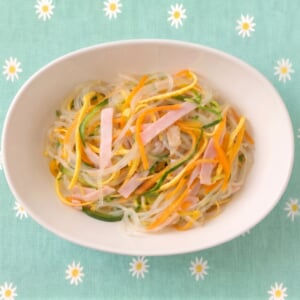
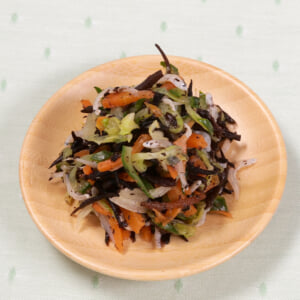
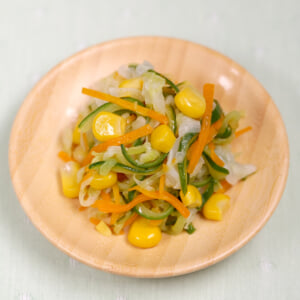
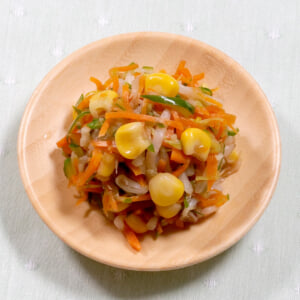
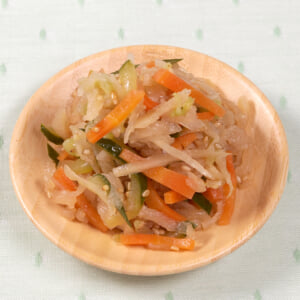
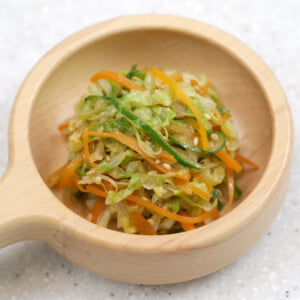
Ricchan Salad (Elementary School Portion)
りっちゃんサラダ · Ricchan Sarada
 By Aoi, licensed nutritionist · From a Japanese elementary school lunch menu
Ricchan Salad is the salad from Eiko Kadono's picture book "Salad de Genki," a story that generations of Japanese children have read in their first-grade language textbooks. Ricchan sets out to make a salad to cheer up her sick mother, and one animal after another drops in to suggest an ingredient: the cat suggests bonito flakes, the dog brings ham, the sparrow adds corn, and so on, until an elephant arrives to add the oil, vinegar and seasoning and toss it all together. Every ingredient here follows the book, which is why it so often turns up on the school lunch menu around the time the class reads the story. The sweet-tangy dressing and the umami from shio kombu and katsuobushi make this a salad that even vegetable-shy kids happily finish.
Toddlers to adults. The whole family can eat this exactly as written.
Wheat-free, but uses soy sauce (made with wheat). Japanese school-lunch allergy menus usually allow it, so check with your doctor. How to read the labels
Added. Open the recipe helper (bottom right) → ☰ Menu → 🛒 Shopping list to see the ingredients for your family size.
Printing uses the number of adults and children set under Ingredients, so set those first.
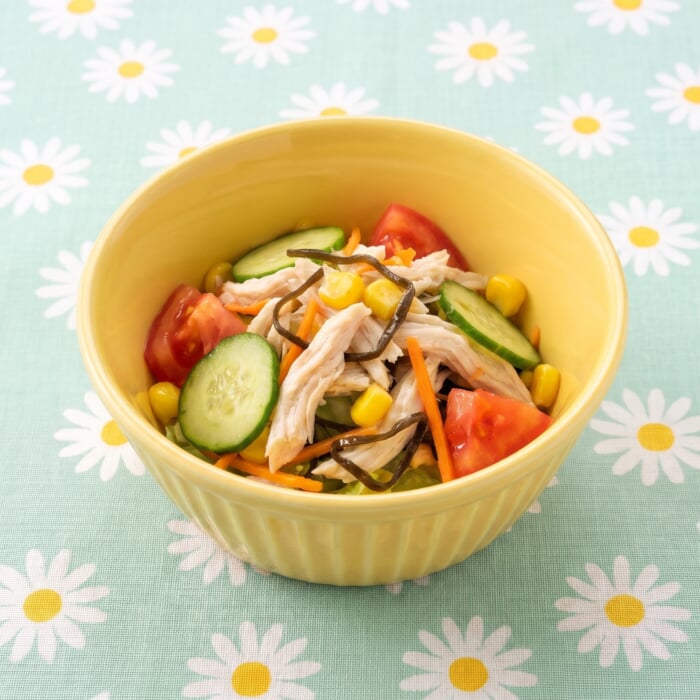
Ingredients
Amounts for 1 child (1 serving). An adult counts as 2 servings.
One serving here is 1.5× the portion served to a child in a Japanese elementary school, sized for Western appetites. An adult counts as two servings. Tap an ingredient to check it off.
Ingredients
- 45 gcabbage
- 15 gcarrot
- 15 gcucumber
- 12 gham
- 18 gwhole kernel corn (canned)
- 24 gtomato
- 2.7 gshio kombu (salted kelp strips)Thin strips of kelp simmered in soy sauce and coated in salt, used as a savory seasoning. Substitute: Finely shredded nori or kombu plus a pinch of salt and a few drops of soy sauce.
- 0.8 gkatsuobushi (bonito flakes)Paper-thin flakes of dried, smoked bonito used for dashi and as a savory topping. Substitute: Omit, or a pinch of instant dashi powder.
Sauce Mixture (A)
- 6.3 gvinegar
- 4.8 gvegetable oil
- 1.2 gsugar
- 2.6 gsoy sauce
About the Japanese ingredients in this recipe
- shio kombu (salted kelp strips) (塩昆布)
- Thin strips of kelp simmered in soy sauce and coated in salt, used as a savory seasoning. Substitute: Finely shredded nori or kombu plus a pinch of salt and a few drops of soy sauce.
- katsuobushi (bonito flakes) (かつお節)
- Paper-thin flakes of dried, smoked bonito used for dashi and as a savory topping. Substitute: Omit, or a pinch of instant dashi powder.
Directions
Video is in Japanese — the steps below are synced to it, so tap ▶ on a step to jump to that moment.
- 1
Cut the cabbage and carrot into thin strips, and slice the cucumber into rounds 2 to 3 mm thick. Cut the ham into thin strips and the tomato into small cubes. Tip the corn into a colander to drain. (If you cut the carrot too thin, it tends to fall apart when boiled.)
- 2
Boil the carrot and cabbage in boiling water for about 30 seconds, then add the cucumber and ham, blanch them briefly, and drain in a colander. Cool under running water and squeeze out the water well. (Don't overcook, so the vegetables keep some crunch. If you prefer, the cucumber and ham can be mixed in raw instead.)
- 3
Put the ingredients for A in a bowl and whisk well so the oil blends in.
- 4
Add the squeezed vegetables from step 2, the corn, tomato, shio kombu and katsuobushi to the dressing from step 3 and toss to combine.
Tips for Best Results
• The umami from the shio kombu and katsuobushi means the flavor comes together with only a little seasoning. The dressing is on the sweet side, so a tomato with some tartness works best.
• If there will be some time before serving, store the vegetables and the dressing separately and toss them just before eating so the salad doesn't turn watery.
Freezing
This salad doesn't freeze well. Keep it in the refrigerator and eat it by the next day.
Nutrition
| Per | 1 serving | 1 adult serving | Your total |
|---|---|---|---|
| Energy | 121.5 kcal | 243 kcal | 121.5 kcal |
| Protein | 4.8 g | 9.6 g | 4.8 g |
| Fat | 6.9 g | 13.8 g | 6.9 g |
| Carbohydrates | 11.3 g | 22.5 g | 11.3 g |
| Fiber | 2.6 g | 5.1 g | 2.6 g |
| Salt equivalent | 1.2 g | 2.4 g | 1.2 g |
| Calcium | 37.5 mg | 75 mg | 37.5 mg |
| Iron | 0.6 mg | 1.2 mg | 0.6 mg |
| Potassium | 331.5 mg | 663 mg | 331.5 mg |
| Phosphorus | 82.5 mg | 165 mg | 82.5 mg |
| Energy | Protein | Fat | Carbs | Fiber | Salt equiv. | Calcium | Iron | Potassium | Phosphorus | |
|---|---|---|---|---|---|---|---|---|---|---|
| 1 serving | 121.5 kcal | 4.8 g | 6.9 g | 11.3 g | 2.6 g | 1.2 g | 37.5 mg | 0.6 mg | 331.5 mg | 82.5 mg |
| 1 adult serving | 243 kcal | 9.6 g | 13.8 g | 22.5 g | 5.1 g | 2.4 g | 75 mg | 1.2 mg | 663 mg | 165 mg |
Values are per serving (1.5× the Japanese elementary-school portion); an adult serving is double. They were calculated by a licensed Japanese nutritionist using the Standard Tables of Food Composition in Japan. "Salt equivalent" is sodium × 2.54, the standard Japanese measure. Allergen flags cover egg, milk and wheat only and come from the nutritionist's records. Soy sauce and miso are made with wheat but are usually allowed on Japanese wheat-free school menus, so check with your doctor.