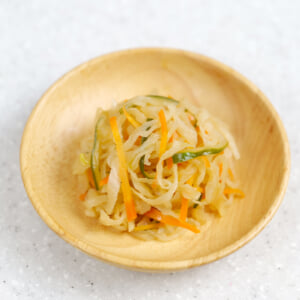
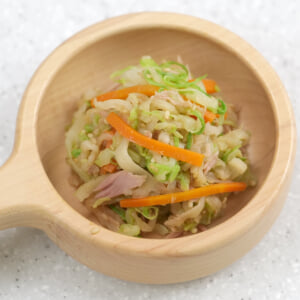
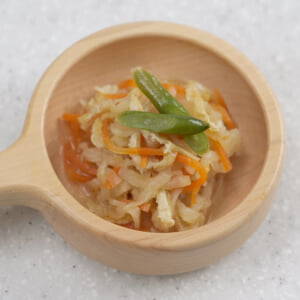
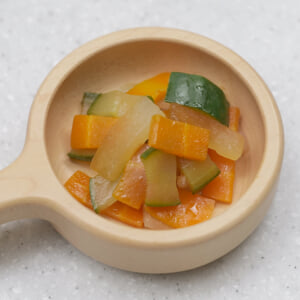
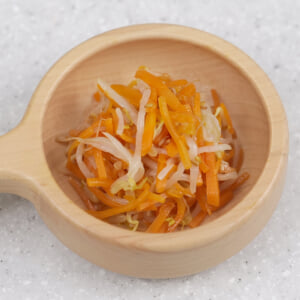
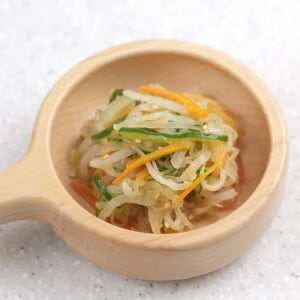
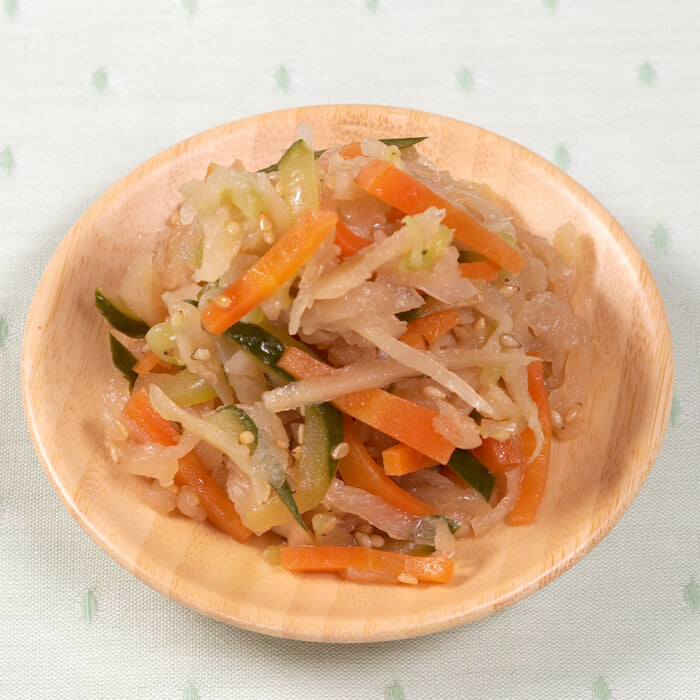
Kiriboshi Daikon Salad with Sesame Dressing
切干大根のごまドレサラダ · Kiriboshi Daikon no Goma Dore Sarada
 By Aoi, licensed nutritionist · From a Japanese preschool lunch menu
Kiriboshi daikon is daikon radish that has been shredded and sun-dried, a pantry staple in Japan that turns pleasantly chewy and slightly sweet once soaked in water. In this preschool salad it is paired with carrot and cucumber and dressed in a light sesame-soy dressing that is warmed briefly so the sharp edge of the vinegar cooks off, which is what makes it so gentle on small palates. Everything is cut short and thin so it is easy for little mouths to chew, and the nutty toasted sesame seeds keep kids coming back for another bite.
Wheat-free, but uses soy sauce (made with wheat). Japanese school-lunch allergy menus usually allow it, so check with your doctor. How to read the labels
Added. Open the recipe helper (bottom right) → ☰ Menu → 🛒 Shopping list to see the ingredients for your family size.
Printing uses the number of adults and children set under Ingredients, so set those first.
Ingredients
Amounts for 1 child (1 serving). An adult counts as 2 servings.
One serving here is 1.5× the portion served to a child in a Japanese preschool, sized for Western appetites. An adult counts as two servings. Tap an ingredient to check it off.
Ingredients
- 7.1 gkiriboshi daikon (dried shredded daikon)Sun-dried strips of daikon radish with a concentrated sweetness and chewy texture, soaked before cooking. Substitute: Fresh daikon or carrot cut into matchsticks.
- 7.5 gcarrot
- 15 gcucumber
Seasonings
- 2.3 gvegetable oil
- 2.3 gvinegar
- 3 gsoy sauce
- 1 gsugar
- 1.5 gwhite sesame seeds
About the Japanese ingredients in this recipe
- kiriboshi daikon (dried shredded daikon) (切干しだいこん)
- Sun-dried strips of daikon radish with a concentrated sweetness and chewy texture, soaked before cooking. Substitute: Fresh daikon or carrot cut into matchsticks.
Directions
- 1
Soak the kiriboshi daikon in water to rehydrate it, then cut it into 3 cm lengths. Cut the carrot and cucumber into short, thin strips.
- 2
Boil each of the vegetables from step 1 separately, then rinse under running water to cool.
- 3
Combine the dressing ingredients and heat them to cook off the sharpness of the vinegar. Toast the white sesame seeds (optional).
- 4
Squeeze the vegetables from step 2 to drain off the water, then toss with the dressing from step 3.
Nutrition
| Per | 1 serving | 1 adult serving | Your total |
|---|---|---|---|
| Energy | 60 kcal | 120 kcal | 60 kcal |
| Protein | 1.5 g | 3 g | 1.5 g |
| Fat | 3 g | 6 g | 3 g |
| Carbohydrates | 7.8 g | 15.6 g | 7.8 g |
| Fiber | 2 g | 3.9 g | 2 g |
| Salt equivalent | 0.5 g | 0.9 g | 0.5 g |
| Calcium | 61.5 mg | 123 mg | 61.5 mg |
| Iron | 0.3 mg | 0.6 mg | 0.3 mg |
| Potassium | 318 mg | 636 mg | 318 mg |
| Energy | Protein | Fat | Carbs | Fiber | Salt equiv. | Calcium | Iron | Potassium | |
|---|---|---|---|---|---|---|---|---|---|
| 1 serving | 60 kcal | 1.5 g | 3 g | 7.8 g | 2 g | 0.5 g | 61.5 mg | 0.3 mg | 318 mg |
| 1 adult serving | 120 kcal | 3 g | 6 g | 15.6 g | 3.9 g | 0.9 g | 123 mg | 0.6 mg | 636 mg |
Values are per serving (1.5× the Japanese preschool portion); an adult serving is double. They were calculated by a licensed Japanese nutritionist using the Standard Tables of Food Composition in Japan. "Salt equivalent" is sodium × 2.54, the standard Japanese measure. Allergen flags cover egg, milk and wheat only and come from the nutritionist's records. Soy sauce and miso are made with wheat but are usually allowed on Japanese wheat-free school menus, so check with your doctor.