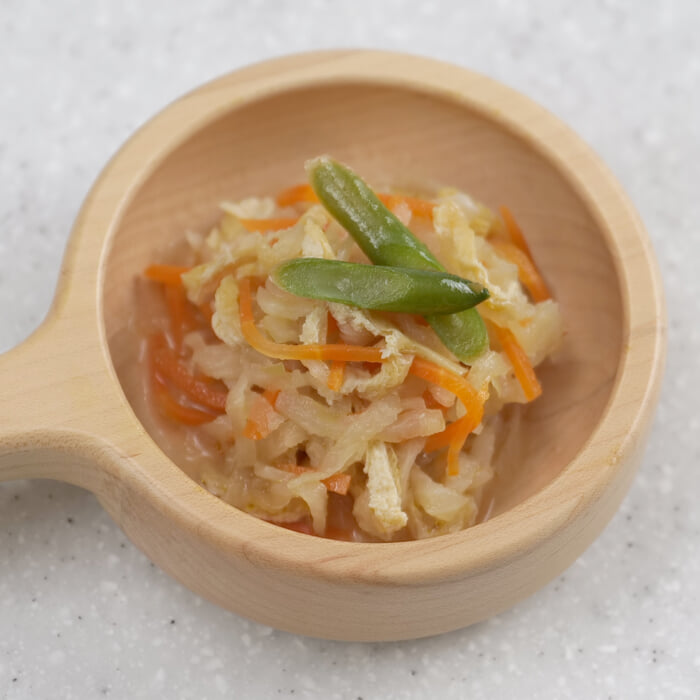
Simmered Kiriboshi Daikon (Dried Shredded Daikon)
切干大根の煮物 · Kiriboshi Daikon no Nimono
 By Aoi, licensed nutritionist · From a Japanese preschool lunch menu
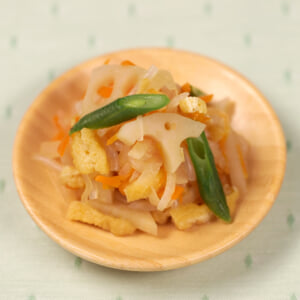
Kiriboshi daikon is daikon radish that has been shredded and dried in the sun, which concentrates its natural sweetness and gives it a pleasantly chewy bite. Simmered with carrot and aburaage in a lightly sweetened dashi and soy sauce broth, it becomes one of the most familiar side dishes on Japanese school lunch trays. Everything is cut short and thin so it is easy for little mouths to manage, and the mild, gently sweet seasoning makes even children who are unsure about vegetables happy to eat it. A touch of green beans stirred in at the end adds color and a fresh crunch.
Wheat-free, but uses soy sauce (made with wheat). Japanese school-lunch allergy menus usually allow it, so check with your doctor. How to read the labels
Added. Open the recipe helper (bottom right) → ☰ Menu → 🛒 Shopping list to see the ingredients for your family size.
Printing uses the number of adults and children set under Ingredients, so set those first.
Ingredients
Amounts for 1 child (1 serving). An adult counts as 2 servings.
One serving here is 1.5× the portion served to a child in a Japanese preschool, sized for Western appetites. An adult counts as two servings. Tap an ingredient to check it off.
Ingredients
- 9 gkiriboshi daikon (dried shredded daikon)Sun-dried strips of daikon radish with a concentrated sweetness and chewy texture, soaked before cooking. Substitute: Fresh daikon or carrot cut into matchsticks.
- 4.5 gaburaage (fried tofu pouch)Thin slices of tofu deep-fried until puffy and golden, sold in packs in the refrigerated section of Japanese and Asian markets. Substitute: Firm tofu, thinly sliced and pan-fried until golden.
- 9 gcarrot
- 3.8 ggreen beans
Seasonings
- 2.3 gvegetable oil
- 105 gdashi stockJapanese soup stock, usually made from kombu (dried kelp) and/or bonito flakes; the base of most Japanese soups and simmered dishes. Substitute: Instant dashi granules dissolved in water, or a mild unsalted chicken or vegetable stock.
- 0.6 gsugar
- 0.8 gmirinMirin is a sweet Japanese rice seasoning that adds gentle sweetness and a glossy finish. Hon-mirin (true mirin) contains about 14% alcohol; "mirin-style seasoning" has little or no alcohol. Some alcohol can remain after short cooking. If you prefer no alcohol for children, use the substitute. Substitute: For each tablespoon of mirin, use 1 tablespoon water plus 1 to 2 teaspoons sugar.
- 2.7 gsoy sauce
About the Japanese ingredients in this recipe
- kiriboshi daikon (dried shredded daikon) (切干しだいこん)
- Sun-dried strips of daikon radish with a concentrated sweetness and chewy texture, soaked before cooking. Substitute: Fresh daikon or carrot cut into matchsticks.
- aburaage (fried tofu pouch) (油揚げ)
- Thin slices of tofu deep-fried until puffy and golden, sold in packs in the refrigerated section of Japanese and Asian markets. Substitute: Firm tofu, thinly sliced and pan-fried until golden.
- dashi stock (だし汁)
- Japanese soup stock, usually made from kombu (dried kelp) and/or bonito flakes; the base of most Japanese soups and simmered dishes. Substitute: Instant dashi granules dissolved in water, or a mild unsalted chicken or vegetable stock.
- mirin (みりん)
- Mirin is a sweet Japanese rice seasoning that adds gentle sweetness and a glossy finish. Hon-mirin (true mirin) contains about 14% alcohol; "mirin-style seasoning" has little or no alcohol. Some alcohol can remain after short cooking. If you prefer no alcohol for children, use the substitute. Substitute: For each tablespoon of mirin, use 1 tablespoon water plus 1 to 2 teaspoons sugar.
Directions
Video is in Japanese and may show a different version of this dish (other ingredients or steps). Follow the ingredients and steps on this page, especially when cooking for allergies.
- 1
Soak the kiriboshi daikon to rehydrate it, then cut it into 3 cm lengths. Cut the carrot into short thin matchsticks. Pour boiling water over the aburaage to remove excess oil, then cut it into short thin strips.
- 2
Cut the green beans diagonally into 2 cm pieces and boil them.
- 3
Heat the oil in a pot, add the ingredients from step 1 and stir-fry. Add the dashi stock, sugar and mirin and simmer until everything is tender.
- 4
Add the soy sauce and simmer a little longer. To finish, stir in the green beans from step 2.
Nutrition
| Per | 1 serving | 1 adult serving | Your total |
|---|---|---|---|
| Energy | 73.5 kcal | 147 kcal | 73.5 kcal |
| Protein | 2.4 g | 4.8 g | 2.4 g |
| Fat | 3.8 g | 7.5 g | 3.8 g |
| Carbohydrates | 8.7 g | 17.4 g | 8.7 g |
| Fiber | 2.4 g | 4.8 g | 2.4 g |
| Salt equivalent | 0.6 g | 1.2 g | 0.6 g |
| Calcium | 67.5 mg | 135 mg | 67.5 mg |
| Iron | 0.5 mg | 0.9 mg | 0.5 mg |
| Potassium | 433.5 mg | 867 mg | 433.5 mg |
| Energy | Protein | Fat | Carbs | Fiber | Salt equiv. | Calcium | Iron | Potassium | |
|---|---|---|---|---|---|---|---|---|---|
| 1 serving | 73.5 kcal | 2.4 g | 3.8 g | 8.7 g | 2.4 g | 0.6 g | 67.5 mg | 0.5 mg | 433.5 mg |
| 1 adult serving | 147 kcal | 4.8 g | 7.5 g | 17.4 g | 4.8 g | 1.2 g | 135 mg | 0.9 mg | 867 mg |
Values are per serving (1.5× the Japanese preschool portion); an adult serving is double. They were calculated by a licensed Japanese nutritionist using the Standard Tables of Food Composition in Japan. "Salt equivalent" is sodium × 2.54, the standard Japanese measure. Allergen flags cover egg, milk and wheat only and come from the nutritionist's records. Soy sauce and miso are made with wheat but are usually allowed on Japanese wheat-free school menus, so check with your doctor.