Pot-au-Feu
ポトフ
 By Aoi, licensed nutritionist · From a Japanese elementary school lunch menu
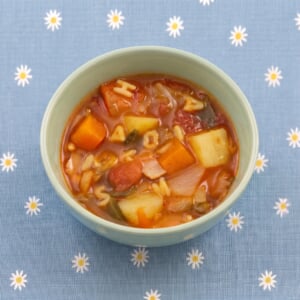
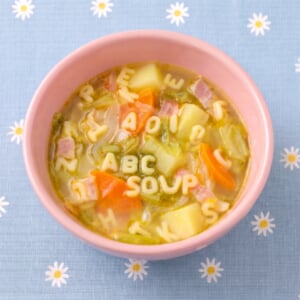
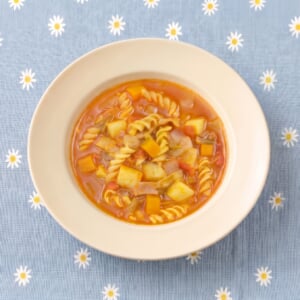
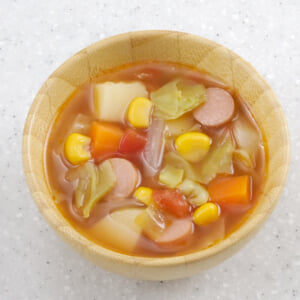
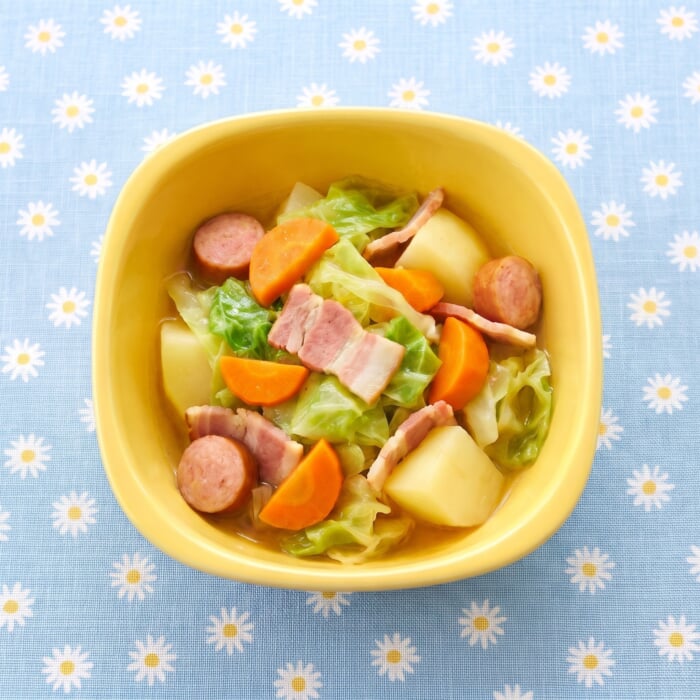
Pot-au-feu is a French-style simmered dish, and in Japan it has become a cozy kitchen staple: a clear, savory soup packed with chunky vegetables, bacon and sausages. Children love it because every spoonful brings something soft and sweet, from the melting potato and carrot to the tender cabbage. The secret is to sauté the vegetables well before the water goes in, which draws out their natural sweetness so the soup tastes full and satisfying without heavy seasoning. A tiny splash of soy sauce at the end rounds everything off.
Toddlers to adults. The whole family can eat this exactly as written.
Added. Open the recipe helper (bottom right) → ☰ Menu → 🛒 Shopping list to see the ingredients for your family size.
Printing uses the number of adults and children set under Ingredients, so set those first.
Ingredients
Amounts for 1 child (1 serving). An adult counts as 2 servings.
One serving here is 1.5× the portion served to a child in a Japanese elementary school, sized for Western appetites. An adult counts as two servings. Tap an ingredient to check it off.
- 10.5 gbacon
- 19.5 gwiener sausages
- 75 gpotato
- 24 gcarrot
- 36 gonion
- 45 gcabbage
- 1.5 gvegetable oil
- 225 mlwater
- 1.8 gconsommé bouillon (granules or cube)Japanese-style Western soup stock powder or cubes, similar to chicken or vegetable bouillon. Substitute: Chicken or vegetable bouillon granules or a bouillon cube.
- 0.3 gsalt
- to tastepepper
- 0.9 gsoy sauce
About the Japanese ingredients in this recipe
- consommé bouillon (granules or cube) (コンソメ)
- Japanese-style Western soup stock powder or cubes, similar to chicken or vegetable bouillon. Substitute: Chicken or vegetable bouillon granules or a bouillon cube.
Directions
Video is in Japanese — the steps below are synced to it, so tap ▶ on a step to jump to that moment.
- 1
Cut the potato into thick quarter-rounds and soak in water for about 5 minutes. Cut the carrot into quarter-rounds, cut the onion in half crosswise and then into wedges, and cut the cabbage into short, narrow strips. Cut the bacon and wiener sausages into 1 cm pieces. (Cutting the vegetables a little smaller makes them easy to scoop up with a spoon, so the flavor of all the ingredients comes together in a single bite.)
- 2
Heat the oil in a pot, add the carrot and onion, and sauté over medium heat for about 5 minutes. Add the bacon and sausages and cook until they take on some browning, then add the cabbage and the drained potato and sauté for about 2 minutes, until everything is coated in oil. (Sautéing the carrot and onion first draws out the vegetables' natural sweetness and savory depth. Add a small amount of water and stir occasionally, cooking until the onion takes on color.)
- 3
Add the water and consommé and bring to a boil over high heat, then reduce to low heat and simmer for about 15 minutes. Add the salt, pepper and soy sauce and heat briefly so the flavors blend. (A small amount of soy sauce takes the sharp edge off the salt and gives the soup a mellow, rounded taste.)
Tips for the Best Result
- The key is to sauté everything well before adding the liquid, to bring out the sweetness of the vegetables and the savory flavor of the bacon and sausages.
- If you are making a big batch to eat again the next day, use a waxy potato such as May Queen (or another firm variety) that holds its shape during simmering.
Freezing Instructions
Remove the potato first, since its texture changes when frozen. Let the soup cool, then divide into single portions in freezer bags and freeze. Reheat in the microwave before eating.
Keeps for about 2 weeks (but enjoy it as soon as you can).
Nutrition
| Per | 1 serving | 1 adult serving | Your total |
|---|---|---|---|
| Energy | 180 kcal | 360 kcal | 180 kcal |
| Protein | 6.5 g | 12.9 g | 6.5 g |
| Fat | 9.8 g | 19.5 g | 9.8 g |
| Carbohydrates | 22.4 g | 44.7 g | 22.4 g |
| Fiber | 8.7 g | 17.4 g | 8.7 g |
| Salt equivalent | 1.8 g | 3.6 g | 1.8 g |
| Calcium | 37.5 mg | 75 mg | 37.5 mg |
| Iron | 0.8 mg | 1.5 mg | 0.8 mg |
| Potassium | 583.5 mg | 1167 mg | 583.5 mg |
| Phosphorus | 129 mg | 258 mg | 129 mg |
| Energy | Protein | Fat | Carbs | Fiber | Salt equiv. | Calcium | Iron | Potassium | Phosphorus | |
|---|---|---|---|---|---|---|---|---|---|---|
| 1 serving | 180 kcal | 6.5 g | 9.8 g | 22.4 g | 8.7 g | 1.8 g | 37.5 mg | 0.8 mg | 583.5 mg | 129 mg |
| 1 adult serving | 360 kcal | 12.9 g | 19.5 g | 44.7 g | 17.4 g | 3.6 g | 75 mg | 1.5 mg | 1167 mg | 258 mg |
Values are per serving (1.5× the Japanese elementary-school portion); an adult serving is double. They were calculated by a licensed Japanese nutritionist using the Standard Tables of Food Composition in Japan. "Salt equivalent" is sodium × 2.54, the standard Japanese measure. Allergen flags cover egg, milk and wheat only and come from the nutritionist's records. Soy sauce and miso are made with wheat but are usually allowed on Japanese wheat-free school menus, so check with your doctor.