Nanakusa-Gayu Style Rice Porridge
七草がゆ風 · Nanakusa-gayu Fu
 By Aoi, licensed nutritionist · From a Japanese preschool lunch menu
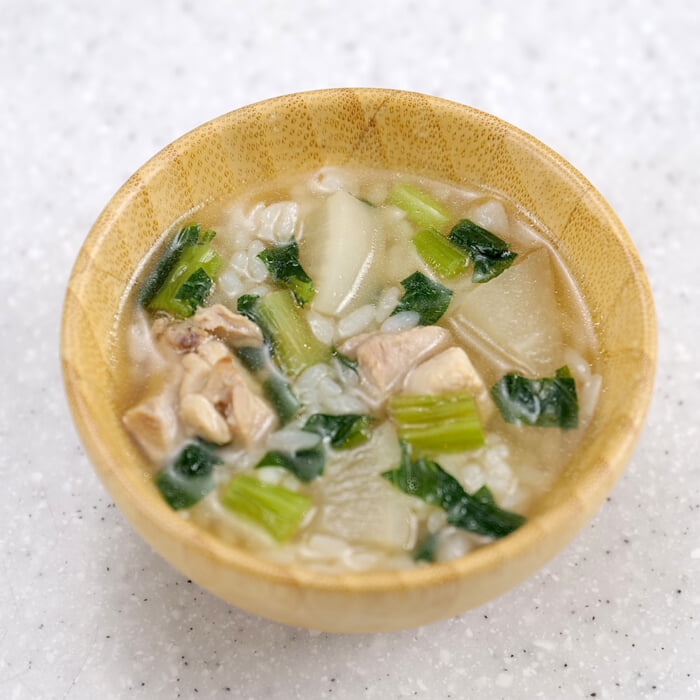
Nanakusa-gayu is the rice porridge eaten in Japan on January 7 (Jinjitsu, one of the year's seasonal festivals), made with seven spring herbs and traditionally said to rest the stomach after the New Year feasting and to wish for good health in the coming year. Of the seven herbs, two are familiar vegetables: suzushiro (daikon radish) and suzuna (turnip). This preschool version uses those two, adds komatsuna for color and a little chicken for flavor and protein, then ladles the gentle dashi broth over plain cooked rice instead of simmering a true porridge. Everything is cut small and cooked until soft, so even the youngest children can manage it with a spoon.
Wheat-free, but uses soy sauce (made with wheat). Japanese school-lunch allergy menus usually allow it, so check with your doctor. How to read the labels
Added. Open the recipe helper (bottom right) → ☰ Menu → 🛒 Shopping list to see the ingredients for your family size.
Printing uses the number of adults and children set under Ingredients, so set those first.
Ingredients
Amounts for 1 child (1 serving). An adult counts as 2 servings.
One serving here is 1.5× the portion served to a child in a Japanese preschool, sized for Western appetites. An adult counts as two servings. Tap an ingredient to check it off.
Ingredients
- 60 griceJapanese short-grain white rice (japonica), which cooks up soft and slightly sticky. The amount listed is for uncooked rice. Substitute: Sushi rice, or another short-grain or medium-grain rice such as Calrose.
- 10.5 gdaikon radish
- 10.5 gturnip
- 22.5 gkomatsunaA mild Japanese leafy green (Japanese mustard spinach) with tender stems. Substitute: Spinach or bok choy.
- 18 gchicken thigh
Seasonings
- 150 gdashi stockJapanese soup stock, usually made from kombu (dried kelp) and/or bonito flakes; the base of most Japanese soups and simmered dishes. Substitute: Instant dashi granules dissolved in water, or a mild unsalted chicken or vegetable stock.
- 0.8 gsoy sauce
- 0.5 gsalt
About the Japanese ingredients in this recipe
- rice (米)
- Japanese short-grain white rice (japonica), which cooks up soft and slightly sticky. The amount listed is for uncooked rice. Substitute: Sushi rice, or another short-grain or medium-grain rice such as Calrose.
- komatsuna (こまつな)
- A mild Japanese leafy green (Japanese mustard spinach) with tender stems. Substitute: Spinach or bok choy.
- dashi stock (だし汁)
- Japanese soup stock, usually made from kombu (dried kelp) and/or bonito flakes; the base of most Japanese soups and simmered dishes. Substitute: Instant dashi granules dissolved in water, or a mild unsalted chicken or vegetable stock.
Directions
- 1
Cook the rice as you normally would.
- 2
Cut the daikon and turnip into thin quarter-rounds (ichō-giri). Cut the komatsuna into 2 cm pieces and boil it. Cut the chicken into 1 cm cubes.
- 3
Put the dashi stock, daikon and turnip in a pot and bring to a boil, then add the chicken and simmer. When the vegetables are soft, season with the soy sauce and salt and add the komatsuna.
- 4
Spoon the cooked rice into bowls and ladle the mixture from step 3 over the top.
Nutrition
| Per | 1 serving | 1 adult serving | Your total |
|---|---|---|---|
| Energy | 249 kcal | 498 kcal | 249 kcal |
| Protein | 7.7 g | 15.3 g | 7.7 g |
| Fat | 3.2 g | 6.3 g | 3.2 g |
| Carbohydrates | 48.4 g | 96.9 g | 48.4 g |
| Fiber | 1.2 g | 2.4 g | 1.2 g |
| Salt equivalent | 0.8 g | 1.5 g | 0.8 g |
| Calcium | 78 mg | 156 mg | 78 mg |
| Iron | 1.4 mg | 2.7 mg | 1.4 mg |
| Potassium | 375 mg | 750 mg | 375 mg |
| Energy | Protein | Fat | Carbs | Fiber | Salt equiv. | Calcium | Iron | Potassium | |
|---|---|---|---|---|---|---|---|---|---|
| 1 serving | 249 kcal | 7.7 g | 3.2 g | 48.4 g | 1.2 g | 0.8 g | 78 mg | 1.4 mg | 375 mg |
| 1 adult serving | 498 kcal | 15.3 g | 6.3 g | 96.9 g | 2.4 g | 1.5 g | 156 mg | 2.7 mg | 750 mg |
Values are per serving (1.5× the Japanese preschool portion); an adult serving is double. They were calculated by a licensed Japanese nutritionist using the Standard Tables of Food Composition in Japan. "Salt equivalent" is sodium × 2.54, the standard Japanese measure. Allergen flags cover egg, milk and wheat only and come from the nutritionist's records. Soy sauce and miso are made with wheat but are usually allowed on Japanese wheat-free school menus, so check with your doctor.