Kofuki Imo (Fluffy Salted Potatoes)
粉ふき芋 · Kofuki Imo
 By Aoi, licensed nutritionist · From a Japanese preschool lunch menu
Kofuki imo, literally "powder-dusted potatoes," is a classic Japanese home-cooking side dish. Potatoes are boiled until tender, then the water is poured off and the pan goes back on the heat so the potatoes dry out and their surfaces break into a soft, floury coating - that fluffy texture is what makes the dish. Starting the potatoes in cold water lets them cook through evenly, and the light seasoning of salt and aonori is just enough for young children. It is a gentle, familiar flavor that little ones take to right away.
Added. Open the recipe helper (bottom right) → ☰ Menu → 🛒 Shopping list to see the ingredients for your family size.
Printing uses the number of adults and children set under Ingredients, so set those first.
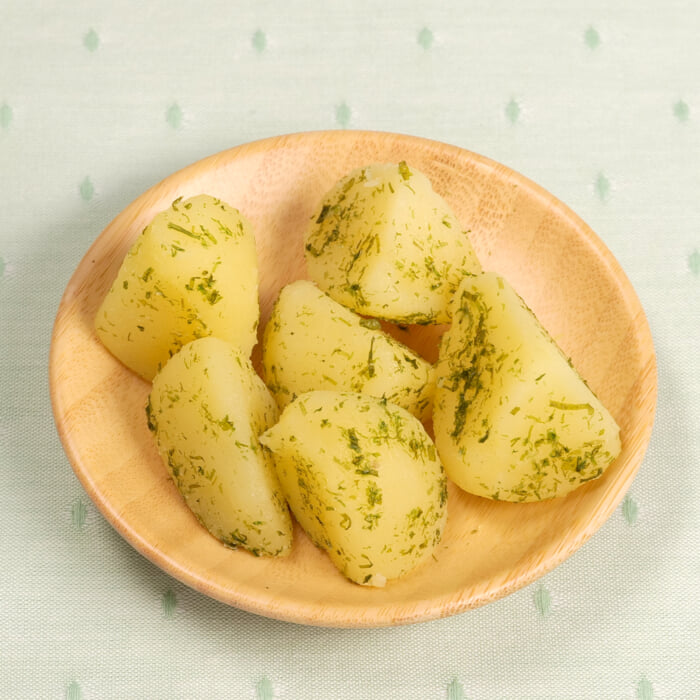
Ingredients
Amounts for 1 child (1 serving). An adult counts as 2 servings.
One serving here is 1.5× the portion served to a child in a Japanese preschool, sized for Western appetites. An adult counts as two servings. Tap an ingredient to check it off.
Ingredients
- 82.5 gpotato
Seasonings
- 0.1 gaonori (green seaweed flakes)Fine, fragrant flakes of dried green seaweed sprinkled over dishes like okonomiyaki and yakisoba. Substitute: Crumbled nori sheets, or omit.
- 0.3 gsalt
About the Japanese ingredients in this recipe
- aonori (green seaweed flakes) (あおのり)
- Fine, fragrant flakes of dried green seaweed sprinkled over dishes like okonomiyaki and yakisoba. Substitute: Crumbled nori sheets, or omit.
Directions
- 1
Cut the potatoes into bite-sized pieces, place them in a pot of cold water, bring to a boil, and boil for 10 minutes.
- 2
Drain off the water and return the potatoes to the pot. Set it back over the heat and shake the pot until the potatoes dry out and their surfaces turn fluffy and floury.
- 3
Add the salt and aonori and toss to coat.
Nutrition
| Per | 1 serving | 1 adult serving | Your total |
|---|---|---|---|
| Energy | 48 kcal | 96 kcal | 48 kcal |
| Protein | 1.5 g | 3 g | 1.5 g |
| Fat | 0.2 g | 0.3 g | 0.2 g |
| Carbohydrates | 14.3 g | 28.5 g | 14.3 g |
| Fiber | 7.4 g | 14.7 g | 7.4 g |
| Salt equivalent | 0.3 g | 0.6 g | 0.3 g |
| Calcium | 4.5 mg | 9 mg | 4.5 mg |
| Iron | 0.5 mg | 0.9 mg | 0.5 mg |
| Potassium | 342 mg | 684 mg | 342 mg |
| Energy | Protein | Fat | Carbs | Fiber | Salt equiv. | Calcium | Iron | Potassium | |
|---|---|---|---|---|---|---|---|---|---|
| 1 serving | 48 kcal | 1.5 g | 0.2 g | 14.3 g | 7.4 g | 0.3 g | 4.5 mg | 0.5 mg | 342 mg |
| 1 adult serving | 96 kcal | 3 g | 0.3 g | 28.5 g | 14.7 g | 0.6 g | 9 mg | 0.9 mg | 684 mg |
Values are per serving (1.5× the Japanese preschool portion); an adult serving is double. They were calculated by a licensed Japanese nutritionist using the Standard Tables of Food Composition in Japan. "Salt equivalent" is sodium × 2.54, the standard Japanese measure. Allergen flags cover egg, milk and wheat only and come from the nutritionist's records. Soy sauce and miso are made with wheat but are usually allowed on Japanese wheat-free school menus, so check with your doctor.