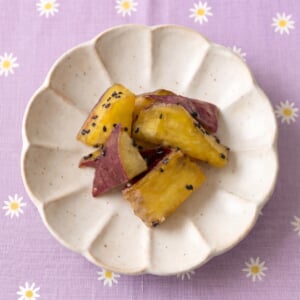
Imo Yokan (Sweet Potato Jelly)
芋ようかん · Imo Yokan
 By Aoi, licensed nutritionist · From a Japanese preschool lunch menu
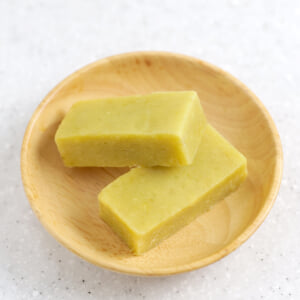
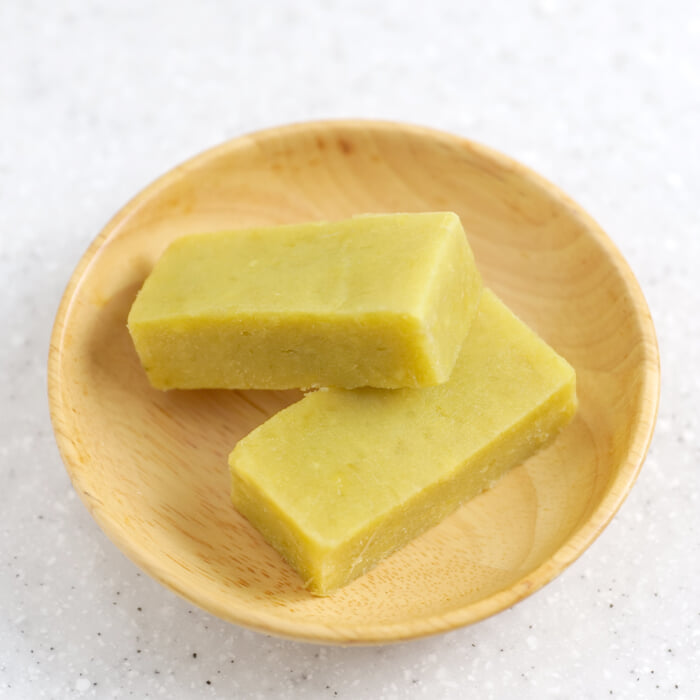
Imo yokan is a traditional Japanese confection in which mashed sweet potato is sweetened, set with kanten (agar) and cut into neat bars. Unlike classic yokan made from sweet bean paste, this version lets the natural flavor of satsumaimo, Japanese sweet potato, do most of the work, so only a little sugar and a pinch of salt are needed. Kids love its soft, smooth texture and gentle sweetness, and it's easy to hold in small hands. In preschool kitchens a spoonful of skim milk powder is kneaded in as well, which adds a mild milky richness and a little extra calcium to snack time.
Added. Open the recipe helper (bottom right) → ☰ Menu → 🛒 Shopping list to see the ingredients for your family size.
Printing uses the number of adults and children set under Ingredients, so set those first.
Ingredients
Amounts for 1 child (1 serving). An adult counts as 2 servings.
One serving here is 1.5× the portion served to a child in a Japanese preschool, sized for Western appetites. An adult counts as two servings. Tap an ingredient to check it off.
Ingredients
- 75 gJapanese sweet potato (satsumaimo)A purple-skinned, pale-yellow-fleshed sweet potato that is sweeter, drier, and fluffier than orange varieties. Substitute: Any sweet potato.
- 6.6 gskim milk powderMilk with the fat and water removed. Substitute: No skim milk powder? Leave it out and use milk in place of the water it is dissolved in, in the same amount (for example, 30 g skim milk powder + 130 g water becomes 130 g milk). Milk still contains milk, so this swap is not for a milk allergy.
- 0.3 gkanten powder (agar powder)A seaweed-based setting agent that gels firmly at room temperature and is plant-based. Substitute: Agar-agar powder; gelatin can be used but gives a softer, wobblier set.
Seasonings
- 10.5 gsugar
- 0.2 gsalt
- 22.5 gwater
About the Japanese ingredients in this recipe
- Japanese sweet potato (satsumaimo) (さつまいも)
- A purple-skinned, pale-yellow-fleshed sweet potato that is sweeter, drier, and fluffier than orange varieties. Substitute: Any sweet potato.
- skim milk powder (スキムミルク)
- Milk with the fat and water removed. Substitute: No skim milk powder? Leave it out and use milk in place of the water it is dissolved in, in the same amount (for example, 30 g skim milk powder + 130 g water becomes 130 g milk). Milk still contains milk, so this swap is not for a milk allergy.
- kanten powder (agar powder) (粉寒天)
- A seaweed-based setting agent that gels firmly at room temperature and is plant-based. Substitute: Agar-agar powder; gelatin can be used but gives a softer, wobblier set.
Directions
- 1
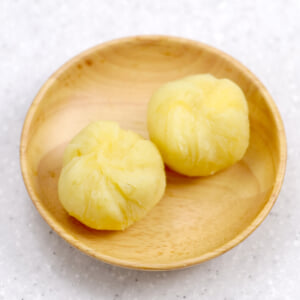
Peel the sweet potatoes, cut them into half-moon slices and boil until soft.
- 2
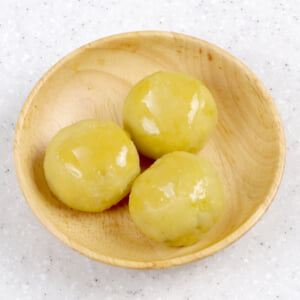
Drain in a colander, mash while still warm, then add the sugar, salt and skim milk powder and knead well until smooth.
- 3
Put the kanten powder and water in a pot and heat, stirring, until fully dissolved. Combine with the sweet potato mixture and knead well.
- 4
Pour into a mold or shallow tray lined with parchment paper, let cool to room temperature, then chill in the refrigerator. Once set, cut into pieces.
Nutrition
| Per | 1 serving | 1 adult serving | Your total |
|---|---|---|---|
| Energy | 160.5 kcal | 321 kcal | 160.5 kcal |
| Protein | 3 g | 6 g | 3 g |
| Fat | 0.5 g | 0.9 g | 0.5 g |
| Carbohydrates | 39.2 g | 78.3 g | 39.2 g |
| Fiber | 2.4 g | 4.8 g | 2.4 g |
| Salt equivalent | 0.5 g | 0.9 g | 0.5 g |
| Calcium | 102 mg | 204 mg | 102 mg |
| Iron | 0.5 mg | 0.9 mg | 0.5 mg |
| Potassium | 403.5 mg | 807 mg | 403.5 mg |
| Energy | Protein | Fat | Carbs | Fiber | Salt equiv. | Calcium | Iron | Potassium | |
|---|---|---|---|---|---|---|---|---|---|
| 1 serving | 160.5 kcal | 3 g | 0.5 g | 39.2 g | 2.4 g | 0.5 g | 102 mg | 0.5 mg | 403.5 mg |
| 1 adult serving | 321 kcal | 6 g | 0.9 g | 78.3 g | 4.8 g | 0.9 g | 204 mg | 0.9 mg | 807 mg |
Values are per serving (1.5× the Japanese preschool portion); an adult serving is double. They were calculated by a licensed Japanese nutritionist using the Standard Tables of Food Composition in Japan. "Salt equivalent" is sodium × 2.54, the standard Japanese measure. Allergen flags cover egg, milk and wheat only and come from the nutritionist's records. Soy sauce and miso are made with wheat but are usually allowed on Japanese wheat-free school menus, so check with your doctor.