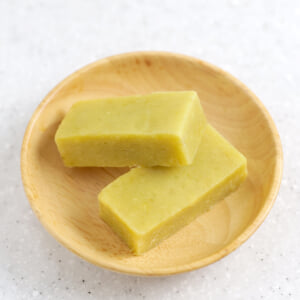
Milk Kanten (Japanese Milk Jelly)
牛乳かん · Gyunyu Kan
 By Aoi, licensed nutritionist · From a Japanese preschool lunch menu
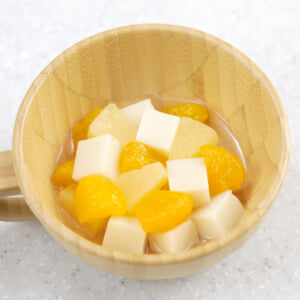
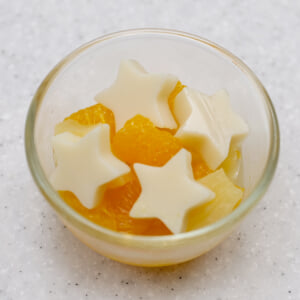
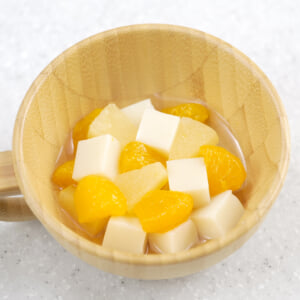
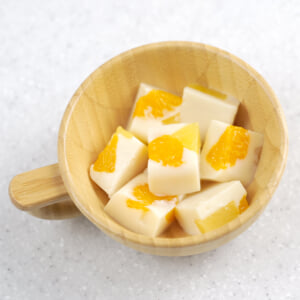
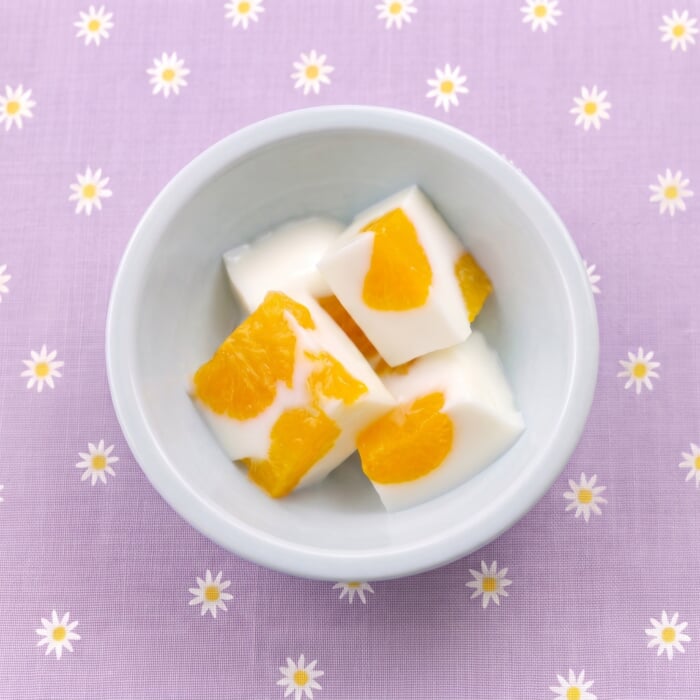
Gyunyu kan is a classic Japanese snack: milk, lightly sweetened, set with kanten (agar, a gelling agent made from seaweed) and studded with canned mandarin oranges. Unlike gelatin, kanten holds its shape at room temperature, so it sets firm enough to cut neatly into cubes while staying tender enough for small children to eat with a spoon. The mild, milky flavor and bright pops of fruit make it a snack-time favorite in preschool kitchens, and it comes together with just a pot and a microwave. It's made without egg or wheat.
Toddlers to adults. The whole family can eat this exactly as written.
Added. Open the recipe helper (bottom right) → ☰ Menu → 🛒 Shopping list to see the ingredients for your family size.
Printing uses the number of adults and children set under Ingredients, so set those first.
Ingredients
Amounts for 1 child (1 serving). An adult counts as 2 servings.
One serving here is 1.5× the portion served to a child in a Japanese preschool, sized for Western appetites. An adult counts as two servings. Tap an ingredient to check it off.
- 0.9 gkanten powder (agar powder)A seaweed-based setting agent that gels firmly at room temperature and is plant-based. Substitute: Agar-agar powder; gelatin can be used but gives a softer, wobblier set.
- 30 mlwater
- 9.9 gsugar
- 90 mlmilk
- 36 gcanned mandarin oranges
About the Japanese ingredients in this recipe
- kanten powder (agar powder) (粉寒天)
- A seaweed-based setting agent that gels firmly at room temperature and is plant-based. Substitute: Agar-agar powder; gelatin can be used but gives a softer, wobblier set.
Directions
Video is in Japanese — the steps below are synced to it, so tap ▶ on a step to jump to that moment.
- 1
Lightly wet a shallow tray or baking dish with water, drain the canned mandarin oranges and arrange them in the bottom. Set aside any that don't fit. (Wetting the tray first makes the jelly easier to lift out once it has set.)
- 2
Pour the milk into a heatproof container and microwave at 1200W for about 30 seconds to 1 minute (1 to 2 minutes at 600W), until it is warmed to about 40°C (104°F). (Adding cold milk makes the kanten more likely to form lumps. Dip in a finger and aim for "just slightly lukewarm"; if you heat it too much, the jelly takes longer to set.)
- 3
Put the water and kanten powder in a pot and place over the heat. Once it comes to a boil, keep stirring and cook for about 2 minutes. Turn off the heat, add the sugar and mix well, then add the warmed milk from step 2 and stir to combine. (Kanten will not set unless you keep it at a boil and dissolve it completely.)
- 4
Skim any foam off the surface and pour the mixture into the tray from step 1. Scatter the remaining mandarin oranges on top, let it cool to room temperature, then chill in the refrigerator for at least 1 hour until set. Cut into pieces that are easy to eat.
Tips for Success
- Warm the milk to about 40°C (104°F) before adding it to the kanten liquid so the kanten doesn't form lumps and everything blends smoothly. Skimming the foam off the surface gives a cleaner, prettier finish.
- When making this at home, pouring it into individual jelly cups is even easier. It also turns out nicely if you use soy milk in place of the milk.
Freezing and Storage
This does not freeze well. Keep it in the refrigerator and finish it by the next day.
Nutrition
| Per | 1 serving | 1 adult serving | Your total |
|---|---|---|---|
| Energy | 118.5 kcal | 237 kcal | 118.5 kcal |
| Protein | 3.2 g | 6.3 g | 3.2 g |
| Fat | 3.5 g | 6.9 g | 3.5 g |
| Carbohydrates | 20.5 g | 41.1 g | 20.5 g |
| Fiber | 0.9 g | 1.8 g | 0.9 g |
| Salt equivalent | 0.2 g | 0.3 g | 0.2 g |
| Calcium | 103.5 mg | 207 mg | 103.5 mg |
| Iron | 0.3 mg | 0.6 mg | 0.3 mg |
| Potassium | 163.5 mg | 327 mg | 163.5 mg |
| Phosphorus | 87 mg | 174 mg | 87 mg |
| Energy | Protein | Fat | Carbs | Fiber | Salt equiv. | Calcium | Iron | Potassium | Phosphorus | |
|---|---|---|---|---|---|---|---|---|---|---|
| 1 serving | 118.5 kcal | 3.2 g | 3.5 g | 20.5 g | 0.9 g | 0.2 g | 103.5 mg | 0.3 mg | 163.5 mg | 87 mg |
| 1 adult serving | 237 kcal | 6.3 g | 6.9 g | 41.1 g | 1.8 g | 0.3 g | 207 mg | 0.6 mg | 327 mg | 174 mg |
Values are per serving (1.5× the Japanese preschool portion); an adult serving is double. They were calculated by a licensed Japanese nutritionist using the Standard Tables of Food Composition in Japan. "Salt equivalent" is sodium × 2.54, the standard Japanese measure. Allergen flags cover egg, milk and wheat only and come from the nutritionist's records. Soy sauce and miso are made with wheat but are usually allowed on Japanese wheat-free school menus, so check with your doctor.
Cooking for bigger kids? See the elementary-school portion of this recipe.