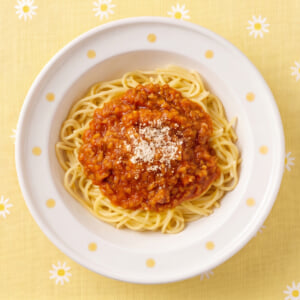
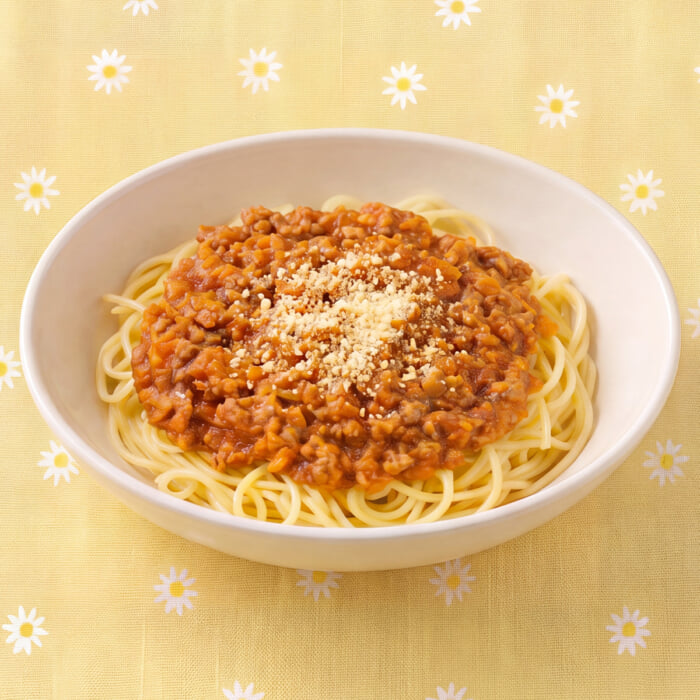
Hot Cook Meat Sauce Spaghetti (Elementary School Portion)
ミートソーススパゲティ(さっぱり味)【ホットクック】
 By Aoi, licensed nutritionist · From a Japanese elementary school lunch menu
Meat sauce spaghetti is a school lunch favorite in Japan, and this version is on the lighter, tangier side: canned tomatoes, ketchup and a little chuno sauce, with no heavy cream or cheese in the sauce itself. It is written for the Hot Cook, Sharp's automatic cooking pot that is popular in Japanese homes, so the machine does the stirring while you boil the pasta. Cooking the minced carrot and onion slowly first draws out their sweetness, and letting the finished sauce cool once before reheating lets the flavors settle, which is why children take to it so readily.
Added. Open the recipe helper (bottom right) → ☰ Menu → 🛒 Shopping list to see the ingredients for your family size.
Printing uses the number of adults and children set under Ingredients, so set those first.
Ingredients
Amounts for 1 child (1 serving). An adult counts as 2 servings.
One serving here is 1.5× the portion served to a child in a Japanese elementary school, sized for Western appetites. An adult counts as two servings. Tap an ingredient to check it off.
Ingredients
- 88.8 gspaghetti
- 55.5 gground beef and pork mixIn Japan a blend of ground beef and pork is sold pre-mixed; use roughly half and half. Substitute: All ground beef, or mix equal parts ground beef and ground pork.
- 55.5 gonion
- 33.3 gcarrot
- 33.3 gwater
- 49.9 gcanned diced tomatoes
Seasonings
- 0.3 ggarlic paste (tube)Grated garlic sold ready to use in a squeeze tube, a staple in Japanese kitchens. Japanese school lunch kitchens grate fresh garlic for its aroma, but for cooking at home Aoi says the tube works just fine. Tube pastes often contain added salt, oil and other ingredients, so check the label. Substitute: Use freshly grated garlic in the same amount. 1 teaspoon of paste is about 5 g.
- 1 gvegetable oil
- 15.5 gketchup
- 7.7 gchuno sauce (Japanese medium-thick brown sauce)A sweet, tangy, fruit-and-vegetable-based brown sauce that sits between thin Worcestershire and thick tonkatsu sauce. Substitute: Tonkatsu sauce, or Worcestershire sauce mixed with a little ketchup.
- 0.9 gsalt
- to tastepepper
About the Japanese ingredients in this recipe
- ground beef and pork mix (合い挽き肉)
- In Japan a blend of ground beef and pork is sold pre-mixed; use roughly half and half. Substitute: All ground beef, or mix equal parts ground beef and ground pork.
- garlic paste (tube) (にんにくチューブ)
- Grated garlic sold ready to use in a squeeze tube, a staple in Japanese kitchens. Japanese school lunch kitchens grate fresh garlic for its aroma, but for cooking at home Aoi says the tube works just fine. Tube pastes often contain added salt, oil and other ingredients, so check the label. Substitute: Use freshly grated garlic in the same amount. 1 teaspoon of paste is about 5 g.
- chuno sauce (Japanese medium-thick brown sauce) (中濃ソース)
- A sweet, tangy, fruit-and-vegetable-based brown sauce that sits between thin Worcestershire and thick tonkatsu sauce. Substitute: Tonkatsu sauce, or Worcestershire sauce mixed with a little ketchup.
Directions
- 1
Finely mince the carrot and onion.
- 2
Put the oil and the vegetables from step 1 into the inner pot and cook on [Manual → Stir-fry] for 10 minutes.
- 3
Add the ground beef and pork mix and the flour, then cook on [Manual → Stir-fry] for 10 minutes.
- 4
Add the canned diced tomatoes, ketchup, chuno sauce, salt, pepper, garlic paste and water, then cook on [Manual → Simmer → Stir] for 5 minutes.
- 5
Open the lid and cook on [Manual → Reduce] for 5 minutes. (Cooking off the sharpness of the ketchup at the end gives you a sweeter meat sauce!)
- 6
Let the sauce cool so the flavors settle. (The flavors meld as it cools, so we recommend letting it cool completely and then reheating it to serve.)
- 7
While the sauce cools, boil the spaghetti in a pot. Toss it with a little oil (not included in the ingredient amounts) so it does not stick together.
- 8
Serve the spaghetti in bowls and top with the meat sauce from step 6. (Sprinkle with grated cheese if you like.)
Cooking the vegetables slowly and thoroughly gives you a sweet, rich meat sauce. Letting it cool once lets the flavors settle.
Nutrition
| Per | 1 serving | 1 adult serving | Your total |
|---|---|---|---|
| Energy | 527.3 kcal | 1054.5 kcal | 527.3 kcal |
| Protein | 22.5 g | 45 g | 22.5 g |
| Fat | 14.7 g | 29.4 g | 14.7 g |
| Carbohydrates | 81.9 g | 163.8 g | 81.9 g |
| Fiber | 7.5 g | 15 g | 7.5 g |
| Salt equivalent | 2 g | 3.9 g | 2 g |
| Calcium | 48.8 mg | 97.5 mg | 48.8 mg |
| Iron | 3.3 mg | 6.6 mg | 3.3 mg |
| Potassium | 702.6 mg | 1405.2 mg | 702.6 mg |
| Energy | Protein | Fat | Carbs | Fiber | Salt equiv. | Calcium | Iron | Potassium | |
|---|---|---|---|---|---|---|---|---|---|
| 1 serving | 527.3 kcal | 22.5 g | 14.7 g | 81.9 g | 7.5 g | 2 g | 48.8 mg | 3.3 mg | 702.6 mg |
| 1 adult serving | 1054.5 kcal | 45 g | 29.4 g | 163.8 g | 15 g | 3.9 g | 97.5 mg | 6.6 mg | 1405.2 mg |
Values are per serving (1.5× the Japanese elementary-school portion); an adult serving is double. They were calculated by a licensed Japanese nutritionist using the Standard Tables of Food Composition in Japan. "Salt equivalent" is sodium × 2.54, the standard Japanese measure. Allergen flags cover egg, milk and wheat only and come from the nutritionist's records. Soy sauce and miso are made with wheat but are usually allowed on Japanese wheat-free school menus, so check with your doctor.