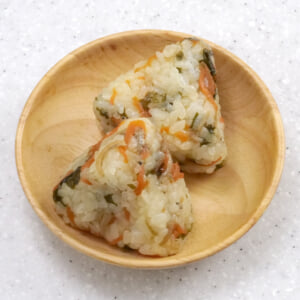
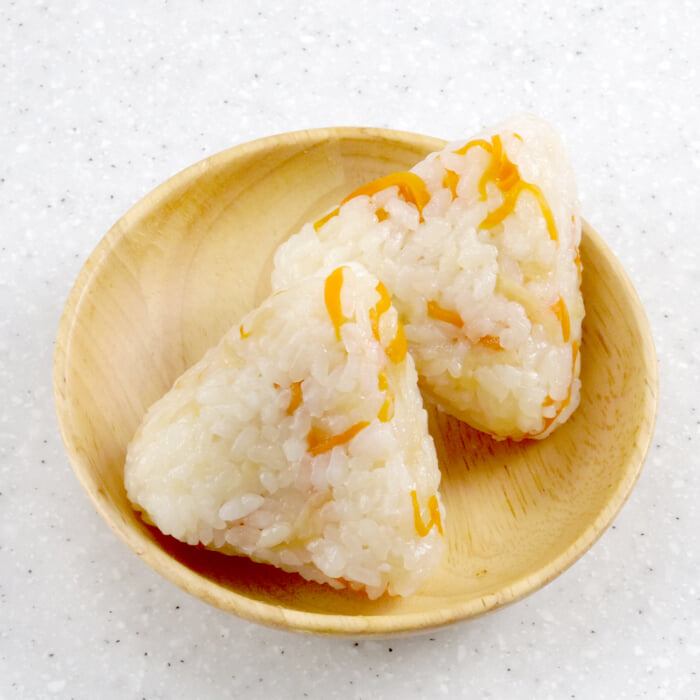
Harihari Onigiri (Kiriboshi Daikon Rice Balls)
ハリハリおにぎり · Harihari Onigiri
 By Aoi, licensed nutritionist · From a Japanese preschool lunch menu
Harihari is the Japanese word for a pleasantly crunchy bite, and it describes exactly what kiriboshi daikon (dried shredded daikon) brings to these rice balls. The daikon is rehydrated, simmered with carrot in a lightly sweetened dashi and soy sauce broth, then folded into hot rice and shaped into onigiri. Kids love the gentle sweetness and the fun chewy texture, and since the seasoning is mixed right through the rice, even little ones who are wary of vegetables tend to eat them without a second thought. It is an easy way to get a nutritious dried vegetable onto the lunch table in a form small hands can hold.
Wheat-free, but uses soy sauce (made with wheat). Japanese school-lunch allergy menus usually allow it, so check with your doctor. How to read the labels
Added. Open the recipe helper (bottom right) → ☰ Menu → 🛒 Shopping list to see the ingredients for your family size.
Printing uses the number of adults and children set under Ingredients, so set those first.
Ingredients
Amounts for 1 child (1 serving). An adult counts as 2 servings.
One serving here is 1.5× the portion served to a child in a Japanese preschool, sized for Western appetites. An adult counts as two servings. Tap an ingredient to check it off.
Ingredients
- 60 griceJapanese short-grain white rice (japonica), which cooks up soft and slightly sticky. The amount listed is for uncooked rice. Substitute: Sushi rice, or another short-grain or medium-grain rice such as Calrose.
- 2.6 gkiriboshi daikon (dried shredded daikon)Sun-dried strips of daikon radish with a concentrated sweetness and chewy texture, soaked before cooking. Substitute: Fresh daikon or carrot cut into matchsticks.
- 6 gcarrot
Seasonings
- 30 gdashi stockJapanese soup stock, usually made from kombu (dried kelp) and/or bonito flakes; the base of most Japanese soups and simmered dishes. Substitute: Instant dashi granules dissolved in water, or a mild unsalted chicken or vegetable stock.
- 3.6 gsoy sauce
- 1.2 gsakeSake (Japanese rice wine) is used in small amounts to soften the smell of fish and meat and add depth. Japanese "cooking sake" often contains added salt. Some alcohol can remain after short cooking. If you prefer no alcohol for children, use the substitute. Substitute: The same amount of water (the taste will be a little simpler), or dry white wine.
- 0.4 gsugar
About the Japanese ingredients in this recipe
- rice (米)
- Japanese short-grain white rice (japonica), which cooks up soft and slightly sticky. The amount listed is for uncooked rice. Substitute: Sushi rice, or another short-grain or medium-grain rice such as Calrose.
- kiriboshi daikon (dried shredded daikon) (切干しだいこん)
- Sun-dried strips of daikon radish with a concentrated sweetness and chewy texture, soaked before cooking. Substitute: Fresh daikon or carrot cut into matchsticks.
- dashi stock (だし汁)
- Japanese soup stock, usually made from kombu (dried kelp) and/or bonito flakes; the base of most Japanese soups and simmered dishes. Substitute: Instant dashi granules dissolved in water, or a mild unsalted chicken or vegetable stock.
- sake (酒)
- Sake (Japanese rice wine) is used in small amounts to soften the smell of fish and meat and add depth. Japanese "cooking sake" often contains added salt. Some alcohol can remain after short cooking. If you prefer no alcohol for children, use the substitute. Substitute: The same amount of water (the taste will be a little simpler), or dry white wine.
Directions
- 1
Soak the kiriboshi daikon in water to rehydrate it, then cut it into 3 cm lengths. Cut the carrot into short matchsticks.
- 2
Put the dashi stock, soy sauce, sake, sugar, and the daikon and carrot from step 1 in a pot and simmer until the vegetables are soft.
- 3
Mix the simmered vegetables from step 2 into the cooked rice. Shape into onigiri (rice balls).
Nutrition
| Per | 1 serving | 1 adult serving | Your total |
|---|---|---|---|
| Energy | 220.5 kcal | 441 kcal | 220.5 kcal |
| Protein | 4.4 g | 8.7 g | 4.4 g |
| Fat | 0.6 g | 1.2 g | 0.6 g |
| Carbohydrates | 49.7 g | 99.3 g | 49.7 g |
| Fiber | 1 g | 2.1 g | 1 g |
| Salt equivalent | 0.5 g | 0.9 g | 0.5 g |
| Calcium | 21 mg | 42 mg | 21 mg |
| Iron | 0.6 mg | 1.2 mg | 0.6 mg |
| Potassium | 195 mg | 390 mg | 195 mg |
| Energy | Protein | Fat | Carbs | Fiber | Salt equiv. | Calcium | Iron | Potassium | |
|---|---|---|---|---|---|---|---|---|---|
| 1 serving | 220.5 kcal | 4.4 g | 0.6 g | 49.7 g | 1 g | 0.5 g | 21 mg | 0.6 mg | 195 mg |
| 1 adult serving | 441 kcal | 8.7 g | 1.2 g | 99.3 g | 2.1 g | 0.9 g | 42 mg | 1.2 mg | 390 mg |
Values are per serving (1.5× the Japanese preschool portion); an adult serving is double. They were calculated by a licensed Japanese nutritionist using the Standard Tables of Food Composition in Japan. "Salt equivalent" is sodium × 2.54, the standard Japanese measure. Allergen flags cover egg, milk and wheat only and come from the nutritionist's records. Soy sauce and miso are made with wheat but are usually allowed on Japanese wheat-free school menus, so check with your doctor.
Ingredients in this recipe
You might also like
All recipes →
Veggie-Packed Butadon (Pork Rice Bowl)
Wakame Rice (Soy Sauce Flavor)
Yakiniku Don (Japanese Grilled Pork Rice Bowl)
Koya-dofu Ankake Don (Freeze-Dried Tofu Rice Bowl)
Mazekomi Inari (Inari-Style Mixed Sushi Rice)