Datemaki (Sweet Rolled Omelet)
伊達巻き · Datemaki
 By Aoi, licensed nutritionist · From a Japanese preschool lunch menu
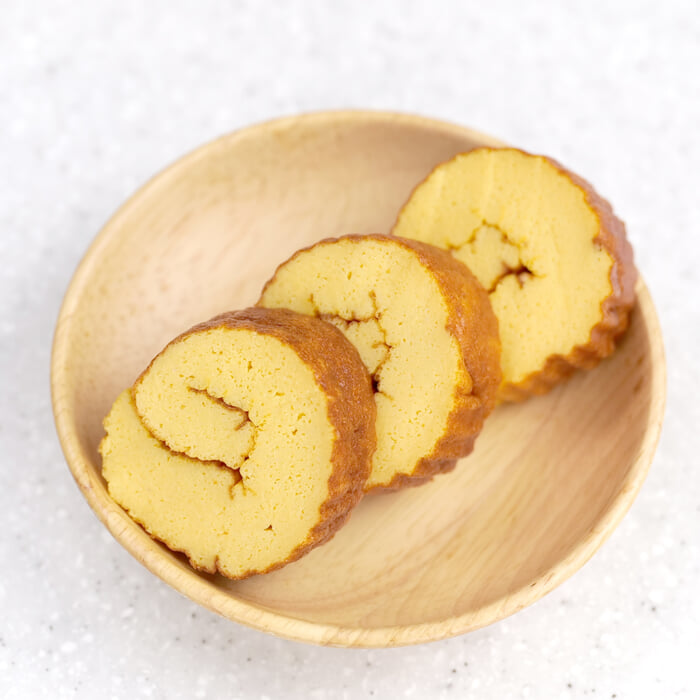
Datemaki is the golden, gently sweet rolled omelet that sits in almost every osechi box at Japanese New Year. Its scroll-like shape is traditionally said to stand for learning and culture, which makes it a lovely dish to share with children as the year begins. The secret to its soft, springy, almost cake-like texture is hanpen, a fluffy white fish cake that is blended right into the eggs. Everything comes together in a food processor and bakes in a toaster oven, so it is far simpler than it looks, and the mild sweetness is exactly what little ones love.
Added. Open the recipe helper (bottom right) → ☰ Menu → 🛒 Shopping list to see the ingredients for your family size.
Printing uses the number of adults and children set under Ingredients, so set those first.
Ingredients
Amounts for 1 child (1 serving). An adult counts as 2 servings.
One serving here is 1.5× the portion served to a child in a Japanese preschool, sized for Western appetites. An adult counts as two servings. Tap an ingredient to check it off.
Ingredients
- 75 gegg
- 45 ghanpen (soft fish cake)A white, spongy steamed fish cake made from ground white fish and grated yam. Substitute: Kamaboko or another mild fish cake, or leave it out.
Seasonings
- 2 gsoy sauce
- 4.5 gmirinMirin is a sweet Japanese rice seasoning that adds gentle sweetness and a glossy finish. Hon-mirin (true mirin) contains about 14% alcohol; "mirin-style seasoning" has little or no alcohol. Some alcohol can remain after short cooking. If you prefer no alcohol for children, use the substitute. Substitute: For each tablespoon of mirin, use 1 tablespoon water plus 1 to 2 teaspoons sugar.
- 2.3 gsugar
About the Japanese ingredients in this recipe
- hanpen (soft fish cake) (はんぺん)
- A white, spongy steamed fish cake made from ground white fish and grated yam. Substitute: Kamaboko or another mild fish cake, or leave it out.
- mirin (みりん)
- Mirin is a sweet Japanese rice seasoning that adds gentle sweetness and a glossy finish. Hon-mirin (true mirin) contains about 14% alcohol; "mirin-style seasoning" has little or no alcohol. Some alcohol can remain after short cooking. If you prefer no alcohol for children, use the substitute. Substitute: For each tablespoon of mirin, use 1 tablespoon water plus 1 to 2 teaspoons sugar.
Directions
- 1
Crack the eggs into a food processor, tear the hanpen into about 8 pieces and add it too. Add the seasonings and blend until smooth.
- 2
Line a small baking sheet or a flat heatproof dish (about 22 x 15 cm inside) with parchment paper.
- 3
Pour in the egg mixture and bake in a toaster oven at 240°C (465°F) for 13 minutes, then at 280°C (535°F) for about 2 minutes more, until the top is nicely browned.
- 4
While it is still hot, lay it on a bamboo sushi mat with the browned side facing down and roll it up tightly, starting from the edge nearest you. Secure both ends with rubber bands and let it cool with the seam side down.
- 5
Cut into 2 cm thick slices.
Toaster ovens vary in temperature and baking time from model to model, so keep an eye on how it is coloring as it bakes!
Nutrition
| Per | 1 serving | 1 adult serving | Your total |
|---|---|---|---|
| Energy | 168 kcal | 336 kcal | 168 kcal |
| Protein | 13.8 g | 27.6 g | 13.8 g |
| Fat | 8.1 g | 16.2 g | 8.1 g |
| Carbohydrates | 11 g | 21.9 g | 11 g |
| Salt equivalent | 1.4 g | 2.7 g | 1.4 g |
| Calcium | 42 mg | 84 mg | 42 mg |
| Iron | 1.4 mg | 2.7 mg | 1.4 mg |
| Energy | Protein | Fat | Carbs | Salt equiv. | Calcium | Iron | |
|---|---|---|---|---|---|---|---|
| 1 serving | 168 kcal | 13.8 g | 8.1 g | 11 g | 1.4 g | 42 mg | 1.4 mg |
| 1 adult serving | 336 kcal | 27.6 g | 16.2 g | 21.9 g | 2.7 g | 84 mg | 2.7 mg |
Values are per serving (1.5× the Japanese preschool portion); an adult serving is double. They were calculated by a licensed Japanese nutritionist using the Standard Tables of Food Composition in Japan. "Salt equivalent" is sodium × 2.54, the standard Japanese measure. Allergen flags cover egg, milk and wheat only and come from the nutritionist's records. Soy sauce and miso are made with wheat but are usually allowed on Japanese wheat-free school menus, so check with your doctor.