Carbonara
カルボナーラ
 By Aoi, licensed nutritionist · From a Japanese preschool lunch menu
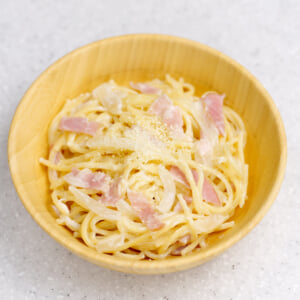
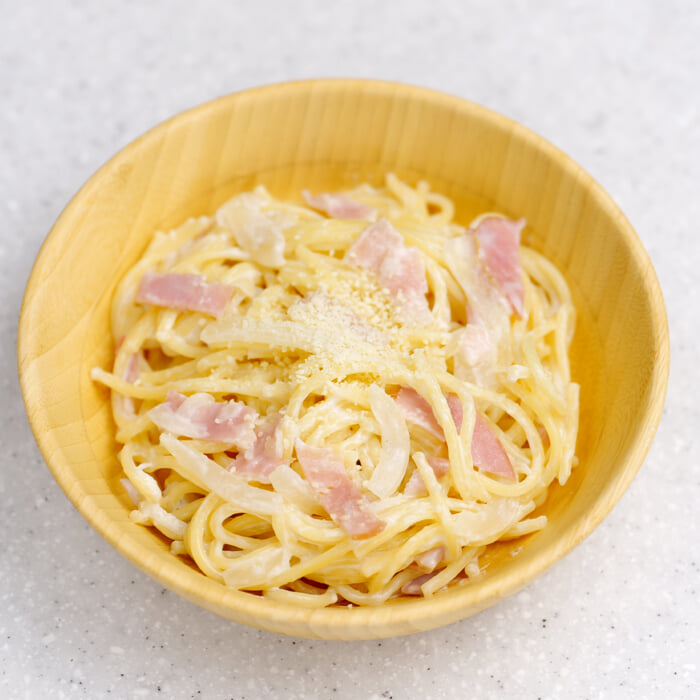
Carbonara is a regular on Japanese school lunch menus, and this is the version I make in the preschool kitchen. Instead of a rich egg-and-cheese emulsion, the sauce here is a mild white sauce thickened with flour and milk, with bacon for savoriness and onion that has been slowly steam-simmered until it turns sweet and melting. The spaghetti is broken into thirds before boiling so little ones can manage it with a fork or spoon, and a sprinkle of Parmesan at the end gives just enough cheesy flavor to keep the kids coming back for more.
Added. Open the recipe helper (bottom right) → ☰ Menu → 🛒 Shopping list to see the ingredients for your family size.
Printing uses the number of adults and children set under Ingredients, so set those first.
Ingredients
Amounts for 1 child (1 serving). An adult counts as 2 servings.
One serving here is 1.5× the portion served to a child in a Japanese preschool, sized for Western appetites. An adult counts as two servings. Tap an ingredient to check it off.
Ingredients
- 67.5 gspaghetti
- 22.5 gbacon
- 37.5 gonion
- 3 gflour
Seasonings
- 1.5 gvegetable oil
- 1.5 gunsalted butter
- 30 gwater
- 112.5 gmilk
- 0.6 gconsommé bouillon (granules or cube)Japanese-style Western soup stock powder or cubes, similar to chicken or vegetable bouillon. Substitute: Chicken or vegetable bouillon granules or a bouillon cube.
- 0.2 gsalt
- to tastepepper
- 3 ggrated Parmesan cheese
About the Japanese ingredients in this recipe
- consommé bouillon (granules or cube) (コンソメ)
- Japanese-style Western soup stock powder or cubes, similar to chicken or vegetable bouillon. Substitute: Chicken or vegetable bouillon granules or a bouillon cube.
Directions
- 1
Cut the onion in half and slice it thinly (so the slices are half the usual length). Cut the bacon into 1 cm strips. Break the spaghetti into thirds and boil it for the time stated on the package.
- 2
Heat the oil and butter in a frying pan, add the onion, and sauté over low heat for about 3 minutes. Add just enough water to cover the onion (extra, not included in the ingredient amounts), cover with a lid, and steam-simmer over low heat for about 10 minutes until the onion is soft.
- 3
If any liquid remains, cook it off completely, then add the bacon and sauté.
- 4
Add the flour and stir it in. Once no floury patches remain, add the milk and consommé and bring to a boil.
- 5
Add the spaghetti, salt, and pepper, and stir over low heat until the sauce coats the pasta and everything comes together. The sauce firms up easily as it cools, so finish with a little liquid still remaining.
- 6
Plate and sprinkle with the grated Parmesan cheese.
Nutrition
| Per | 1 serving | 1 adult serving | Your total |
|---|---|---|---|
| Energy | 453 kcal | 906 kcal | 453 kcal |
| Protein | 17.4 g | 34.8 g | 17.4 g |
| Fat | 17.9 g | 35.7 g | 17.9 g |
| Carbohydrates | 61.4 g | 122.7 g | 61.4 g |
| Salt equivalent | 0.9 g | 1.8 g | 0.9 g |
| Calcium | 183 mg | 366 mg | 183 mg |
| Iron | 1 mg | 2.1 mg | 1 mg |
| Energy | Protein | Fat | Carbs | Salt equiv. | Calcium | Iron | |
|---|---|---|---|---|---|---|---|
| 1 serving | 453 kcal | 17.4 g | 17.9 g | 61.4 g | 0.9 g | 183 mg | 1 mg |
| 1 adult serving | 906 kcal | 34.8 g | 35.7 g | 122.7 g | 1.8 g | 366 mg | 2.1 mg |
Values are per serving (1.5× the Japanese preschool portion); an adult serving is double. They were calculated by a licensed Japanese nutritionist using the Standard Tables of Food Composition in Japan. "Salt equivalent" is sodium × 2.54, the standard Japanese measure. Allergen flags cover egg, milk and wheat only and come from the nutritionist's records. Soy sauce and miso are made with wheat but are usually allowed on Japanese wheat-free school menus, so check with your doctor.