Teriyaki Chicken (Elementary School Portion)
【小学校】照り焼きチキン · Teriyaki Chikin
 By Aoi, licensed nutritionist · From a Japanese elementary school lunch menu
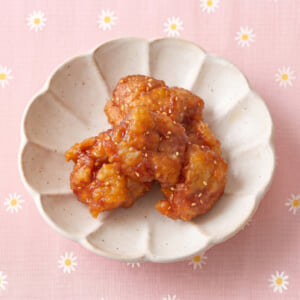
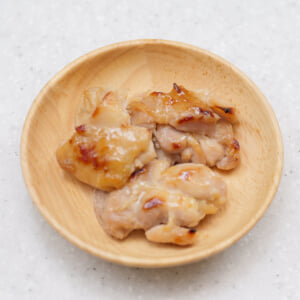
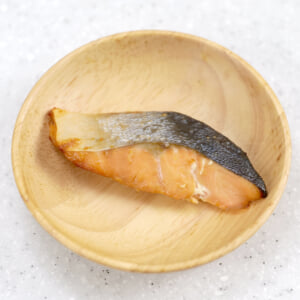
Teriyaki chicken is one of the most reliable crowd-pleasers on a Japanese school lunch menu. Bite-sized pieces of chicken thigh soak up a sweet-savory marinade of sake, sugar, mirin and soy sauce, then go into the oven so the sauce clings to the meat and turns glossy. Baking on a tray instead of pan-frying is how we cook it for large numbers in the school kitchen, and it makes things wonderfully hands-off at home too. Cutting the chicken into small pieces also lets the flavor soak in quickly and makes it easy for children to eat.
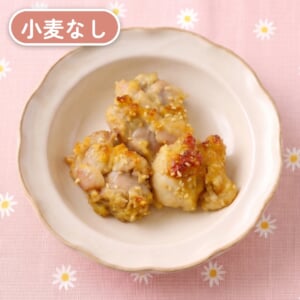
Wheat-free, but uses soy sauce (made with wheat). Japanese school-lunch allergy menus usually allow it, so check with your doctor. How to read the labels
Added. Open the recipe helper (bottom right) → ☰ Menu → 🛒 Shopping list to see the ingredients for your family size.
Printing uses the number of adults and children set under Ingredients, so set those first.
Ingredients
Amounts for 1 child (1 serving). An adult counts as 2 servings.
One serving here is 1.5× the portion served to a child in a Japanese elementary school, sized for Western appetites. An adult counts as two servings. Tap an ingredient to check it off.
Ingredients
- 77.7 gchicken thigh
Seasonings
- 1.5 gsakeSake (Japanese rice wine) is used in small amounts to soften the smell of fish and meat and add depth. Japanese "cooking sake" often contains added salt. Some alcohol can remain after short cooking. If you prefer no alcohol for children, use the substitute. Substitute: The same amount of water (the taste will be a little simpler), or dry white wine.
- 2.8 gsugar
- 1.5 gmirinMirin is a sweet Japanese rice seasoning that adds gentle sweetness and a glossy finish. Hon-mirin (true mirin) contains about 14% alcohol; "mirin-style seasoning" has little or no alcohol. Some alcohol can remain after short cooking. If you prefer no alcohol for children, use the substitute. Substitute: For each tablespoon of mirin, use 1 tablespoon water plus 1 to 2 teaspoons sugar.
- 4.4 gsoy sauce
About the Japanese ingredients in this recipe
- sake (酒)
- Sake (Japanese rice wine) is used in small amounts to soften the smell of fish and meat and add depth. Japanese "cooking sake" often contains added salt. Some alcohol can remain after short cooking. If you prefer no alcohol for children, use the substitute. Substitute: The same amount of water (the taste will be a little simpler), or dry white wine.
- mirin (みりん)
- Mirin is a sweet Japanese rice seasoning that adds gentle sweetness and a glossy finish. Hon-mirin (true mirin) contains about 14% alcohol; "mirin-style seasoning" has little or no alcohol. Some alcohol can remain after short cooking. If you prefer no alcohol for children, use the substitute. Substitute: For each tablespoon of mirin, use 1 tablespoon water plus 1 to 2 teaspoons sugar.
Directions
- 1
Cut the chicken into bite-sized pieces.
- 2
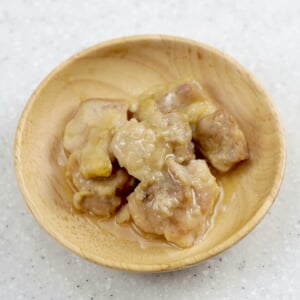
Combine the sauce ingredients, add the chicken from step 1 and rub the marinade into the meat. Cover with plastic wrap and let it rest in the refrigerator for 20 minutes so the flavor soaks in.
- 3
Arrange the chicken on a baking sheet and bake in an oven preheated to 200°C (400°F) for about 15 minutes.
Nutrition
| Per | 1 serving | 1 adult serving | Your total |
|---|---|---|---|
| Energy | 167.6 kcal | 335.1 kcal | 167.6 kcal |
| Protein | 13.2 g | 26.4 g | 13.2 g |
| Fat | 11 g | 21.9 g | 11 g |
| Carbohydrates | 4.1 g | 8.1 g | 4.1 g |
| Fiber | 0 g | 0 g | 0 g |
| Salt equivalent | 0.8 g | 1.5 g | 0.8 g |
| Calcium | 5.6 mg | 11.1 mg | 5.6 mg |
| Iron | 0.5 mg | 0.9 mg | 0.5 mg |
| Potassium | 243 mg | 486 mg | 243 mg |
| Energy | Protein | Fat | Carbs | Fiber | Salt equiv. | Calcium | Iron | Potassium | |
|---|---|---|---|---|---|---|---|---|---|
| 1 serving | 167.6 kcal | 13.2 g | 11 g | 4.1 g | 0 g | 0.8 g | 5.6 mg | 0.5 mg | 243 mg |
| 1 adult serving | 335.1 kcal | 26.4 g | 21.9 g | 8.1 g | 0 g | 1.5 g | 11.1 mg | 0.9 mg | 486 mg |
Values are per serving (1.5× the Japanese elementary-school portion); an adult serving is double. They were calculated by a licensed Japanese nutritionist using the Standard Tables of Food Composition in Japan. "Salt equivalent" is sodium × 2.54, the standard Japanese measure. Allergen flags cover egg, milk and wheat only and come from the nutritionist's records. Soy sauce and miso are made with wheat but are usually allowed on Japanese wheat-free school menus, so check with your doctor.