Sumashijiru (Clear Soup) with Wakame and Carrot
すまし汁(わかめ・にんじん) · Sumashijiru
 By Aoi, licensed nutritionist · From a Japanese preschool lunch menu
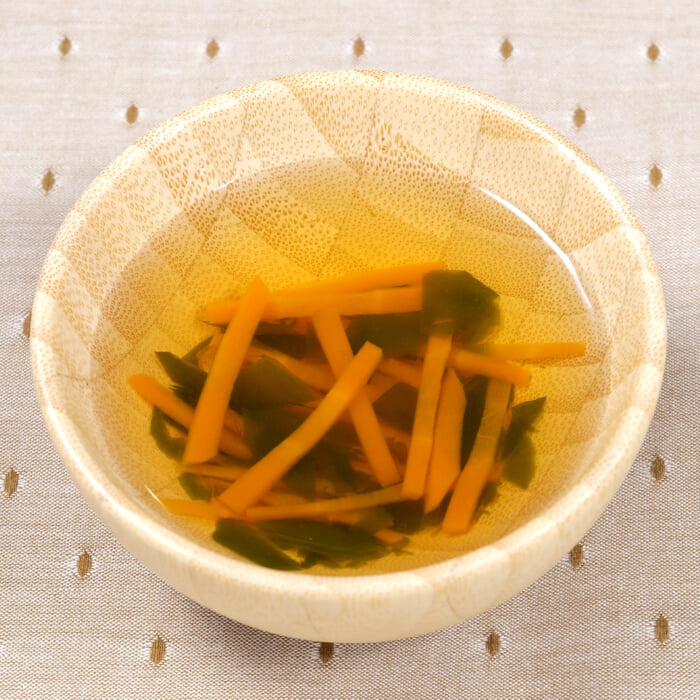
Sumashijiru is a clear Japanese soup built on dashi and seasoned with just a touch of soy sauce and salt, so the broth stays light and the flavor of the stock shines through. Here it is filled with tender wakame seaweed and thin slivers of carrot, which soften quickly and are easy for little ones to manage with a spoon. It is one of the everyday soups served alongside rice in preschool kitchens, and its mildness makes it a gentle companion to almost any main dish.
Added. Open the recipe helper (bottom right) → ☰ Menu → 🛒 Shopping list to see the ingredients for your family size.
Printing uses the number of adults and children set under Ingredients, so set those first.
Ingredients
Amounts for 1 child (1 serving). An adult counts as 2 servings.
One serving here is 1.5× the portion served to a child in a Japanese preschool, sized for Western appetites. An adult counts as two servings. Tap an ingredient to check it off.
Ingredients
- 15 gcarrot
- 0.5 gdried cut wakameSmall pieces of dried wakame seaweed that rehydrate in a few minutes and are used in soups and salads. Substitute: Any dried seaweed for soup, or omit.
Seasonings
- 150 gbonito and kombu dashiJapanese soup stock made from dried bonito flakes and kombu kelp, the everyday base for soups and simmered dishes. Substitute: Instant dashi granules dissolved in water, or a light vegetable or chicken stock.
- 0.8 gsoy sauce
- 0.2 gsalt
About the Japanese ingredients in this recipe
- dried cut wakame (カットわかめ)
- Small pieces of dried wakame seaweed that rehydrate in a few minutes and are used in soups and salads. Substitute: Any dried seaweed for soup, or omit.
- bonito and kombu dashi (かつお・昆布だし汁)
- Japanese soup stock made from dried bonito flakes and kombu kelp, the everyday base for soups and simmered dishes. Substitute: Instant dashi granules dissolved in water, or a light vegetable or chicken stock.
Directions
- 1
Cut the carrot into short, thin matchsticks. Soak the dried wakame in water to rehydrate it, then chop it finely.
- 2
Put the dashi and carrot in a pot and bring to a boil. Add the wakame and simmer until everything is soft.
- 3
Add the soy sauce and salt and simmer briefly.
Nutrition
| Per | 1 serving | 1 adult serving | Your total |
|---|---|---|---|
| Energy | 10.5 kcal | 21 kcal | 10.5 kcal |
| Protein | 0.8 g | 1.5 g | 0.8 g |
| Fat | 0 g | 0 g | 0 g |
| Carbohydrates | 1.8 g | 3.6 g | 1.8 g |
| Salt equivalent | 0.6 g | 1.2 g | 0.6 g |
| Calcium | 12 mg | 24 mg | 12 mg |
| Iron | 0 mg | 0 mg | 0 mg |
| Energy | Protein | Fat | Carbs | Salt equiv. | Calcium | Iron | |
|---|---|---|---|---|---|---|---|
| 1 serving | 10.5 kcal | 0.8 g | 0 g | 1.8 g | 0.6 g | 12 mg | 0 mg |
| 1 adult serving | 21 kcal | 1.5 g | 0 g | 3.6 g | 1.2 g | 24 mg | 0 mg |
Values are per serving (1.5× the Japanese preschool portion); an adult serving is double. They were calculated by a licensed Japanese nutritionist using the Standard Tables of Food Composition in Japan. "Salt equivalent" is sodium × 2.54, the standard Japanese measure. Allergen flags cover egg, milk and wheat only and come from the nutritionist's records. Soy sauce and miso are made with wheat but are usually allowed on Japanese wheat-free school menus, so check with your doctor.