Spring Rolls (Elementary School Portion)
春巻き · Harumaki
 By Aoi, licensed nutritionist · From a Japanese elementary school lunch menu
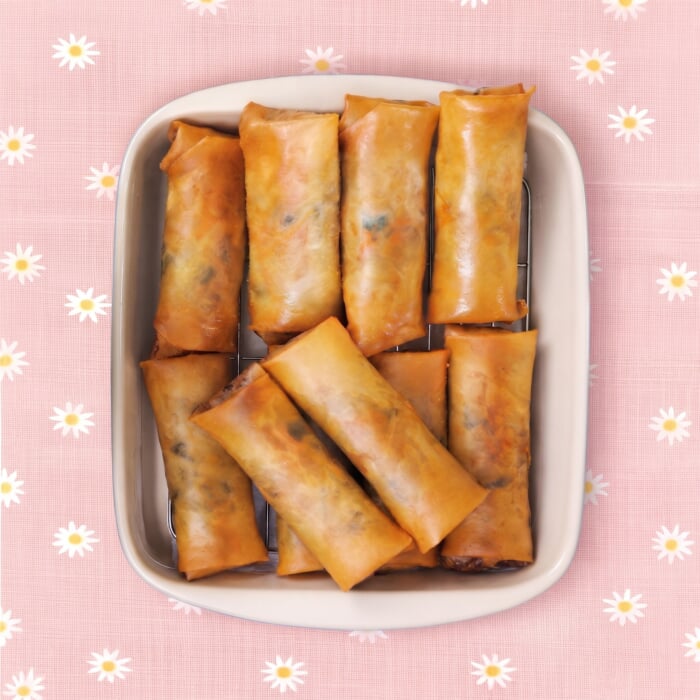
Harumaki, the Japanese take on spring rolls, are a familiar favorite on school lunch menus, and the shatteringly crisp wrapper is what wins children over. Inside is a gently seasoned filling of pork, carrot, bamboo shoots, shiitake and garlic chives, bulked out with glass noodles and bound with a lightly thickened soy and oyster sauce so nothing leaks out while they fry. The filling is cooled before rolling and the rolls are wrapped tightly, which is the secret to a wrapper that stays intact and fries up golden. This version is made without egg or milk.
Toddlers to adults. The whole family can eat this exactly as written.
Added. Open the recipe helper (bottom right) → ☰ Menu → 🛒 Shopping list to see the ingredients for your family size.
Printing uses the number of adults and children set under Ingredients, so set those first.
Ingredients
Amounts for 1 child (1 serving). An adult counts as 2 servings.
One serving here is 1.5× the portion served to a child in a Japanese elementary school, sized for Western appetites. An adult counts as two servings. Tap an ingredient to check it off.
Ingredients
- 9 gcarrot
- 15 gboiled bamboo shootsPre-cooked bamboo shoots sold vacuum-packed in water at Japanese groceries, ready to slice and use. Substitute: Canned bamboo shoots, drained and rinsed, work.
- 4.5 gshiitake mushrooms
- 7.5 ggarlic chives (nira)Flat-leaved chives with a mild garlic flavor, sold in bunches at Asian markets. Substitute: Scallion greens with a little minced garlic.
- 30 gthinly sliced pork (komagire)Small, thin offcuts of pork sold in Japan for quick stir-fries and simmered dishes. Substitute: Thinly sliced pork shoulder or loin cut into bite-size pieces.
- 3 gvegetable oil
- 5.4 gglass noodles (short-cut)Dried glass noodles pre-cut into short lengths so they can go straight into soups and salads without cutting. Substitute: Regular glass noodles snipped into short lengths with kitchen scissors work.
- 15 mlwater
- 0.6 gpotato starchJapanese katakuriko, a fine potato starch used for thickening sauces and coating food before frying. Substitute: Cornstarch: start with the same amount and add a little more if it is still thin. It thickens a little less than potato starch and needs a couple of minutes at a gentle bubble to reach full thickness.
- 3 mlwater (for the potato starch)
- 1.5 slice(s)spring roll wrappers
- 0.9 gflour
- 1.5 mlwater (for the flour)
- to tasteoil for deep-frying
Sauce Mixture (A)
- 1.5 gsugar
- 2.3 gsoy sauce
- 0.9 goyster sauce
About the Japanese ingredients in this recipe
- boiled bamboo shoots (ゆでたけのこ)
- Pre-cooked bamboo shoots sold vacuum-packed in water at Japanese groceries, ready to slice and use. Substitute: Canned bamboo shoots, drained and rinsed, work.
- garlic chives (nira) (にら)
- Flat-leaved chives with a mild garlic flavor, sold in bunches at Asian markets. Substitute: Scallion greens with a little minced garlic.
- thinly sliced pork (komagire) (豚こま切れ肉)
- Small, thin offcuts of pork sold in Japan for quick stir-fries and simmered dishes. Substitute: Thinly sliced pork shoulder or loin cut into bite-size pieces.
- glass noodles (short-cut) (春雨(ショートタイプ))
- Dried glass noodles pre-cut into short lengths so they can go straight into soups and salads without cutting. Substitute: Regular glass noodles snipped into short lengths with kitchen scissors work.
- potato starch (片栗粉)
- Japanese katakuriko, a fine potato starch used for thickening sauces and coating food before frying. Substitute: Cornstarch: start with the same amount and add a little more if it is still thin. It thickens a little less than potato starch and needs a couple of minutes at a gentle bubble to reach full thickness. Read the guide: Katakuriko (Japanese Potato Starch) and What to Use Instead → Guide: japanese-school-lunch.com/articles/katakuriko-potato-starch/
Directions
Video is in Japanese — the steps below are synced to it, so tap ▶ on a step to jump to that moment.
- 1
Cut the carrot, bamboo shoots and shiitake into thin matchsticks, the garlic chives into 2 cm lengths, and the pork into 1 cm wide strips.
- 2
Heat the vegetable oil in a frying pan and stir-fry the vegetables and pork from step 1 over medium heat. Once the pork is cooked through, push the filling to the edge of the pan, add the glass noodles and water to the center, and simmer over low heat for about 4 minutes. When the noodles are soft, add (A) and stir-fry briefly to combine.
- 3
Turn off the heat and stir in the potato starch dissolved in water, then return to low heat and stir quickly until thickened. Set aside to cool. (You want almost no loose sauce left, just enough to hold the filling together. Cooling it thoroughly is what makes the rolls fry up crisp.)
- 4
Lay a spring roll wrapper rough side up, turned so it sits like a diamond, and spoon a thin strip of the filling from step 3 across the third nearest you. Fold the near corner over the filling and roll it up tightly, fold the left and right corners in toward the center, then roll to the end and seal the edge with the flour dissolved in water. (Keeping the smooth side on the outside gives a neater finish, and rolling tightly makes the wrapper less likely to tear when fried.)
- 5
Slide the rolls into oil heated to 170°C (340°F). After about 2 minutes, start gently turning them over now and then, and fry for about 5 minutes in total until golden brown. (Touching them right after they go in can tear the wrappers, so wait a little before turning.)
Tips for Best Results
・Dried shiitake give an even better aroma than fresh, so swap them in if you like. Either works.
・If you only have long glass noodles, soak them briefly in lukewarm water and cut them into 3 cm lengths before using; this helps the filling hold together.
How to Freeze
Fry the rolls, let them cool, then pack single portions into freezer bags and freeze. Reheat in the microwave when ready to eat.
Keeps for: about 2 weeks (best eaten as soon as possible).
Nutrition
| Per | 1 serving | 1 adult serving | Your total |
|---|---|---|---|
| Energy | 291 kcal | 582 kcal | 291 kcal |
| Protein | 9.1 g | 18.3 g | 9.1 g |
| Fat | 18.5 g | 36.9 g | 18.5 g |
| Carbohydrates | 24 g | 48 g | 24 g |
| Fiber | 2.3 g | 4.5 g | 2.3 g |
| Salt equivalent | 0.8 g | 1.5 g | 0.8 g |
| Calcium | 16.5 mg | 33 mg | 16.5 mg |
| Iron | 0.5 mg | 0.9 mg | 0.5 mg |
| Potassium | 288 mg | 576 mg | 288 mg |
| Phosphorus | 99 mg | 198 mg | 99 mg |
| Energy | Protein | Fat | Carbs | Fiber | Salt equiv. | Calcium | Iron | Potassium | Phosphorus | |
|---|---|---|---|---|---|---|---|---|---|---|
| 1 serving | 291 kcal | 9.1 g | 18.5 g | 24 g | 2.3 g | 0.8 g | 16.5 mg | 0.5 mg | 288 mg | 99 mg |
| 1 adult serving | 582 kcal | 18.3 g | 36.9 g | 48 g | 4.5 g | 1.5 g | 33 mg | 0.9 mg | 576 mg | 198 mg |
Values are per serving (1.5× the Japanese elementary-school portion); an adult serving is double. They were calculated by a licensed Japanese nutritionist using the Standard Tables of Food Composition in Japan. "Salt equivalent" is sodium × 2.54, the standard Japanese measure. Allergen flags cover egg, milk and wheat only and come from the nutritionist's records. Soy sauce and miso are made with wheat but are usually allowed on Japanese wheat-free school menus, so check with your doctor.