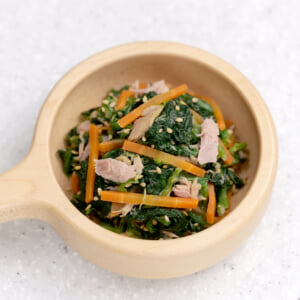
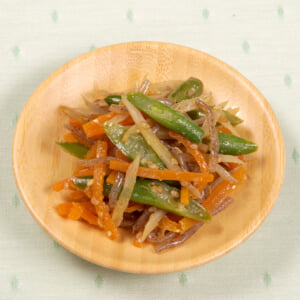
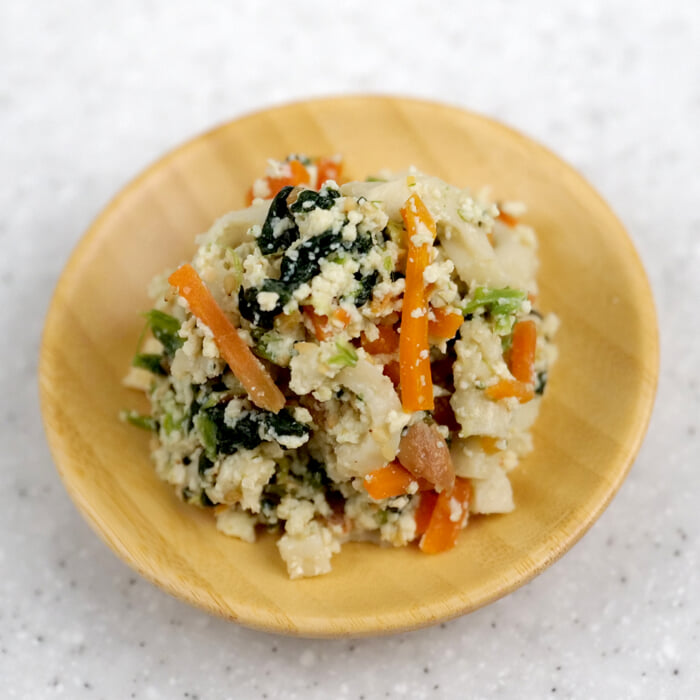
Spinach Shiraae (Tofu and Sesame Salad)
ほうれん草の白和え · Horenso no Shiraae
 By Aoi, licensed nutritionist · From a Japanese preschool lunch menu
Shiraae (literally "white dressing") is a traditional Japanese side dish in which vegetables are tossed with a smooth dressing of mashed tofu, ground sesame and a little miso and sugar. The creamy, mildly sweet tofu coats the spinach and takes the edge off its slightly bitter taste, which is why even children who usually pass on leafy greens tend to eat it happily. Cutting the spinach short and slicing the carrot fine keeps every bite soft and easy for small mouths. The key to a dressing that isn't watery is draining the tofu thoroughly, so take your time with that first step.
Wheat-free, but uses soy sauce and miso (made with wheat). Japanese school-lunch allergy menus usually allow them, so check with your doctor. How to read the labels
Added. Open the recipe helper (bottom right) → ☰ Menu → 🛒 Shopping list to see the ingredients for your family size.
Printing uses the number of adults and children set under Ingredients, so set those first.
Ingredients
Amounts for 1 child (1 serving). An adult counts as 2 servings.
One serving here is 1.5× the portion served to a child in a Japanese preschool, sized for Western appetites. An adult counts as two servings. Tap an ingredient to check it off.
Ingredients
- 45 gfirm tofu
- 18 gspinach
- 15 gcarrot
- 15 gchikuwa (grilled fish cake tube)A mild, slightly chewy tube-shaped fish cake made from white fish paste grilled around a stick. Substitute: Imitation crab sticks or other mild fish cake (kamaboko); check the label, as fish cakes often contain egg white and wheat.
Seasonings
- 48 gdashi stockJapanese soup stock, usually made from kombu (dried kelp) and/or bonito flakes; the base of most Japanese soups and simmered dishes. Substitute: Instant dashi granules dissolved in water, or a mild unsalted chicken or vegetable stock.
- 0.3 gsugar
- 0.6 gsoy sauce
- 2.7 gwhite sesame seeds
- 2.1 gmisoFermented soybean paste. Salty and savory, it is Japan's everyday seasoning for miso soup and many simmered dishes. Substitute: Any light (white or awase) miso. Misos differ in saltiness, so start with a little less and taste. Some misos are made with barley or wheat, so check the label if you avoid them.
- 2.1 gsugar
About the Japanese ingredients in this recipe
- chikuwa (grilled fish cake tube) (焼き竹輪)
- A mild, slightly chewy tube-shaped fish cake made from white fish paste grilled around a stick. Substitute: Imitation crab sticks or other mild fish cake (kamaboko); check the label, as fish cakes often contain egg white and wheat.
- dashi stock (だし汁)
- Japanese soup stock, usually made from kombu (dried kelp) and/or bonito flakes; the base of most Japanese soups and simmered dishes. Substitute: Instant dashi granules dissolved in water, or a mild unsalted chicken or vegetable stock.
- miso (みそ)
- Fermented soybean paste. Salty and savory, it is Japan's everyday seasoning for miso soup and many simmered dishes. Substitute: Any light (white or awase) miso. Misos differ in saltiness, so start with a little less and taste. Some misos are made with barley or wheat, so check the label if you avoid them.
Directions
- 1
Boil the tofu, then tip it into a fine-mesh sieve and mash it right in the sieve to drain off the water thoroughly (stir it, let it sit a little, and repeat until no more water comes out).
- 2
Cut the spinach into 2 cm pieces, boil it, then rinse under running water to cool. Cut the carrot into short, thin matchsticks and slice the chikuwa into half-moons.
- 3
Put the dashi stock and carrot in a pot and simmer. Add the sugar, soy sauce and chikuwa and continue simmering until the dashi has cooked away.
- 4
Toast the white sesame seeds and grind them (ready-ground sesame can be used instead).
- 5
Squeeze the spinach to remove excess water, then combine all the ingredients with the miso and sugar.
Nutrition
| Per | 1 serving | 1 adult serving | Your total |
|---|---|---|---|
| Energy | 90 kcal | 180 kcal | 90 kcal |
| Protein | 6.8 g | 13.5 g | 6.8 g |
| Fat | 3.9 g | 7.8 g | 3.9 g |
| Carbohydrates | 8.1 g | 16.2 g | 8.1 g |
| Fiber | 1.8 g | 3.6 g | 1.8 g |
| Salt equivalent | 0.9 g | 1.8 g | 0.9 g |
| Calcium | 99 mg | 198 mg | 99 mg |
| Iron | 1.5 mg | 3 mg | 1.5 mg |
| Potassium | 279 mg | 558 mg | 279 mg |
| Energy | Protein | Fat | Carbs | Fiber | Salt equiv. | Calcium | Iron | Potassium | |
|---|---|---|---|---|---|---|---|---|---|
| 1 serving | 90 kcal | 6.8 g | 3.9 g | 8.1 g | 1.8 g | 0.9 g | 99 mg | 1.5 mg | 279 mg |
| 1 adult serving | 180 kcal | 13.5 g | 7.8 g | 16.2 g | 3.6 g | 1.8 g | 198 mg | 3 mg | 558 mg |
Values are per serving (1.5× the Japanese preschool portion); an adult serving is double. They were calculated by a licensed Japanese nutritionist using the Standard Tables of Food Composition in Japan. "Salt equivalent" is sodium × 2.54, the standard Japanese measure. Allergen flags cover egg, milk and wheat only and come from the nutritionist's records. Soy sauce and miso are made with wheat but are usually allowed on Japanese wheat-free school menus, so check with your doctor.