Snack-Time Yaki Udon (Stir-Fried Udon)
おやつ焼きうどん · Oyatsu Yaki Udon
 By Aoi, licensed nutritionist · From a Japanese preschool lunch menu
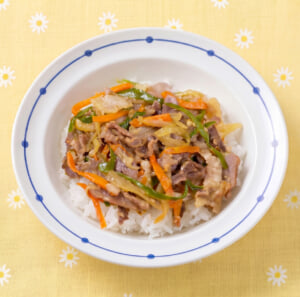
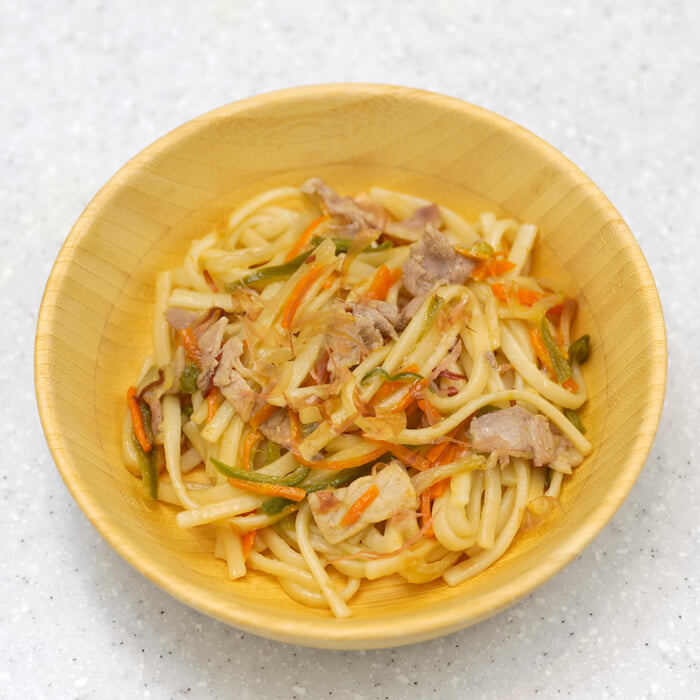
In Japanese preschools, the afternoon snack (oyatsu) is not always something sweet - a small savory dish like this stir-fried udon is just as common, and it keeps little ones going until dinner. Yaki udon is a simple pan-fried noodle dish: chewy udon tossed with pork, carrot, green bell pepper and onion, then seasoned gently with dashi and soy sauce and finished with a handful of bonito flakes. Breaking the dried noodles into thirds before boiling makes them short enough for small children to pick up with a fork or chopsticks, and rinsing them after cooking washes away the salt in the noodles so the seasoning stays mild.
Added. Open the recipe helper (bottom right) → ☰ Menu → 🛒 Shopping list to see the ingredients for your family size.
Printing uses the number of adults and children set under Ingredients, so set those first.
Ingredients
Amounts for 1 child (1 serving). An adult counts as 2 servings.
One serving here is 1.5× the portion served to a child in a Japanese preschool, sized for Western appetites. An adult counts as two servings. Tap an ingredient to check it off.
Ingredients
- 30 gdried udon noodles
- 22.5 gthinly sliced pork (komagire)Small, thin offcuts of pork sold in Japan for quick stir-fries and simmered dishes. Substitute: Thinly sliced pork shoulder or loin cut into bite-size pieces.
- 9 gcarrot
- 9 ggreen bell pepper
- 15 gonion
Seasonings
- 3 gsesame oil
- 30 gdashi stockJapanese soup stock, usually made from kombu (dried kelp) and/or bonito flakes; the base of most Japanese soups and simmered dishes. Substitute: Instant dashi granules dissolved in water, or a mild unsalted chicken or vegetable stock.
- 0.4 gsalt
- 1.5 gsoy sauce
- 0.5 gkatsuobushi (dried bonito flakes)Paper-thin shavings of dried, smoked skipjack tuna that add a savory, smoky depth as a topping or stock base. Substitute: A pinch of dashi powder, or omit.
About the Japanese ingredients in this recipe
- thinly sliced pork (komagire) (豚こま切れ肉)
- Small, thin offcuts of pork sold in Japan for quick stir-fries and simmered dishes. Substitute: Thinly sliced pork shoulder or loin cut into bite-size pieces.
- dashi stock (だし汁)
- Japanese soup stock, usually made from kombu (dried kelp) and/or bonito flakes; the base of most Japanese soups and simmered dishes. Substitute: Instant dashi granules dissolved in water, or a mild unsalted chicken or vegetable stock.
- katsuobushi (dried bonito flakes) (かつお削り節)
- Paper-thin shavings of dried, smoked skipjack tuna that add a savory, smoky depth as a topping or stock base. Substitute: A pinch of dashi powder, or omit.
Directions
- 1
Break the dried udon into thirds and boil. Rinse under running water to wash off the salt.
- 2
Cut the pork into 1 to 2 cm wide pieces. Cut the carrot and green bell pepper into thin 4 cm long strips. Cut the onion in half crosswise, then slice it lengthwise into 5 mm thick slices.
- 3
Heat the sesame oil in a frying pan over medium heat, add the carrot, green bell pepper and onion, and stir-fry for about 5 minutes. Add the pork, turn the heat down to low and stir-fry for about 1 minute.
- 4
Add the udon and dashi stock and stir-fry over low heat for about 3 minutes, loosening the noodles as you go.
- 5
Add the salt and soy sauce and stir-fry over low heat for about 1 minute. Turn off the heat, add the katsuobushi and mix it through.
Nutrition
| Per | 1 serving | 1 adult serving | Your total |
|---|---|---|---|
| Energy | 178.5 kcal | 357 kcal | 178.5 kcal |
| Protein | 8.3 g | 16.5 g | 8.3 g |
| Fat | 5.6 g | 11.1 g | 5.6 g |
| Carbohydrates | 24.5 g | 48.9 g | 24.5 g |
| Fiber | 1.5 g | 3 g | 1.5 g |
| Salt equivalent | 1.8 g | 3.6 g | 1.8 g |
| Calcium | 15 mg | 30 mg | 15 mg |
| Iron | 0.3 mg | 0.6 mg | 0.3 mg |
| Potassium | 214.5 mg | 429 mg | 214.5 mg |
| Energy | Protein | Fat | Carbs | Fiber | Salt equiv. | Calcium | Iron | Potassium | |
|---|---|---|---|---|---|---|---|---|---|
| 1 serving | 178.5 kcal | 8.3 g | 5.6 g | 24.5 g | 1.5 g | 1.8 g | 15 mg | 0.3 mg | 214.5 mg |
| 1 adult serving | 357 kcal | 16.5 g | 11.1 g | 48.9 g | 3 g | 3.6 g | 30 mg | 0.6 mg | 429 mg |
Values are per serving (1.5× the Japanese preschool portion); an adult serving is double. They were calculated by a licensed Japanese nutritionist using the Standard Tables of Food Composition in Japan. "Salt equivalent" is sodium × 2.54, the standard Japanese measure. Allergen flags cover egg, milk and wheat only and come from the nutritionist's records. Soy sauce and miso are made with wheat but are usually allowed on Japanese wheat-free school menus, so check with your doctor.