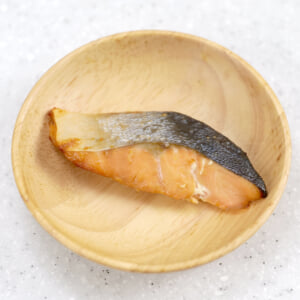
Sawara Saikyo-yaki (Miso-Glazed Spanish Mackerel)
サワラの西京焼き · Sawara no Saikyo-yaki
 By Aoi, licensed nutritionist · From a Japanese preschool lunch menu
Saikyo-yaki is a classic Japanese way of cooking fish: the fillet is coated in sweet white miso and gently cooked until the glaze turns golden. The style takes its name from Saikyo miso, the mild, sweet white miso of Kyoto, and its gentle sweetness makes it a natural fit for young children. Sawara (Spanish mackerel) is a soft, delicate fish - its kanji even contains the character for spring, when it is at its best - and it soaks up the miso glaze beautifully. In the preschool kitchen we cook the fish straight from frozen, so there is no thawing to plan ahead for; both an oven method and a frying-pan method are given below.
Added. Open the recipe helper (bottom right) → ☰ Menu → 🛒 Shopping list to see the ingredients for your family size.
Printing uses the number of adults and children set under Ingredients, so set those first.
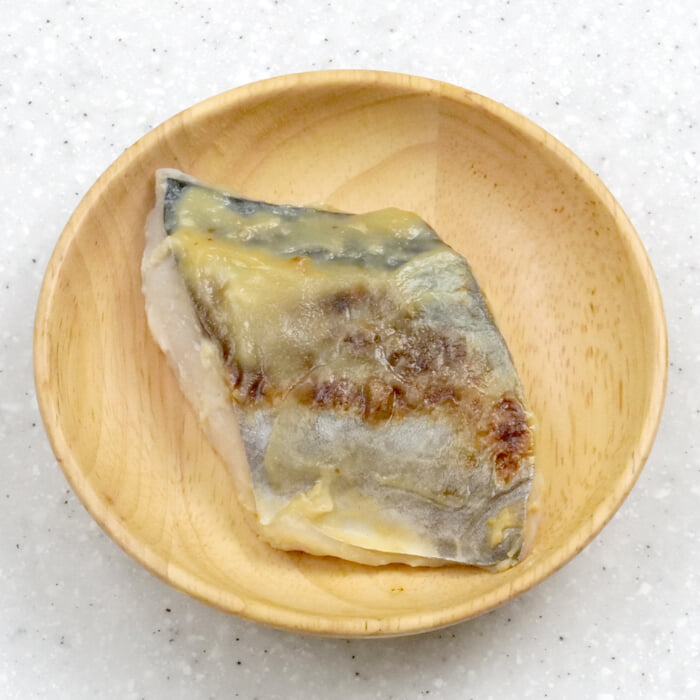
Ingredients
Amounts for 1 child (1 serving). An adult counts as 2 servings.
One serving here is 1.5× the portion served to a child in a Japanese preschool, sized for Western appetites. An adult counts as two servings. Tap an ingredient to check it off.
Ingredients
- 67.5 gfrozen Spanish mackerel (sawara)A mild, tender fish popular in Japan, milder than regular mackerel. Substitute: Mackerel, kingfish, or a mild firm white fish such as cod.
Seasonings
- 0.6 gsakeSake (Japanese rice wine) is used in small amounts to soften the smell of fish and meat and add depth. Japanese "cooking sake" often contains added salt. Some alcohol can remain after short cooking. If you prefer no alcohol for children, use the substitute. Substitute: The same amount of water (the taste will be a little simpler), or dry white wine.
- 0.8 gmirinMirin is a sweet Japanese rice seasoning that adds gentle sweetness and a glossy finish. Hon-mirin (true mirin) contains about 14% alcohol; "mirin-style seasoning" has little or no alcohol. Some alcohol can remain after short cooking. If you prefer no alcohol for children, use the substitute. Substitute: For each tablespoon of mirin, use 1 tablespoon water plus 1 to 2 teaspoons sugar.
- 7.5 gwhite misoA sweet, mild, pale miso with a low salt content. Substitute: Any light or mild miso with a small pinch of sugar.
- 0.3 gsugar
- 0.6 gvegetable oil
About the Japanese ingredients in this recipe
- frozen Spanish mackerel (sawara) (冷凍サワラ)
- A mild, tender fish popular in Japan, milder than regular mackerel. Substitute: Mackerel, kingfish, or a mild firm white fish such as cod.
- sake (酒)
- Sake (Japanese rice wine) is used in small amounts to soften the smell of fish and meat and add depth. Japanese "cooking sake" often contains added salt. Some alcohol can remain after short cooking. If you prefer no alcohol for children, use the substitute. Substitute: The same amount of water (the taste will be a little simpler), or dry white wine.
- mirin (みりん)
- Mirin is a sweet Japanese rice seasoning that adds gentle sweetness and a glossy finish. Hon-mirin (true mirin) contains about 14% alcohol; "mirin-style seasoning" has little or no alcohol. Some alcohol can remain after short cooking. If you prefer no alcohol for children, use the substitute. Substitute: For each tablespoon of mirin, use 1 tablespoon water plus 1 to 2 teaspoons sugar.
- white miso (白みそ)
- A sweet, mild, pale miso with a low salt content. Substitute: Any light or mild miso with a small pinch of sugar.
Directions
- 1
Put the sake and mirin in a microwave-safe bowl, cover loosely with plastic wrap leaving a gap for steam, and microwave at 1200W for about 20 seconds (40 seconds at 600W) to cook off the alcohol. Add the white miso, sugar and vegetable oil and mix well. - 2
Preheat the oven to 240°C (475°F).
- 3
Place the Spanish mackerel, still frozen, in a shallow dish or bowl, add 2/3 of the miso mixture and turn to coat.
- 4
Arrange the fish on a baking sheet lined with parchment paper.
- 5
Place a tray of hot water on the lower rack of the oven and bake the fish at 240°C (475°F) for 10 minutes. Take it out, brush on the remaining glaze, and bake at 240°C (475°F) for another 5 minutes.
- 6
Place the Spanish mackerel, still frozen, in a shallow dish or bowl, add 1/3 of the miso mixture and turn to coat. - 7
Line a frying pan with cooking foil made for frying pans (non-stick foil), arrange the fish on it and cover with a lid.
- 8
Turn on the heat and cook over low heat for 6 minutes, then flip, cover again and cook over low heat for 4 minutes (the glaze burns easily, so keep an eye on it). Once the fish is nicely browned, remove the lid and brush the remaining glaze over both sides. Turn the fish skin-side up, turn off the heat, cover and let it steam for 3 minutes.
Oven method
Note: If using fresh (not frozen) fish, set the oven to 200°C (400°F) and follow the same steps otherwise.
Nutrition
| Per | 1 serving | 1 adult serving | Your total |
|---|---|---|---|
| Energy | 132 kcal | 264 kcal | 132 kcal |
| Protein | 14.3 g | 28.5 g | 14.3 g |
| Fat | 7.5 g | 15 g | 7.5 g |
| Carbohydrates | 2.4 g | 4.8 g | 2.4 g |
| Salt equivalent | 0.6 g | 1.2 g | 0.6 g |
| Calcium | 15 mg | 30 mg | 15 mg |
| Iron | 0.9 mg | 1.8 mg | 0.9 mg |
| Energy | Protein | Fat | Carbs | Salt equiv. | Calcium | Iron | |
|---|---|---|---|---|---|---|---|
| 1 serving | 132 kcal | 14.3 g | 7.5 g | 2.4 g | 0.6 g | 15 mg | 0.9 mg |
| 1 adult serving | 264 kcal | 28.5 g | 15 g | 4.8 g | 1.2 g | 30 mg | 1.8 mg |
Values are per serving (1.5× the Japanese preschool portion); an adult serving is double. They were calculated by a licensed Japanese nutritionist using the Standard Tables of Food Composition in Japan. "Salt equivalent" is sodium × 2.54, the standard Japanese measure. Allergen flags cover egg, milk and wheat only and come from the nutritionist's records. Soy sauce and miso are made with wheat but are usually allowed on Japanese wheat-free school menus, so check with your doctor.
Cooking for bigger kids? See the elementary-school portion of this recipe.