Sautéed Green Beans and Carrot
いんげんと人参のソテー
 By Aoi, licensed nutritionist · From a Japanese preschool lunch menu
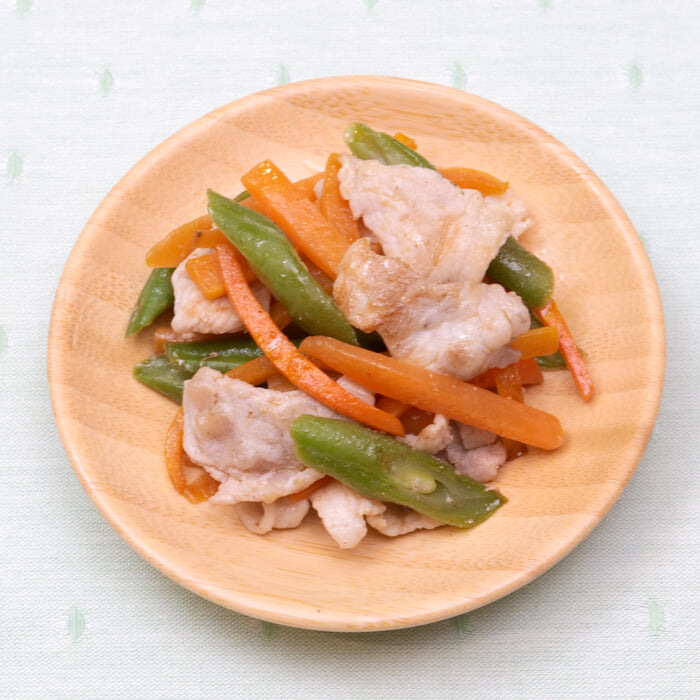
This is one of those quiet, dependable side dishes that shows up often on Japanese preschool lunch trays. Green beans are boiled first so they turn tender, then tossed in a pan with sweet carrot matchsticks and a little pork, seasoned with nothing more than salt and pepper. Cutting everything thin and short means small children can chew it easily and scoop it up with a spoon, and the bit of pork gives the vegetables a savory flavor that makes kids reach for seconds.
Added. Open the recipe helper (bottom right) → ☰ Menu → 🛒 Shopping list to see the ingredients for your family size.
Printing uses the number of adults and children set under Ingredients, so set those first.
Ingredients
Amounts for 1 child (1 serving). An adult counts as 2 servings.
One serving here is 1.5× the portion served to a child in a Japanese preschool, sized for Western appetites. An adult counts as two servings. Tap an ingredient to check it off.
Ingredients
- 10.5 ggreen beans
- 24 gcarrot
- 22.5 gthinly sliced pork (komagire)Small, thin offcuts of pork sold in Japan for quick stir-fries and simmered dishes. Substitute: Thinly sliced pork shoulder or loin cut into bite-size pieces.
Seasonings
- 1.8 gvegetable oil
- 0.2 gsalt
- to tastepepper
About the Japanese ingredients in this recipe
- thinly sliced pork (komagire) (豚こま切れ肉)
- Small, thin offcuts of pork sold in Japan for quick stir-fries and simmered dishes. Substitute: Thinly sliced pork shoulder or loin cut into bite-size pieces.
Directions
- 1
Slice the green beans thinly on the diagonal and boil them.
- 2
Cut the carrot into short, thin matchsticks. Cut the pork into 1 cm-wide strips.
- 3
Heat the oil in a frying pan and sauté the carrot. Add the green beans from step 1 and the pork, and continue to sauté.
- 4
Once everything is tender, season with salt and pepper.
Nutrition
| Per | 1 serving | 1 adult serving | Your total |
|---|---|---|---|
| Energy | 67.5 kcal | 135 kcal | 67.5 kcal |
| Protein | 4.9 g | 9.9 g | 4.9 g |
| Fat | 4.1 g | 8.1 g | 4.1 g |
| Carbohydrates | 2.8 g | 5.7 g | 2.8 g |
| Fiber | 0.9 g | 1.8 g | 0.9 g |
| Salt equivalent | 0.2 g | 0.3 g | 0.2 g |
| Calcium | 13.5 mg | 27 mg | 13.5 mg |
| Iron | 0.2 mg | 0.3 mg | 0.2 mg |
| Potassium | 178.5 mg | 357 mg | 178.5 mg |
| Energy | Protein | Fat | Carbs | Fiber | Salt equiv. | Calcium | Iron | Potassium | |
|---|---|---|---|---|---|---|---|---|---|
| 1 serving | 67.5 kcal | 4.9 g | 4.1 g | 2.8 g | 0.9 g | 0.2 g | 13.5 mg | 0.2 mg | 178.5 mg |
| 1 adult serving | 135 kcal | 9.9 g | 8.1 g | 5.7 g | 1.8 g | 0.3 g | 27 mg | 0.3 mg | 357 mg |
Values are per serving (1.5× the Japanese preschool portion); an adult serving is double. They were calculated by a licensed Japanese nutritionist using the Standard Tables of Food Composition in Japan. "Salt equivalent" is sodium × 2.54, the standard Japanese measure. Allergen flags cover egg, milk and wheat only and come from the nutritionist's records. Soy sauce and miso are made with wheat but are usually allowed on Japanese wheat-free school menus, so check with your doctor.