Satsumaimo Chakin (Sweet Potato Purses)
さつまいも茶巾 · Satsumaimo Chakin
 By Aoi, licensed nutritionist · From a Japanese preschool lunch menu
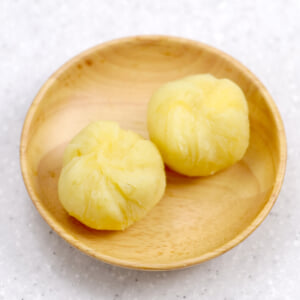
Chakin shibori is a classic Japanese way of shaping soft, mashed foods: you gather the mixture in a cloth (or, in a modern kitchen, a sheet of plastic wrap) and twist it into a neat little pleated purse. Here it turns Japanese sweet potato and softly stewed apple into a snack with no added sugar at all - the apple brings both moisture and a gentle sweetness that children love. The texture is soft and easy for little ones to eat, and the twisted shape makes it fun to hold. Just two ingredients, and a quiet, satisfying snack for after-nap time.
Added. Open the recipe helper (bottom right) → ☰ Menu → 🛒 Shopping list to see the ingredients for your family size.
Printing uses the number of adults and children set under Ingredients, so set those first.
Ingredients
Amounts for 1 child (1 serving). An adult counts as 2 servings.
One serving here is 1.5× the portion served to a child in a Japanese preschool, sized for Western appetites. An adult counts as two servings. Tap an ingredient to check it off.
- 52.5 gJapanese sweet potato (satsumaimo)A purple-skinned, pale-yellow-fleshed sweet potato that is sweeter, drier, and fluffier than orange varieties. Substitute: Any sweet potato.
- 12 gapple
About the Japanese ingredients in this recipe
- Japanese sweet potato (satsumaimo) (さつまいも)
- A purple-skinned, pale-yellow-fleshed sweet potato that is sweeter, drier, and fluffier than orange varieties. Substitute: Any sweet potato.
Directions
- 1
Peel the sweet potato, cut it into rounds, and boil until tender. While it is still warm, mash it with a potato masher.
- 2
Cut the apple into small cubes and simmer in a small amount of water (not included in the ingredient amounts) until soft.
- 3
Combine the mashed sweet potato and the cooked apple (adding a little hot water as needed to adjust the consistency), then place the mixture on a sheet of plastic wrap, gather up the edges, and twist it into a small rounded purse shape.
Nutrition
| Per | 1 serving | 1 adult serving | Your total |
|---|---|---|---|
| Energy | 72 kcal | 144 kcal | 72 kcal |
| Protein | 0.5 g | 0.9 g | 0.5 g |
| Fat | 0.3 g | 0.6 g | 0.3 g |
| Carbohydrates | 19.2 g | 38.4 g | 19.2 g |
| Fiber | 1.7 g | 3.3 g | 1.7 g |
| Salt equivalent | 0 g | 0 g | 0 g |
| Calcium | 21 mg | 42 mg | 21 mg |
| Iron | 0.3 mg | 0.6 mg | 0.3 mg |
| Potassium | 214.5 mg | 429 mg | 214.5 mg |
| Energy | Protein | Fat | Carbs | Fiber | Salt equiv. | Calcium | Iron | Potassium | |
|---|---|---|---|---|---|---|---|---|---|
| 1 serving | 72 kcal | 0.5 g | 0.3 g | 19.2 g | 1.7 g | 0 g | 21 mg | 0.3 mg | 214.5 mg |
| 1 adult serving | 144 kcal | 0.9 g | 0.6 g | 38.4 g | 3.3 g | 0 g | 42 mg | 0.6 mg | 429 mg |
Values are per serving (1.5× the Japanese preschool portion); an adult serving is double. They were calculated by a licensed Japanese nutritionist using the Standard Tables of Food Composition in Japan. "Salt equivalent" is sodium × 2.54, the standard Japanese measure. Allergen flags cover egg, milk and wheat only and come from the nutritionist's records. Soy sauce and miso are made with wheat but are usually allowed on Japanese wheat-free school menus, so check with your doctor.