Sanma Kabayaki Rice Bowl (Elementary School Portion)
【小学校】さんまのかば焼き丼【オカフーズ版】 · Sanma no Kabayaki Don
 By Aoi, licensed nutritionist · From a Japanese elementary school lunch menu
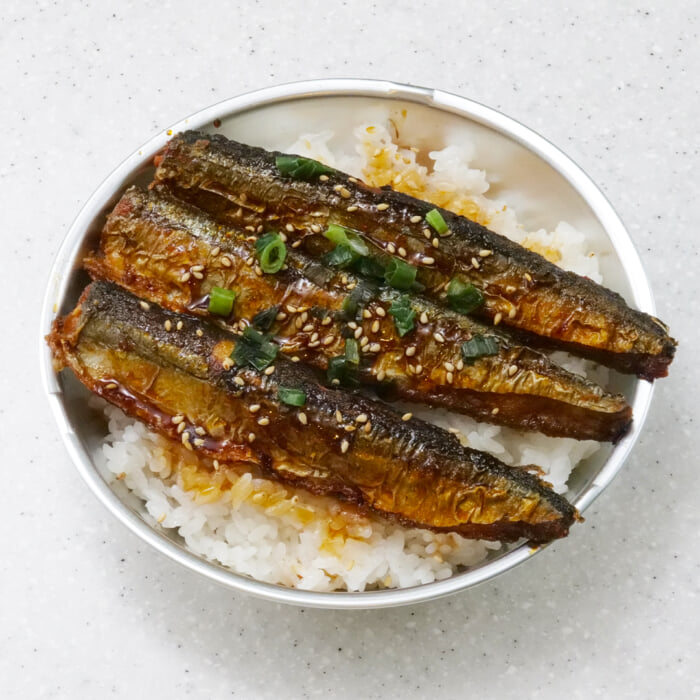
Kabayaki is the sweet soy-and-mirin glaze best known on grilled eel, and it works beautifully on sanma (Pacific saury), the oily fish Japan looks forward to every autumn. Here the fish is dusted in flour, deep-fried until crisp, then rolled in the bubbling glaze and laid over rice so the sauce soaks in - the sweet-savory coating wins over children who are usually wary of fish. This version is written for the boneless frozen saury fillets we get from the school-lunch supplier Okafoods, so it goes straight from the freezer into the fryer, with a note for anyone using fresh, filleted fish instead.
Added. Open the recipe helper (bottom right) → ☰ Menu → 🛒 Shopping list to see the ingredients for your family size.
Printing uses the number of adults and children set under Ingredients, so set those first.
Ingredients
Amounts for 1 child (1 serving). An adult counts as 2 servings.
One serving here is 1.5× the portion served to a child in a Japanese elementary school, sized for Western appetites. An adult counts as two servings. Tap an ingredient to check it off.
Ingredients
- 67.2 gfrozen Pacific saury (sanma)A slender, oily fish that is an autumn favorite in Japan. Substitute: Mackerel, sardines, or herring.
- 2.3 gflour
- 184.8 gwarm cooked rice
Seasonings
- 7.8 gvegetable oil
- 3 gwater
- 1 gmirinMirin is a sweet Japanese rice seasoning that adds gentle sweetness and a glossy finish. Hon-mirin (true mirin) contains about 14% alcohol; "mirin-style seasoning" has little or no alcohol. Some alcohol can remain after short cooking. If you prefer no alcohol for children, use the substitute. Substitute: For each tablespoon of mirin, use 1 tablespoon water plus 1 to 2 teaspoons sugar.
- 3.3 gsugar
- 5.7 gsoy sauce
- 1.4 gsakeSake (Japanese rice wine) is used in small amounts to soften the smell of fish and meat and add depth. Japanese "cooking sake" often contains added salt. Some alcohol can remain after short cooking. If you prefer no alcohol for children, use the substitute. Substitute: The same amount of water (the taste will be a little simpler), or dry white wine.
- 0.9 gwhite sesame seeds
About the Japanese ingredients in this recipe
- frozen Pacific saury (sanma) (冷凍サンマ)
- A slender, oily fish that is an autumn favorite in Japan. Substitute: Mackerel, sardines, or herring.
- mirin (みりん)
- Mirin is a sweet Japanese rice seasoning that adds gentle sweetness and a glossy finish. Hon-mirin (true mirin) contains about 14% alcohol; "mirin-style seasoning" has little or no alcohol. Some alcohol can remain after short cooking. If you prefer no alcohol for children, use the substitute. Substitute: For each tablespoon of mirin, use 1 tablespoon water plus 1 to 2 teaspoons sugar.
- sake (酒)
- Sake (Japanese rice wine) is used in small amounts to soften the smell of fish and meat and add depth. Japanese "cooking sake" often contains added salt. Some alcohol can remain after short cooking. If you prefer no alcohol for children, use the substitute. Substitute: The same amount of water (the taste will be a little simpler), or dry white wine.
Directions
- 1
Dust the frozen saury all over with flour.
- 2
Heat the oil to 170°C (340°F) and deep-fry the saury for about 7 minutes, turning it as it cooks (if using fresh saury that has been filleted into two boneless fillets, fry at 170°C (340°F) for 3 to 5 minutes).
- 3
Put the water, mirin, sugar, soy sauce, and sake in a separate pot and bring to a boil over low heat.
- 4
Add the fried saury and roll it around in the pot so the glaze coats it all over.
- 5
Place the saury on top of the warm cooked rice, spoon over the sauce left in the pot, and sprinkle with white sesame seeds.
Nutrition
| Per | 1 serving | 1 adult serving | Your total |
|---|---|---|---|
| Energy | 583.5 kcal | 1167 kcal | 583.5 kcal |
| Protein | 17.7 g | 35.4 g | 17.7 g |
| Fat | 26.1 g | 52.2 g | 26.1 g |
| Carbohydrates | 76.7 g | 153.3 g | 76.7 g |
| Salt equivalent | 1.2 g | 2.4 g | 1.2 g |
| Calcium | 37.5 mg | 75 mg | 37.5 mg |
| Iron | 1.4 mg | 2.7 mg | 1.4 mg |
| Energy | Protein | Fat | Carbs | Salt equiv. | Calcium | Iron | |
|---|---|---|---|---|---|---|---|
| 1 serving | 583.5 kcal | 17.7 g | 26.1 g | 76.7 g | 1.2 g | 37.5 mg | 1.4 mg |
| 1 adult serving | 1167 kcal | 35.4 g | 52.2 g | 153.3 g | 2.4 g | 75 mg | 2.7 mg |
Values are per serving (1.5× the Japanese elementary-school portion); an adult serving is double. They were calculated by a licensed Japanese nutritionist using the Standard Tables of Food Composition in Japan. "Salt equivalent" is sodium × 2.54, the standard Japanese measure. Allergen flags cover egg, milk and wheat only and come from the nutritionist's records. Soy sauce and miso are made with wheat but are usually allowed on Japanese wheat-free school menus, so check with your doctor.
This is the elementary-school portion of Sanma Kabayaki Rice Bowl (Sweet Soy-Glazed Saury) (larger quantities, same method).