Pacific Saury Takikomi Gohan (Elementary School Portion)
【小学校】さんまの炊き込みごはん【オカフーズ版】 · Sanma no Takikomi Gohan
 By Aoi, licensed nutritionist · From a Japanese elementary school lunch menu
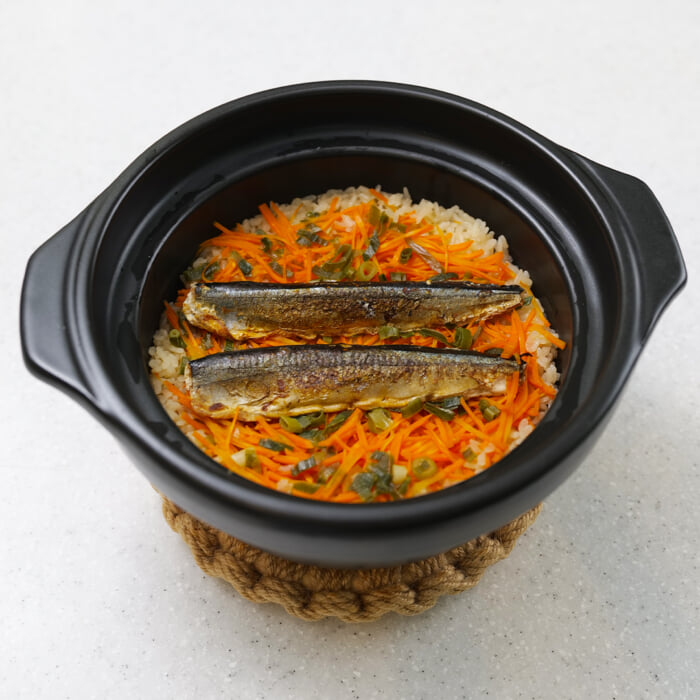
Takikomi gohan is Japanese rice cooked together with its toppings, so every grain soaks up the flavor. This version stars sanma (Pacific saury), a slender, oily fish that is a true taste of autumn in Japan, browned first in a frying pan so it loses any fishiness and picks up a savory, toasty edge before it goes on top of the rice. Once the rice is done, the fish is flaked and folded through with sweet carrot and green onions - children who are wary of a whole fish on the plate happily eat it this way. It is written for the frozen saury fillets we use in school kitchens (the Okafoods product), which go into the pan straight from the freezer with no thawing needed.
Added. Open the recipe helper (bottom right) → ☰ Menu → 🛒 Shopping list to see the ingredients for your family size.
Printing uses the number of adults and children set under Ingredients, so set those first.
Ingredients
Amounts for 1 child (1 serving). An adult counts as 2 servings.
One serving here is 1.5× the portion served to a child in a Japanese elementary school, sized for Western appetites. An adult counts as two servings. Tap an ingredient to check it off.
Ingredients
- 84 griceJapanese short-grain white rice (japonica), which cooks up soft and slightly sticky. The amount listed is for uncooked rice. Substitute: Sushi rice, or another short-grain or medium-grain rice such as Calrose.
- 13.5 gcarrot
- 33.6 gfrozen Pacific saury (sanma)A slender, oily fish that is an autumn favorite in Japan. Substitute: Mackerel, sardines, or herring.
- 3.9 gfrozen chopped green onions
Seasonings
- 2.7 gsakeSake (Japanese rice wine) is used in small amounts to soften the smell of fish and meat and add depth. Japanese "cooking sake" often contains added salt. Some alcohol can remain after short cooking. If you prefer no alcohol for children, use the substitute. Substitute: The same amount of water (the taste will be a little simpler), or dry white wine.
- 2.7 gmirinMirin is a sweet Japanese rice seasoning that adds gentle sweetness and a glossy finish. Hon-mirin (true mirin) contains about 14% alcohol; "mirin-style seasoning" has little or no alcohol. Some alcohol can remain after short cooking. If you prefer no alcohol for children, use the substitute. Substitute: For each tablespoon of mirin, use 1 tablespoon water plus 1 to 2 teaspoons sugar.
- 3.9 gsoy sauce
- 0.8 gsalt
About the Japanese ingredients in this recipe
- rice (米)
- Japanese short-grain white rice (japonica), which cooks up soft and slightly sticky. The amount listed is for uncooked rice. Substitute: Sushi rice, or another short-grain or medium-grain rice such as Calrose.
- frozen Pacific saury (sanma) (冷凍サンマ)
- A slender, oily fish that is an autumn favorite in Japan. Substitute: Mackerel, sardines, or herring.
- sake (酒)
- Sake (Japanese rice wine) is used in small amounts to soften the smell of fish and meat and add depth. Japanese "cooking sake" often contains added salt. Some alcohol can remain after short cooking. If you prefer no alcohol for children, use the substitute. Substitute: The same amount of water (the taste will be a little simpler), or dry white wine.
- mirin (みりん)
- Mirin is a sweet Japanese rice seasoning that adds gentle sweetness and a glossy finish. Hon-mirin (true mirin) contains about 14% alcohol; "mirin-style seasoning" has little or no alcohol. Some alcohol can remain after short cooking. If you prefer no alcohol for children, use the substitute. Substitute: For each tablespoon of mirin, use 1 tablespoon water plus 1 to 2 teaspoons sugar.
Directions
- 1
Add the usual amount of water to the rice and let it soak for at least 30 minutes.
- 2
Cut the carrot into short, thin matchsticks.
- 3
Line a frying pan with nonstick frying-pan foil, turn on the heat, and once the pan is hot, lay the saury in the pan straight from frozen.
- 4
Cook over medium heat, turning the saury so that both sides take on some browning (as a guide, about 3 minutes per side).
- 5
Add the seasonings to the soaked rice from step 1 and stir well, then lay the carrot, green onions and saury on top in that order and cook the rice as usual.
- 6
Once the rice is cooked, mix everything together, breaking up the saury into flakes as you go.
Note: As a guide for upper-elementary children, 1 go (a Japanese rice-cooker cup, about 180 ml / 150 g) of rice serves 2, 2 go serves 4, and 3 go serves 6.
Nutrition
| Per | 1 serving | 1 adult serving | Your total |
|---|---|---|---|
| Energy | 402 kcal | 804 kcal | 402 kcal |
| Protein | 11.7 g | 23.4 g | 11.7 g |
| Fat | 9.5 g | 18.9 g | 9.5 g |
| Carbohydrates | 74.3 g | 148.5 g | 74.3 g |
| Salt equivalent | 1.5 g | 3 g | 1.5 g |
| Calcium | 19.5 mg | 39 mg | 19.5 mg |
| Iron | 1.2 mg | 2.4 mg | 1.2 mg |
| Energy | Protein | Fat | Carbs | Salt equiv. | Calcium | Iron | |
|---|---|---|---|---|---|---|---|
| 1 serving | 402 kcal | 11.7 g | 9.5 g | 74.3 g | 1.5 g | 19.5 mg | 1.2 mg |
| 1 adult serving | 804 kcal | 23.4 g | 18.9 g | 148.5 g | 3 g | 39 mg | 2.4 mg |
Values are per serving (1.5× the Japanese elementary-school portion); an adult serving is double. They were calculated by a licensed Japanese nutritionist using the Standard Tables of Food Composition in Japan. "Salt equivalent" is sodium × 2.54, the standard Japanese measure. Allergen flags cover egg, milk and wheat only and come from the nutritionist's records. Soy sauce and miso are made with wheat but are usually allowed on Japanese wheat-free school menus, so check with your doctor.
This is the elementary-school portion of Pacific Saury Takikomi Gohan (larger quantities, same method).