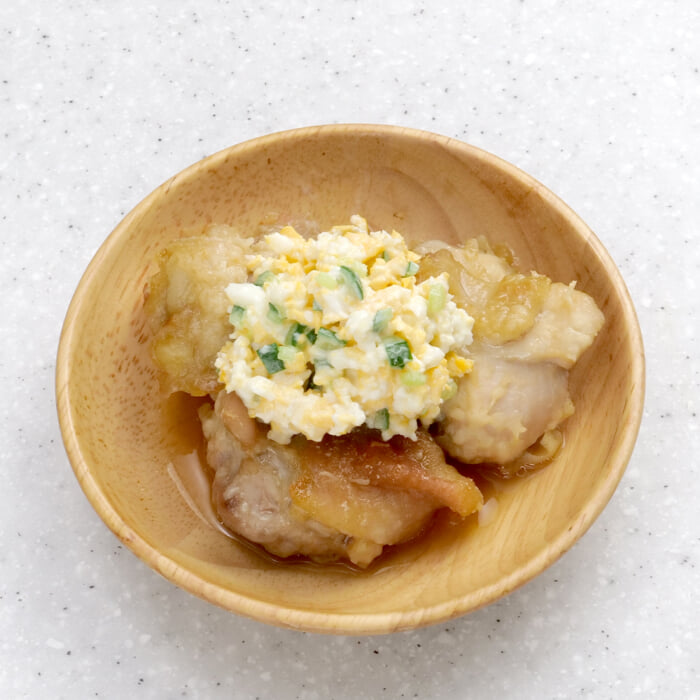
No-Fry Chicken Nanban
揚げないチキン南蛮 · Chikin Nanban
 By Aoi, licensed nutritionist · From a Japanese preschool lunch menu
Chicken nanban is a beloved dish from Miyazaki Prefecture in southern Japan: fried chicken dipped in a sweet-and-sour soy sauce and finished with a generous spoonful of tartar sauce. In this version the chicken is marinated in ginger, sake, and soy sauce, dusted with flour, and baked in a toaster oven, so there is no pot of hot oil to deal with and the pieces stay light and tender. The tartar sauce is made in the microwave with finely chopped cucumber and mashed egg, which keeps the tang mild and the texture soft for small mouths. The combination of gentle sweet-sour sauce and creamy topping is one that kids happily clean their plates for.
Added. Open the recipe helper (bottom right) → ☰ Menu → 🛒 Shopping list to see the ingredients for your family size.
Printing uses the number of adults and children set under Ingredients, so set those first.
Ingredients
Amounts for 1 child (1 serving). An adult counts as 2 servings.
One serving here is 1.5× the portion served to a child in a Japanese preschool, sized for Western appetites. An adult counts as two servings. Tap an ingredient to check it off.
Ingredients
- 75 gboneless, skinless chicken thigh
- 4.5 gflour
- 6 gcucumber
- 15 gegg
Seasonings
- 0.3 gginger paste (tube)Grated ginger sold ready to use in a squeeze tube, a staple in Japanese kitchens. Japanese school lunch kitchens grate fresh ginger for its aroma, but for cooking at home Aoi says the tube works just fine. Tube pastes often contain added salt, oil and other ingredients, so check the label. Substitute: Use freshly grated ginger in the same amount. 1 teaspoon of paste is about 5 g.
- 1.5 gsakeSake (Japanese rice wine) is used in small amounts to soften the smell of fish and meat and add depth. Japanese "cooking sake" often contains added salt. Some alcohol can remain after short cooking. If you prefer no alcohol for children, use the substitute. Substitute: The same amount of water (the taste will be a little simpler), or dry white wine.
- 0.5 gsoy sauce
- 1.5 gvegetable oil
- 9.8 gbonito and kombu dashiJapanese soup stock made from dried bonito flakes and kombu kelp, the everyday base for soups and simmered dishes. Substitute: Instant dashi granules dissolved in water, or a light vegetable or chicken stock.
- 1.5 gsugar
- 1.5 gsoy sauce
- 1.8 gvinegar
- 1.5 gwater
- 3.8 gegg-free mayonnaise (Mayodore)A Japanese egg-free mayonnaise-style dressing. Substitute: Any egg-free or vegan mayonnaise.
About the Japanese ingredients in this recipe
- ginger paste (tube) (しょうが,おろしチューブ)
- Grated ginger sold ready to use in a squeeze tube, a staple in Japanese kitchens. Japanese school lunch kitchens grate fresh ginger for its aroma, but for cooking at home Aoi says the tube works just fine. Tube pastes often contain added salt, oil and other ingredients, so check the label. Substitute: Use freshly grated ginger in the same amount. 1 teaspoon of paste is about 5 g.
- sake (酒)
- Sake (Japanese rice wine) is used in small amounts to soften the smell of fish and meat and add depth. Japanese "cooking sake" often contains added salt. Some alcohol can remain after short cooking. If you prefer no alcohol for children, use the substitute. Substitute: The same amount of water (the taste will be a little simpler), or dry white wine.
- bonito and kombu dashi (かつお・昆布だし汁)
- Japanese soup stock made from dried bonito flakes and kombu kelp, the everyday base for soups and simmered dishes. Substitute: Instant dashi granules dissolved in water, or a light vegetable or chicken stock.
- egg-free mayonnaise (Mayodore) (マヨドレ)
- A Japanese egg-free mayonnaise-style dressing. Substitute: Any egg-free or vegan mayonnaise.
Directions
- 1
Cut the chicken into 20 g pieces. Combine the ginger, sake, and soy sauce, add the chicken, and rub the marinade in well. Add the flour and rub it in as well.
- 2
Line a baking sheet with parchment paper, brush it with the oil, and arrange the chicken from step 1 on top. Bake in a toaster oven for about 20 minutes (or, if using an oven, preheat to 200°C (400°F) and bake for about 20 minutes).
- 3
Finely mince the cucumber, place it in a heatproof bowl, and sprinkle with the water. Cover loosely with plastic wrap and microwave at 1200W for about 45 seconds (1 minute 30 seconds at 600W). Remove the wrap and let cool slightly.
- 4
Crack the egg into a small heatproof bowl (about 14 cm in diameter) and lightly beat it with a fork. Microwave uncovered at 1200W for about 25 seconds (50 seconds at 600W). While it is still hot, mash it finely with a fork. Let cool slightly. Add the cucumber from step 3 and the egg-free mayonnaise (or regular mayonnaise) and mix. Chill in the refrigerator.
- 5
Put the dashi, sugar, soy sauce, and vinegar in a heatproof bowl, cover loosely with plastic wrap, and microwave at 1200W for about 15 seconds (30 seconds at 600W).
- 6
Arrange the chicken from step 2 on a plate, top with the tartar sauce from step 4, and pour the sauce from step 5 over everything.
Nutrition
| Per | 1 serving | 1 adult serving | Your total |
|---|---|---|---|
| Energy | 165 kcal | 330 kcal | 165 kcal |
| Protein | 17 g | 33.9 g | 17 g |
| Fat | 9.1 g | 18.3 g | 9.1 g |
| Carbohydrates | 4.1 g | 8.1 g | 4.1 g |
| Salt equivalent | 0.8 g | 1.5 g | 0.8 g |
| Calcium | 13.5 mg | 27 mg | 13.5 mg |
| Iron | 0.9 mg | 1.8 mg | 0.9 mg |
| Energy | Protein | Fat | Carbs | Salt equiv. | Calcium | Iron | |
|---|---|---|---|---|---|---|---|
| 1 serving | 165 kcal | 17 g | 9.1 g | 4.1 g | 0.8 g | 13.5 mg | 0.9 mg |
| 1 adult serving | 330 kcal | 33.9 g | 18.3 g | 8.1 g | 1.5 g | 27 mg | 1.8 mg |
Values are per serving (1.5× the Japanese preschool portion); an adult serving is double. They were calculated by a licensed Japanese nutritionist using the Standard Tables of Food Composition in Japan. "Salt equivalent" is sodium × 2.54, the standard Japanese measure. Allergen flags cover egg, milk and wheat only and come from the nutritionist's records. Soy sauce and miso are made with wheat but are usually allowed on Japanese wheat-free school menus, so check with your doctor.
Ingredients in this recipe
You might also like
All recipes →
Chicken Nanbanzuke (Chicken in Sweet Vinegar Sauce)
Chicken Nanbanzuke (Sweet-Vinegar Marinated Chicken)
Salmon Nanbanzuke (Fried Salmon in Sweet Vinegar Sauce)
Aji Nanbanzuke (Fried Horse Mackerel in Sweet Vinegar Sauce)