Nikumiso Onigiri (Miso Pork Rice Balls)
肉味噌おにぎり · Nikumiso Onigiri
 By Aoi, licensed nutritionist · From a Japanese preschool lunch menu
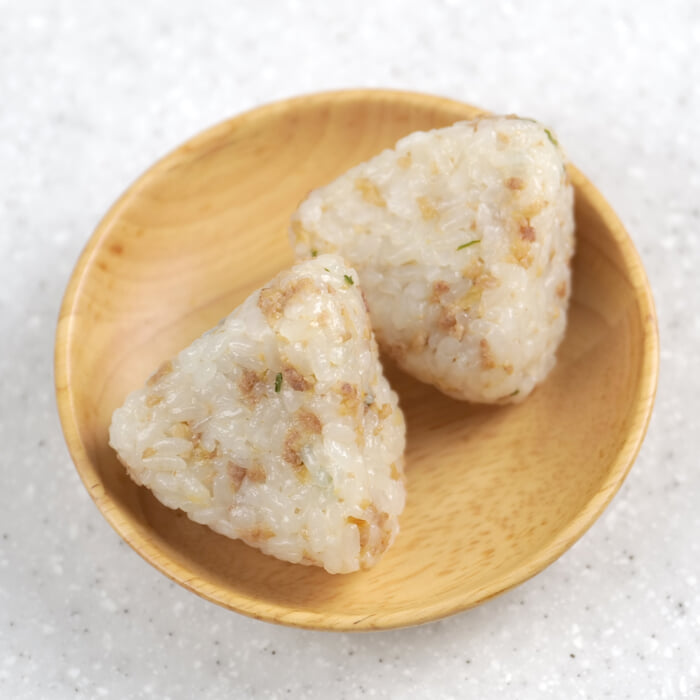
Nikumiso is a savory Japanese topping of ground pork simmered with miso, soy sauce, mirin and a little sugar. Here it is stirred right through freshly cooked rice and shaped into onigiri, so every bite has some of the sweet, gently salty pork in it and there is no filling to fall out. Children love the mild miso flavor, and because the meat and rice are all in one hand-sized ball, even small kids can manage it on their own. It is an easy way to turn plain rice into a meal, and just as good packed in a lunch box as served warm.
Wheat-free, but uses soy sauce and miso (made with wheat). Japanese school-lunch allergy menus usually allow them, so check with your doctor. How to read the labels
Added. Open the recipe helper (bottom right) → ☰ Menu → 🛒 Shopping list to see the ingredients for your family size.
Printing uses the number of adults and children set under Ingredients, so set those first.
Ingredients
Amounts for 1 child (1 serving). An adult counts as 2 servings.
One serving here is 1.5× the portion served to a child in a Japanese preschool, sized for Western appetites. An adult counts as two servings. Tap an ingredient to check it off.
Ingredients
- 60 griceJapanese short-grain white rice (japonica), which cooks up soft and slightly sticky. The amount listed is for uncooked rice. Substitute: Sushi rice, or another short-grain or medium-grain rice such as Calrose.
- 22.5 gground pork
- 3 ggreen onion (naga negi)Japanese long onion, thicker and milder than Western scallions. Substitute: Scallions or the white part of a leek.
Seasonings
- 1.5 gsesame oil
- 5.3 gmirinMirin is a sweet Japanese rice seasoning that adds gentle sweetness and a glossy finish. Hon-mirin (true mirin) contains about 14% alcohol; "mirin-style seasoning" has little or no alcohol. Some alcohol can remain after short cooking. If you prefer no alcohol for children, use the substitute. Substitute: For each tablespoon of mirin, use 1 tablespoon water plus 1 to 2 teaspoons sugar.
- 1.2 gsugar
- 1.8 gsoy sauce
- 2.8 gmisoFermented soybean paste. Salty and savory, it is Japan's everyday seasoning for miso soup and many simmered dishes. Substitute: Any light (white or awase) miso. Misos differ in saltiness, so start with a little less and taste. Some misos are made with barley or wheat, so check the label if you avoid them.
About the Japanese ingredients in this recipe
- rice (米)
- Japanese short-grain white rice (japonica), which cooks up soft and slightly sticky. The amount listed is for uncooked rice. Substitute: Sushi rice, or another short-grain or medium-grain rice such as Calrose.
- green onion (naga negi) (ねぎ)
- Japanese long onion, thicker and milder than Western scallions. Substitute: Scallions or the white part of a leek.
- mirin (みりん)
- Mirin is a sweet Japanese rice seasoning that adds gentle sweetness and a glossy finish. Hon-mirin (true mirin) contains about 14% alcohol; "mirin-style seasoning" has little or no alcohol. Some alcohol can remain after short cooking. If you prefer no alcohol for children, use the substitute. Substitute: For each tablespoon of mirin, use 1 tablespoon water plus 1 to 2 teaspoons sugar.
- miso (みそ)
- Fermented soybean paste. Salty and savory, it is Japan's everyday seasoning for miso soup and many simmered dishes. Substitute: Any light (white or awase) miso. Misos differ in saltiness, so start with a little less and taste. Some misos are made with barley or wheat, so check the label if you avoid them.
Directions
- 1
Cook the rice as usual.
- 2
Finely chop the green onion.
- 3
Heat the sesame oil in a frying pan, add the green onion from step 2 and the ground pork, and stir-fry. Once the green onion has softened, add the seasonings and stir-fry to combine.
- 4
Mix the rice from step 1 with the pork mixture from step 3, then shape into rice balls.
Nutrition
| Per | 1 serving | 1 adult serving | Your total |
|---|---|---|---|
| Energy | 289.5 kcal | 579 kcal | 289.5 kcal |
| Protein | 8.1 g | 16.2 g | 8.1 g |
| Fat | 6.1 g | 12.3 g | 6.1 g |
| Carbohydrates | 51 g | 102 g | 51 g |
| Fiber | 0.6 g | 1.2 g | 0.6 g |
| Salt equivalent | 0.6 g | 1.2 g | 0.6 g |
| Calcium | 9 mg | 18 mg | 9 mg |
| Iron | 0.9 mg | 1.8 mg | 0.9 mg |
| Potassium | 144 mg | 288 mg | 144 mg |
| Energy | Protein | Fat | Carbs | Fiber | Salt equiv. | Calcium | Iron | Potassium | |
|---|---|---|---|---|---|---|---|---|---|
| 1 serving | 289.5 kcal | 8.1 g | 6.1 g | 51 g | 0.6 g | 0.6 g | 9 mg | 0.9 mg | 144 mg |
| 1 adult serving | 579 kcal | 16.2 g | 12.3 g | 102 g | 1.2 g | 1.2 g | 18 mg | 1.8 mg | 288 mg |
Values are per serving (1.5× the Japanese preschool portion); an adult serving is double. They were calculated by a licensed Japanese nutritionist using the Standard Tables of Food Composition in Japan. "Salt equivalent" is sodium × 2.54, the standard Japanese measure. Allergen flags cover egg, milk and wheat only and come from the nutritionist's records. Soy sauce and miso are made with wheat but are usually allowed on Japanese wheat-free school menus, so check with your doctor.