Melon Pan Muffins (Cookie-Topped Muffins)
メロンパンマフィン · Meronpan Mafin
 By Aoi, licensed nutritionist · From a Japanese preschool lunch menu
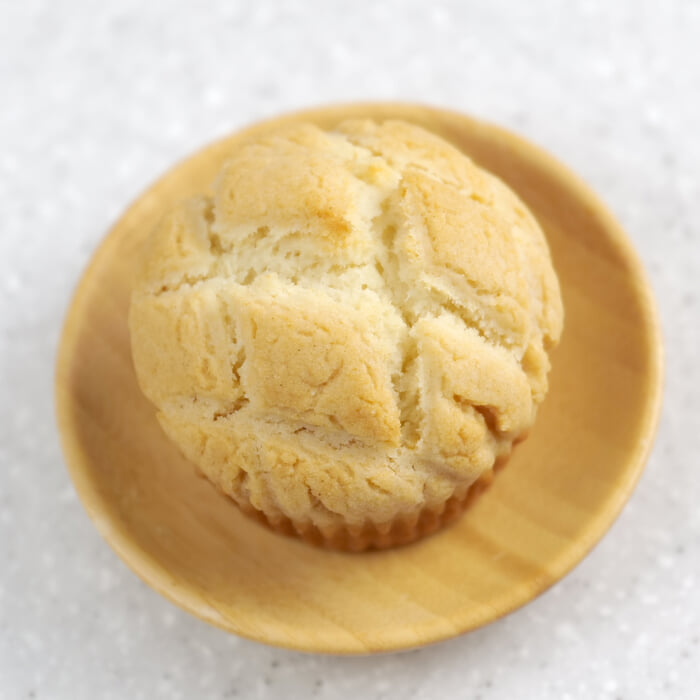
Melon pan is one of Japan's best-loved bakery treats: a soft sweet bun wrapped in a thin, crisp cookie crust that is scored in a crosshatch pattern to look like the netting on a melon. Here I turn it into an easy muffin, so there is no yeast and no waiting for dough to rise - just a quick muffin batter and a quick cookie dough, both made from pancake mix, layered in the same cup and baked together. Children love pressing the crosshatch pattern into the cookie dough themselves, and the contrast of a crunchy top and a fluffy inside makes these disappear fast at snack time. Japanese pancake mix (hotcake mix) is already sweetened and contains baking powder, so if you can't find it, use a sweetened, complete pancake mix.
Added. Open the recipe helper (bottom right) → ☰ Menu → 🛒 Shopping list to see the ingredients for your family size.
Printing uses the number of adults and children set under Ingredients, so set those first.
Ingredients
Amounts for 1 child (1 serving). An adult counts as 2 servings.
One serving here is 1.5× the portion served to a child in a Japanese preschool, sized for Western appetites. An adult counts as two servings. Tap an ingredient to check it off.
Ingredients
- 56.3 gpancake mixJapanese 'hotcake mix' is a sweetened pancake mix of flour, sugar, and leavening, often used as a shortcut baking mix. Brands differ, and some contain milk or egg, so check the label if you are cooking for a food allergy. Substitute: Sweetened pancake mix, or self-rising flour plus about 2 tablespoons sugar per 100 g.
Seasonings
- 26.3 mlmilk
- 14.3 gvegetable oil
- 1.5 gsugar
About the Japanese ingredients in this recipe
- pancake mix (ホットケーキミックス)
- Japanese 'hotcake mix' is a sweetened pancake mix of flour, sugar, and leavening, often used as a shortcut baking mix. Brands differ, and some contain milk or egg, so check the label if you are cooking for a food allergy. Substitute: Sweetened pancake mix, or self-rising flour plus about 2 tablespoons sugar per 100 g.
Directions
- 1
First, make the muffin batter that goes into the cups. In a bowl, combine the pancake mix, milk, and vegetable oil and mix well. Divide the batter evenly and pour it into the cups.
- 2
Next, make the cookie dough for the topping. In a separate bowl, combine the pancake mix and sugar. Add the milk and vegetable oil, mix, and bring the dough together into one ball.
- 3
Divide the dough from step 2 into equal portions, roll each into a ball, and flatten it thinly to the diameter of the cups from step 1 (think of a gyoza wrapper).
- 4
Using a rubber spatula or the back of a knife, score a crosshatch pattern on the surface of each dough round, like the top of a melon pan.
- 5
Lay the cookie dough from step 4 on top of the cups from step 1. Set them on a baking sheet and bake in an oven preheated to 180°C (350°F) for about 15 minutes. Cover with aluminum foil so they don't burn, and bake for about 5 more minutes.
These are made in two stages:
1. Make the muffin batter and pour it into the cups.
2. Make the cookie dough and lay it over the batter from step 1.
Nutrition
| Per | 1 serving | 1 adult serving | Your total |
|---|---|---|---|
| Energy | 351 kcal | 702 kcal | 351 kcal |
| Protein | 5.4 g | 10.8 g | 5.4 g |
| Fat | 17.5 g | 35.1 g | 17.5 g |
| Carbohydrates | 44.6 g | 89.1 g | 44.6 g |
| Fiber | 1 g | 2.1 g | 1 g |
| Salt equivalent | 0.6 g | 1.2 g | 0.6 g |
| Calcium | 87 mg | 174 mg | 87 mg |
| Iron | 0.3 mg | 0.6 mg | 0.3 mg |
| Potassium | 171 mg | 342 mg | 171 mg |
| Energy | Protein | Fat | Carbs | Fiber | Salt equiv. | Calcium | Iron | Potassium | |
|---|---|---|---|---|---|---|---|---|---|
| 1 serving | 351 kcal | 5.4 g | 17.5 g | 44.6 g | 1 g | 0.6 g | 87 mg | 0.3 mg | 171 mg |
| 1 adult serving | 702 kcal | 10.8 g | 35.1 g | 89.1 g | 2.1 g | 1.2 g | 174 mg | 0.6 mg | 342 mg |
Values are per serving (1.5× the Japanese preschool portion); an adult serving is double. They were calculated by a licensed Japanese nutritionist using the Standard Tables of Food Composition in Japan. "Salt equivalent" is sodium × 2.54, the standard Japanese measure. Allergen flags cover egg, milk and wheat only and come from the nutritionist's records. Soy sauce and miso are made with wheat but are usually allowed on Japanese wheat-free school menus, so check with your doctor.