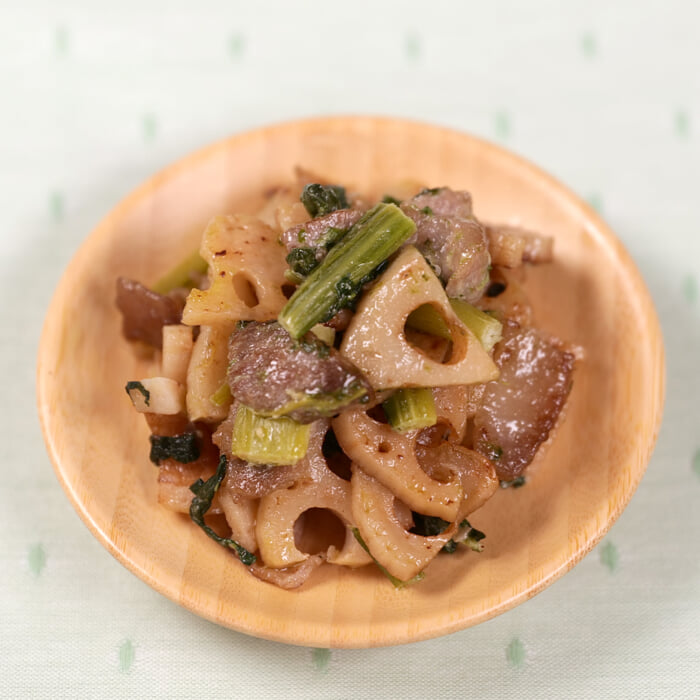
Lotus Root Stir-Fry with Mayonnaise
れんこんのマヨ炒め · Renkon no Mayo Itame
 By Aoi, licensed nutritionist · From a Japanese preschool lunch menu
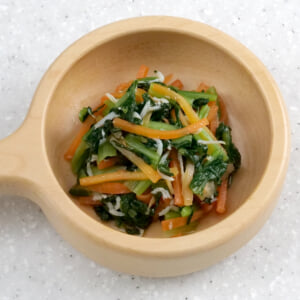
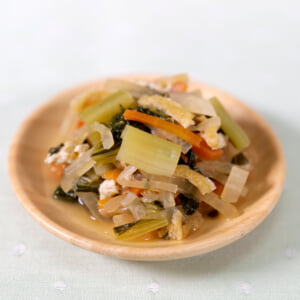
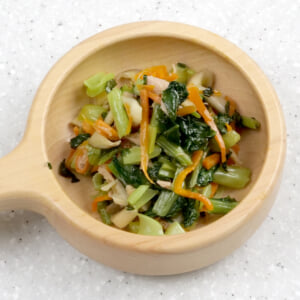
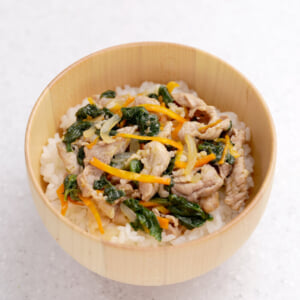
Renkon no mayo itame pairs lotus root, komatsuna and thinly sliced pork with a simple coating of mayonnaise, soy sauce and a touch of garlic. Lotus root has a light, crisp bite that children enjoy, and the mayonnaise rounds off the soy sauce into a gentle, creamy flavor that even picky eaters take to. The vegetables are parboiled first - the lotus root started in cold water so it cooks through evenly, and the komatsuna squeezed dry so the seasoning clings instead of turning watery - which keeps the final stir-fry quick and tender.
Wheat-free, but uses soy sauce (made with wheat). Japanese school-lunch allergy menus usually allow it, so check with your doctor. How to read the labels
Added. Open the recipe helper (bottom right) → ☰ Menu → 🛒 Shopping list to see the ingredients for your family size.
Printing uses the number of adults and children set under Ingredients, so set those first.
Ingredients
Amounts for 1 child (1 serving). An adult counts as 2 servings.
One serving here is 1.5× the portion served to a child in a Japanese preschool, sized for Western appetites. An adult counts as two servings. Tap an ingredient to check it off.
Ingredients
- 37.5 glotus root (renkon)A crisp, mildly sweet root vegetable with a lacy pattern of holes when sliced, sold fresh in Asian markets or frozen/vacuum-packed. Substitute: Water chestnuts or jicama for crunch, or thinly sliced potato.
- 15 gkomatsunaA mild Japanese leafy green (Japanese mustard spinach) with tender stems. Substitute: Spinach or bok choy.
- 15 gthinly sliced pork (komagire)Small, thin offcuts of pork sold in Japan for quick stir-fries and simmered dishes. Substitute: Thinly sliced pork shoulder or loin cut into bite-size pieces.
Seasonings
- 0.3 ggarlic paste (tube)Grated garlic sold ready to use in a squeeze tube, a staple in Japanese kitchens. Japanese school lunch kitchens grate fresh garlic for its aroma, but for cooking at home Aoi says the tube works just fine. Tube pastes often contain added salt, oil and other ingredients, so check the label. Substitute: Use freshly grated garlic in the same amount. 1 teaspoon of paste is about 5 g.
- 4.5 gmayonnaise
- 0.9 gsoy sauce
About the Japanese ingredients in this recipe
- lotus root (renkon) (れんこん)
- A crisp, mildly sweet root vegetable with a lacy pattern of holes when sliced, sold fresh in Asian markets or frozen/vacuum-packed. Substitute: Water chestnuts or jicama for crunch, or thinly sliced potato.
- komatsuna (こまつな)
- A mild Japanese leafy green (Japanese mustard spinach) with tender stems. Substitute: Spinach or bok choy.
- thinly sliced pork (komagire) (豚こま切れ肉)
- Small, thin offcuts of pork sold in Japan for quick stir-fries and simmered dishes. Substitute: Thinly sliced pork shoulder or loin cut into bite-size pieces.
- garlic paste (tube) (にんにくチューブ)
- Grated garlic sold ready to use in a squeeze tube, a staple in Japanese kitchens. Japanese school lunch kitchens grate fresh garlic for its aroma, but for cooking at home Aoi says the tube works just fine. Tube pastes often contain added salt, oil and other ingredients, so check the label. Substitute: Use freshly grated garlic in the same amount. 1 teaspoon of paste is about 5 g.
Directions
- 1
Cut the lotus root into quarter-rounds (icho-giri) and the komatsuna into 2 cm pieces.
- 2
Start the lotus root in cold water, bring to a boil and boil for 3 minutes; boil the komatsuna in boiling water for 5 minutes.
- 3
Drain each in a colander. Once the komatsuna is cool enough to handle, squeeze out the excess water.
- 4
Cut the pork into 1 to 2 cm wide pieces.
- 5
Put the lotus root in a frying pan and stir-fry briefly over low heat to sear the surface. Add the pork, komatsuna and garlic and stir-fry until everything is well combined.
- 6
Add the mayonnaise and soy sauce and stir-fry briefly over low heat for 2 to 3 minutes.
Nutrition
| Per | 1 serving | 1 adult serving | Your total |
|---|---|---|---|
| Energy | 82.5 kcal | 165 kcal | 82.5 kcal |
| Protein | 4.2 g | 8.4 g | 4.2 g |
| Fat | 4.9 g | 9.9 g | 4.9 g |
| Carbohydrates | 6.5 g | 12.9 g | 6.5 g |
| Fiber | 1 g | 2.1 g | 1 g |
| Salt equivalent | 0.3 g | 0.6 g | 0.3 g |
| Calcium | 33 mg | 66 mg | 33 mg |
| Iron | 0.8 mg | 1.5 mg | 0.8 mg |
| Potassium | 297 mg | 594 mg | 297 mg |
| Energy | Protein | Fat | Carbs | Fiber | Salt equiv. | Calcium | Iron | Potassium | |
|---|---|---|---|---|---|---|---|---|---|
| 1 serving | 82.5 kcal | 4.2 g | 4.9 g | 6.5 g | 1 g | 0.3 g | 33 mg | 0.8 mg | 297 mg |
| 1 adult serving | 165 kcal | 8.4 g | 9.9 g | 12.9 g | 2.1 g | 0.6 g | 66 mg | 1.5 mg | 594 mg |
Values are per serving (1.5× the Japanese preschool portion); an adult serving is double. They were calculated by a licensed Japanese nutritionist using the Standard Tables of Food Composition in Japan. "Salt equivalent" is sodium × 2.54, the standard Japanese measure. Allergen flags cover egg, milk and wheat only and come from the nutritionist's records. Soy sauce and miso are made with wheat but are usually allowed on Japanese wheat-free school menus, so check with your doctor.