Harusame Salad (Glass Noodle Salad) (Egg & Milk-Free)
春雨サラダ(卵乳なし) · Harusame Salada
 By Aoi, licensed nutritionist · From a Japanese preschool lunch menu
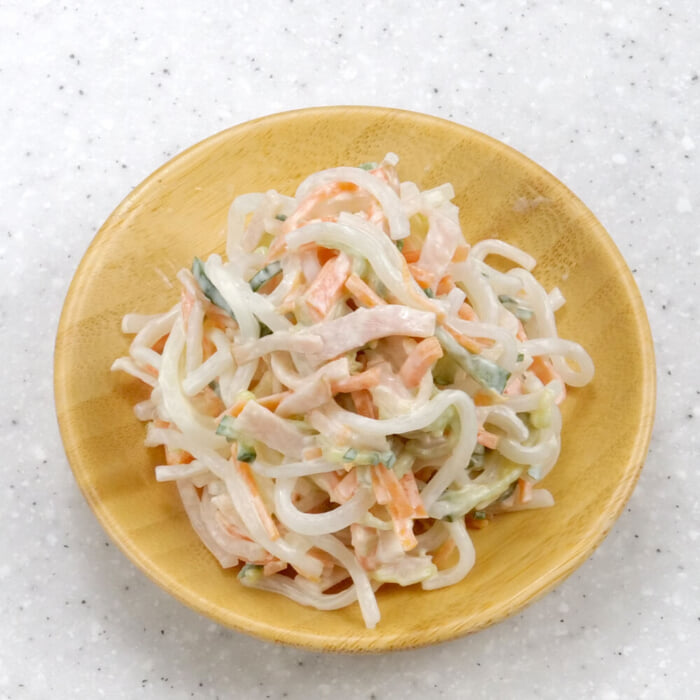
Harusame salad is a preschool lunch classic: slippery glass noodles tossed with slender strips of carrot and cucumber and a light mayonnaise dressing. The cool, smooth noodles go down easily, and even children who push vegetables aside tend to eat them happily once they are tangled in among the harusame. This version uses egg-free mayonnaise and is made without egg or milk. Check the label of any store-bought mayonnaise, as products differ by brand. Everything is cooked, cooled and squeezed dry so the salad stays fresh-tasting rather than watery.
Added. Open the recipe helper (bottom right) → ☰ Menu → 🛒 Shopping list to see the ingredients for your family size.
Printing uses the number of adults and children set under Ingredients, so set those first.
Ingredients
Amounts for 1 child (1 serving). An adult counts as 2 servings.
One serving here is 1.5× the portion served to a child in a Japanese preschool, sized for Western appetites. An adult counts as two servings. Tap an ingredient to check it off.
Ingredients
- 6 gharusame (glass noodles)Thin, translucent noodles made from potato or mung bean starch that soften quickly in hot water. Substitute: Mung bean glass noodles or thin rice vermicelli.
- 7.5 gcarrot
- 18 gcucumber
Seasonings
- 7.5 gegg-free mayonnaise (Mayodore)A Japanese egg-free mayonnaise-style dressing. Substitute: Any egg-free or vegan mayonnaise.
- 0.2 gsalt
- to tastepepper
About the Japanese ingredients in this recipe
- harusame (glass noodles) (春雨)
- Thin, translucent noodles made from potato or mung bean starch that soften quickly in hot water. Substitute: Mung bean glass noodles or thin rice vermicelli.
- egg-free mayonnaise (Mayodore) (マヨドレ)
- A Japanese egg-free mayonnaise-style dressing. Substitute: Any egg-free or vegan mayonnaise.
Directions
- 1
Boil the harusame and cut it into 3 cm lengths. Rinse under running water to cool.
- 2
Cut the carrot and cucumber into short, fine matchsticks and boil each separately. Rinse under running water to cool.
- 3
Squeeze the noodles and vegetables from steps 1 and 2 to remove excess water, then toss with the seasonings.
Nutrition
| Per | 1 serving | 1 adult serving | Your total |
|---|---|---|---|
| Energy | 69 kcal | 138 kcal | 69 kcal |
| Protein | 0.2 g | 0.3 g | 0.2 g |
| Fat | 4.4 g | 8.7 g | 4.4 g |
| Carbohydrates | 7.2 g | 14.4 g | 7.2 g |
| Fiber | 0.6 g | 1.2 g | 0.6 g |
| Salt equivalent | 0.3 g | 0.6 g | 0.3 g |
| Calcium | 7.5 mg | 15 mg | 7.5 mg |
| Iron | 0 mg | 0 mg | 0 mg |
| Potassium | 61.5 mg | 123 mg | 61.5 mg |
| Energy | Protein | Fat | Carbs | Fiber | Salt equiv. | Calcium | Iron | Potassium | |
|---|---|---|---|---|---|---|---|---|---|
| 1 serving | 69 kcal | 0.2 g | 4.4 g | 7.2 g | 0.6 g | 0.3 g | 7.5 mg | 0 mg | 61.5 mg |
| 1 adult serving | 138 kcal | 0.3 g | 8.7 g | 14.4 g | 1.2 g | 0.6 g | 15 mg | 0 mg | 123 mg |
Values are per serving (1.5× the Japanese preschool portion); an adult serving is double. They were calculated by a licensed Japanese nutritionist using the Standard Tables of Food Composition in Japan. "Salt equivalent" is sodium × 2.54, the standard Japanese measure. Allergen flags cover egg, milk and wheat only and come from the nutritionist's records. Soy sauce and miso are made with wheat but are usually allowed on Japanese wheat-free school menus, so check with your doctor.