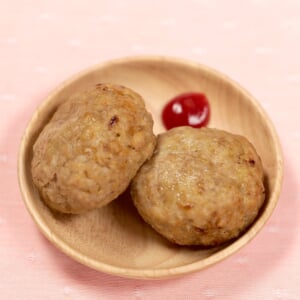
Hamburg Steak (Wheat-Free)
ハンバーグ(小麦なし)
 By Aoi, licensed nutritionist · From a Japanese preschool lunch menu
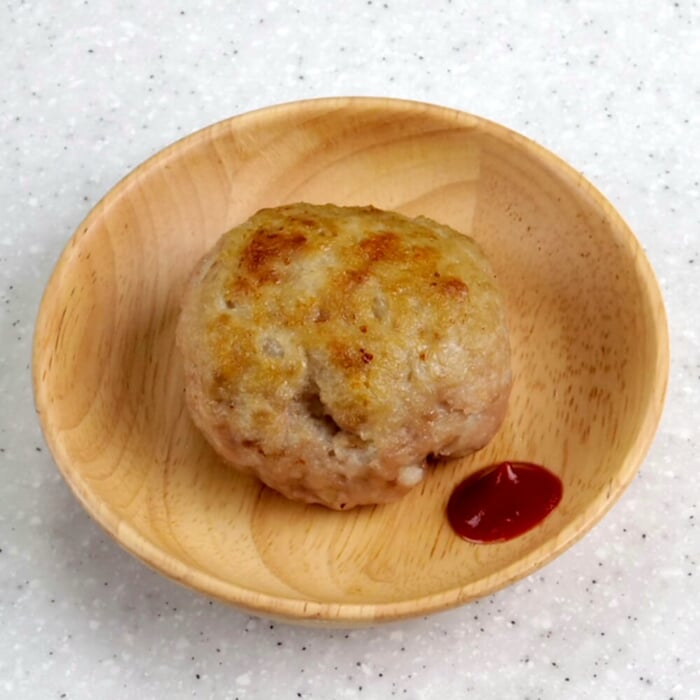
Hamburg steak is Japan's take on the meat patty, served on a plate with a fork rather than in a bun, and it is one of the most requested dishes on any preschool lunch menu. This version skips the usual breadcrumbs and egg: potato starch and soy milk keep the ground pork tender and hold the patties together. Baking the patties in the oven instead of pan-frying means they cook through evenly and gently, which is how we make them in large batches in the preschool kitchen. A little ketchup on the side is all the sauce most little ones need.
Added. Open the recipe helper (bottom right) → ☰ Menu → 🛒 Shopping list to see the ingredients for your family size.
Printing uses the number of adults and children set under Ingredients, so set those first.
Ingredients
Amounts for 1 child (1 serving). An adult counts as 2 servings.
One serving here is 1.5× the portion served to a child in a Japanese preschool, sized for Western appetites. An adult counts as two servings. Tap an ingredient to check it off.
Ingredients
- 67.5 gground pork
- 22.5 gonion
Seasonings
- 1.5 gvegetable oil
- 4.5 gpotato starch (katakuriko)Japanese potato starch used for thickening sauces and coating fried foods. Substitute: Cornstarch: start with the same amount and add a little more if it is still thin. It thickens a little less than potato starch and needs a couple of minutes at a gentle bubble to reach full thickness.
- 7.5 gsweetened soy milk (Japanese chosei tonyu)Japanese 'prepared' soy milk that is lightly sweetened and flavored to taste milder than plain soy milk. Substitute: Regular (original, lightly sweetened) soy milk from the supermarket.
- 0.2 gsalt
- to tastepepper
- 3 gketchup
About the Japanese ingredients in this recipe
- potato starch (katakuriko) (かたくり粉)
- Japanese potato starch used for thickening sauces and coating fried foods. Substitute: Cornstarch: start with the same amount and add a little more if it is still thin. It thickens a little less than potato starch and needs a couple of minutes at a gentle bubble to reach full thickness. Read the guide: Katakuriko (Japanese Potato Starch) and What to Use Instead → Guide: japanese-school-lunch.com/articles/katakuriko-potato-starch/
- sweetened soy milk (Japanese chosei tonyu) (調製豆乳)
- Japanese 'prepared' soy milk that is lightly sweetened and flavored to taste milder than plain soy milk. Substitute: Regular (original, lightly sweetened) soy milk from the supermarket.
Directions
- 1
Finely mince the onion. Heat the oil in a frying pan and sauté the onion until soft and translucent, then set aside to cool slightly.
- 2
Combine the ground pork, cooled onion, potato starch, soy milk, salt and pepper, and knead well until the mixture becomes sticky. Slap the mixture between your hands to knock out any air, then shape into round patties.
- 3
Arrange the patties on a baking sheet and press the center of each one lightly to make a shallow dip. Bake in an oven preheated to 180°C (350°F) for about 20 minutes.
- 4
Plate the patties and serve with ketchup on the side.
Nutrition
| Per | 1 serving | 1 adult serving | Your total |
|---|---|---|---|
| Energy | 184.5 kcal | 369 kcal | 184.5 kcal |
| Protein | 12.6 g | 25.2 g | 12.6 g |
| Fat | 13.4 g | 26.7 g | 13.4 g |
| Carbohydrates | 6.8 g | 13.5 g | 6.8 g |
| Fiber | 0.5 g | 0.9 g | 0.5 g |
| Salt equivalent | 0.3 g | 0.6 g | 0.3 g |
| Calcium | 12 mg | 24 mg | 12 mg |
| Iron | 0.9 mg | 1.8 mg | 0.9 mg |
| Potassium | 258 mg | 516 mg | 258 mg |
| Energy | Protein | Fat | Carbs | Fiber | Salt equiv. | Calcium | Iron | Potassium | |
|---|---|---|---|---|---|---|---|---|---|
| 1 serving | 184.5 kcal | 12.6 g | 13.4 g | 6.8 g | 0.5 g | 0.3 g | 12 mg | 0.9 mg | 258 mg |
| 1 adult serving | 369 kcal | 25.2 g | 26.7 g | 13.5 g | 0.9 g | 0.6 g | 24 mg | 1.8 mg | 516 mg |
Values are per serving (1.5× the Japanese preschool portion); an adult serving is double. They were calculated by a licensed Japanese nutritionist using the Standard Tables of Food Composition in Japan. "Salt equivalent" is sodium × 2.54, the standard Japanese measure. Allergen flags cover egg, milk and wheat only and come from the nutritionist's records. Soy sauce and miso are made with wheat but are usually allowed on Japanese wheat-free school menus, so check with your doctor.