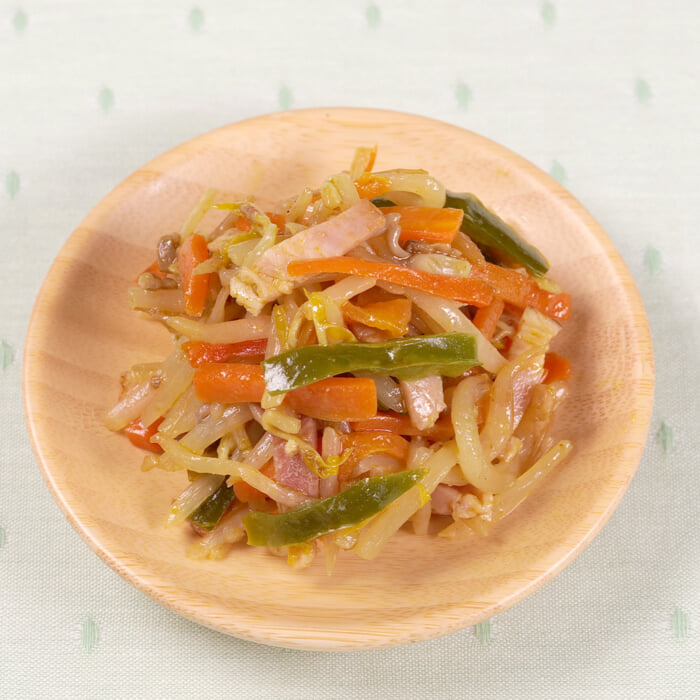
Curry Stir-Fried Bean Sprouts
もやしのカレー炒め · Moyashi no Curry Itame
 By Aoi, licensed nutritionist · From a Japanese preschool lunch menu
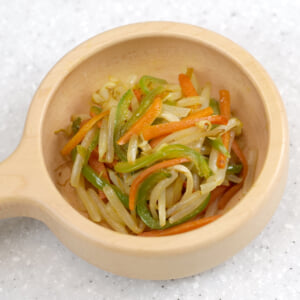
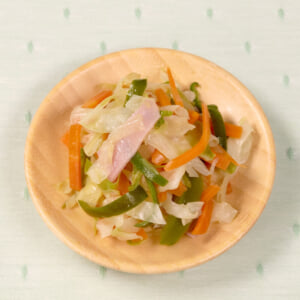
Moyashi (bean sprouts) are one of the most budget-friendly vegetables in Japan, and this simple side dish turns them into something children reach for. Carrot, green bell pepper and a little bacon are stir-fried slowly until soft, then finished with soy sauce, curry powder and a pinch of sugar. The gentle curry flavor softens the bitterness of the green pepper, which is exactly why it works so well for picky eaters.
Wheat-free, but uses soy sauce (made with wheat). Japanese school-lunch allergy menus usually allow it, so check with your doctor. How to read the labels
Added. Open the recipe helper (bottom right) → ☰ Menu → 🛒 Shopping list to see the ingredients for your family size.
Printing uses the number of adults and children set under Ingredients, so set those first.
Ingredients
Amounts for 1 child (1 serving). An adult counts as 2 servings.
One serving here is 1.5× the portion served to a child in a Japanese preschool, sized for Western appetites. An adult counts as two servings. Tap an ingredient to check it off.
Ingredients
- 13.5 gcarrot
- 9 ggreen bell pepper
- 49.5 gbean sprouts
- 9 gbacon
Seasonings
- 0.8 gvegetable oil
- 1.2 gsoy sauce
- 0.2 gcurry powder
- 0.2 gsugar
Directions
- 1
Cut the carrot and green bell pepper into thin 4 cm long strips. Cut the bean sprouts into 2 cm lengths. Cut the bacon into 5 mm wide strips.
- 2
Heat the oil in a frying pan, add the carrot and green bell pepper, and stir-fry over low heat for 7 minutes (adjust the heat within the low range so nothing scorches).
- 3
Add the bean sprouts and bacon and stir-fry over low heat for 10 minutes.
- 4
Drizzle in the soy sauce, curry powder and sugar, and stir-fry over low heat for 1 minute so the flavors meld.
Stir-frying the green bell pepper for a long time reduces its bitterness. Using curry powder also softens the bitterness of the vegetables and makes them easier for children to eat.
Nutrition
| Per | 1 serving | 1 adult serving | Your total |
|---|---|---|---|
| Energy | 45 kcal | 90 kcal | 45 kcal |
| Protein | 2.7 g | 5.4 g | 2.7 g |
| Fat | 2.6 g | 5.1 g | 2.6 g |
| Carbohydrates | 3.6 g | 7.2 g | 3.6 g |
| Fiber | 1.2 g | 2.4 g | 1.2 g |
| Salt equivalent | 0.5 g | 0.9 g | 0.5 g |
| Calcium | 12 mg | 24 mg | 12 mg |
| Iron | 0.2 mg | 0.3 mg | 0.2 mg |
| Potassium | 124.5 mg | 249 mg | 124.5 mg |
| Energy | Protein | Fat | Carbs | Fiber | Salt equiv. | Calcium | Iron | Potassium | |
|---|---|---|---|---|---|---|---|---|---|
| 1 serving | 45 kcal | 2.7 g | 2.6 g | 3.6 g | 1.2 g | 0.5 g | 12 mg | 0.2 mg | 124.5 mg |
| 1 adult serving | 90 kcal | 5.4 g | 5.1 g | 7.2 g | 2.4 g | 0.9 g | 24 mg | 0.3 mg | 249 mg |
Values are per serving (1.5× the Japanese preschool portion); an adult serving is double. They were calculated by a licensed Japanese nutritionist using the Standard Tables of Food Composition in Japan. "Salt equivalent" is sodium × 2.54, the standard Japanese measure. Allergen flags cover egg, milk and wheat only and come from the nutritionist's records. Soy sauce and miso are made with wheat but are usually allowed on Japanese wheat-free school menus, so check with your doctor.