Cheese Dakgalbi (Korean Chicken with Melted Cheese)
チーズタッカルビ(保育園用)
 By Aoi, licensed nutritionist · From a Japanese preschool lunch menu
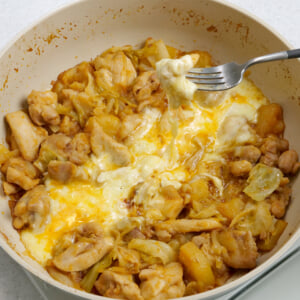
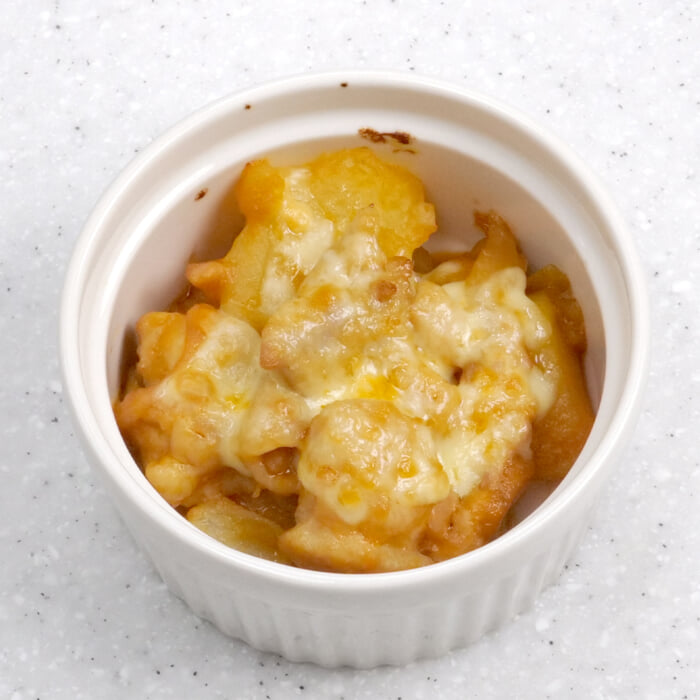
Cheese dakgalbi is a Korean dish of chicken and vegetables cooked in a spicy sauce and finished with a blanket of melted cheese, and it became hugely popular in Japan a few years ago. This is the version I make for preschool: instead of chili paste, the sauce is built on ketchup, miso, mirin and soy sauce, so it has the same sweet-savory depth without any heat. Cabbage, onion and thinly sliced potato soak up the sauce and turn soft enough for little mouths, and the bubbling cheese on top is what makes children reach for seconds. Baking it in individual foil cups keeps every portion neat and makes serving easy.
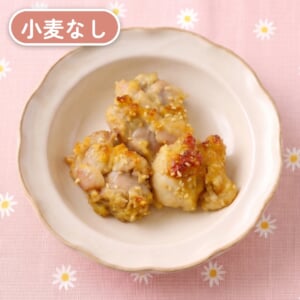
Wheat-free, but uses soy sauce and miso (made with wheat). Japanese school-lunch allergy menus usually allow them, so check with your doctor. How to read the labels
Added. Open the recipe helper (bottom right) → ☰ Menu → 🛒 Shopping list to see the ingredients for your family size.
Printing uses the number of adults and children set under Ingredients, so set those first.
Ingredients
Amounts for 1 child (1 serving). An adult counts as 2 servings.
One serving here is 1.5× the portion served to a child in a Japanese preschool, sized for Western appetites. An adult counts as two servings. Tap an ingredient to check it off.
Ingredients
- 75 gchicken thigh
- 22.5 gonion
- 22.5 gcabbage
- 22.5 gpotato
- 6.8 gshredded pizza cheese
Seasonings
- 2.3 gsesame oil
- 3 gketchup
- 2.4 gmisoFermented soybean paste. Salty and savory, it is Japan's everyday seasoning for miso soup and many simmered dishes. Substitute: Any light (white or awase) miso. Misos differ in saltiness, so start with a little less and taste. Some misos are made with barley or wheat, so check the label if you avoid them.
- 1.5 gmirinMirin is a sweet Japanese rice seasoning that adds gentle sweetness and a glossy finish. Hon-mirin (true mirin) contains about 14% alcohol; "mirin-style seasoning" has little or no alcohol. Some alcohol can remain after short cooking. If you prefer no alcohol for children, use the substitute. Substitute: For each tablespoon of mirin, use 1 tablespoon water plus 1 to 2 teaspoons sugar.
- 0.8 gsoy sauce
- 0.2 gchicken stock powder (Chinese-style)Japanese granulated chicken bone soup base used for Chinese-style soups and stir-fries. Substitute: Chicken bouillon granules or powder.
About the Japanese ingredients in this recipe
- miso (みそ)
- Fermented soybean paste. Salty and savory, it is Japan's everyday seasoning for miso soup and many simmered dishes. Substitute: Any light (white or awase) miso. Misos differ in saltiness, so start with a little less and taste. Some misos are made with barley or wheat, so check the label if you avoid them.
- mirin (みりん)
- Mirin is a sweet Japanese rice seasoning that adds gentle sweetness and a glossy finish. Hon-mirin (true mirin) contains about 14% alcohol; "mirin-style seasoning" has little or no alcohol. Some alcohol can remain after short cooking. If you prefer no alcohol for children, use the substitute. Substitute: For each tablespoon of mirin, use 1 tablespoon water plus 1 to 2 teaspoons sugar.
- chicken stock powder (Chinese-style) (鶏ガラスープの素)
- Japanese granulated chicken bone soup base used for Chinese-style soups and stir-fries. Substitute: Chicken bouillon granules or powder.
Directions
- 1
Thinly slice the onion and cut the slices in half lengthwise. Cut the potato into thin quarter-rounds about 3 mm thick.
- 2
Cut the cabbage into 2 cm squares. Cut the chicken into pieces of about 20 g each.
- 3
Heat the sesame oil in a frying pan, add the vegetables and stir-fry. Add the chicken and stir-fry until the surface is cooked through.
- 4
Add the combined sauce ingredients and stir-fry briefly, then cover and steam-cook until the vegetables are soft. Remove the lid and keep cooking to evaporate the excess liquid.
- 5
Spoon the mixture into foil cups (or spread it on a baking sheet) and top with the shredded pizza cheese.
- 6
Bake in a 200°C (400°F) oven for about 5 minutes, until the cheese has melted.
Nutrition
| Per | 1 serving | 1 adult serving | Your total |
|---|---|---|---|
| Energy | 225 kcal | 450 kcal | 225 kcal |
| Protein | 15.6 g | 31.2 g | 15.6 g |
| Fat | 15.3 g | 30.6 g | 15.3 g |
| Carbohydrates | 9.3 g | 18.6 g | 9.3 g |
| Fiber | 2.8 g | 5.7 g | 2.8 g |
| Salt equivalent | 0.9 g | 1.8 g | 0.9 g |
| Calcium | 72 mg | 144 mg | 72 mg |
| Iron | 0.8 mg | 1.5 mg | 0.8 mg |
| Potassium | 418.5 mg | 837 mg | 418.5 mg |
| Energy | Protein | Fat | Carbs | Fiber | Salt equiv. | Calcium | Iron | Potassium | |
|---|---|---|---|---|---|---|---|---|---|
| 1 serving | 225 kcal | 15.6 g | 15.3 g | 9.3 g | 2.8 g | 0.9 g | 72 mg | 0.8 mg | 418.5 mg |
| 1 adult serving | 450 kcal | 31.2 g | 30.6 g | 18.6 g | 5.7 g | 1.8 g | 144 mg | 1.5 mg | 837 mg |
Values are per serving (1.5× the Japanese preschool portion); an adult serving is double. They were calculated by a licensed Japanese nutritionist using the Standard Tables of Food Composition in Japan. "Salt equivalent" is sodium × 2.54, the standard Japanese measure. Allergen flags cover egg, milk and wheat only and come from the nutritionist's records. Soy sauce and miso are made with wheat but are usually allowed on Japanese wheat-free school menus, so check with your doctor.