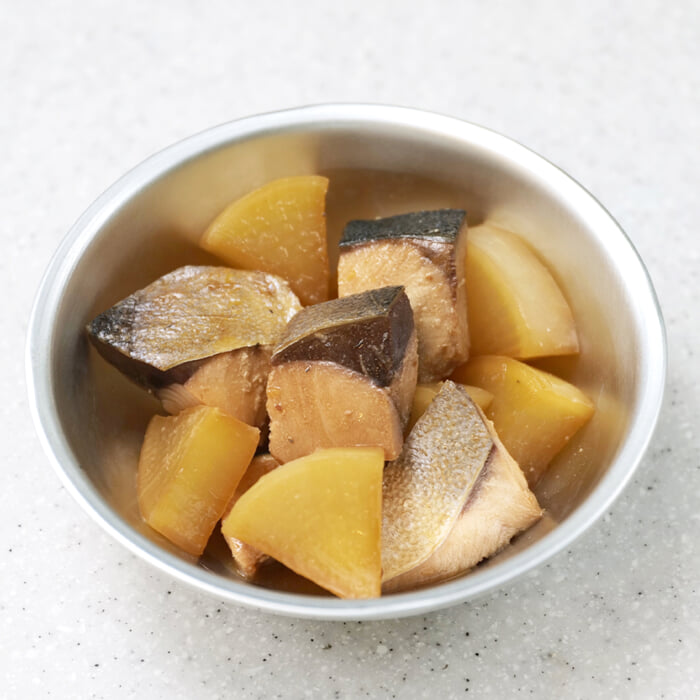
Buri Daikon (Simmered Yellowtail and Daikon)
ぶり大根【オカフーズ版】 · Buri Daikon
 By Aoi, licensed nutritionist · From a Japanese preschool lunch menu
Buri daikon is one of Japan's best-loved winter dishes: chunks of yellowtail and daikon radish simmered slowly in dashi, sake, sugar, and soy sauce until the radish turns translucent and soaks up the savory broth. Both fish and radish are at their peak in the cold months, which is why it shows up on so many school lunch menus in winter. This version is written for the frozen, ready-to-cook yellowtail fillets from Okafoods that we use in preschool kitchens, so there are no bones to worry about and the fish is easy to cut while still half-frozen. The daikon is simmered first so it becomes soft enough for small children, and the whole pot is left to cool so the flavor sinks all the way in.
Added. Open the recipe helper (bottom right) → ☰ Menu → 🛒 Shopping list to see the ingredients for your family size.
Printing uses the number of adults and children set under Ingredients, so set those first.
Ingredients
Amounts for 1 child (1 serving). An adult counts as 2 servings.
One serving here is 1.5× the portion served to a child in a Japanese preschool, sized for Western appetites. An adult counts as two servings. Tap an ingredient to check it off.
Ingredients
- 67.5 gfrozen yellowtail (buri)A rich, oily fish that is at its best in winter in Japan. Substitute: Amberjack, mackerel, or salmon.
- 54 gdaikon radish
Seasonings
- 2.7 gsugar
- 0.9 gsakeSake (Japanese rice wine) is used in small amounts to soften the smell of fish and meat and add depth. Japanese "cooking sake" often contains added salt. Some alcohol can remain after short cooking. If you prefer no alcohol for children, use the substitute. Substitute: The same amount of water (the taste will be a little simpler), or dry white wine.
- 112.5 gdashi stockJapanese soup stock, usually made from kombu (dried kelp) and/or bonito flakes; the base of most Japanese soups and simmered dishes. Substitute: Instant dashi granules dissolved in water, or a mild unsalted chicken or vegetable stock.
- 3.5 gsoy sauce
About the Japanese ingredients in this recipe
- frozen yellowtail (buri) (冷凍ブリ)
- A rich, oily fish that is at its best in winter in Japan. Substitute: Amberjack, mackerel, or salmon.
- sake (酒)
- Sake (Japanese rice wine) is used in small amounts to soften the smell of fish and meat and add depth. Japanese "cooking sake" often contains added salt. Some alcohol can remain after short cooking. If you prefer no alcohol for children, use the substitute. Substitute: The same amount of water (the taste will be a little simpler), or dry white wine.
- dashi stock (だし汁)
- Japanese soup stock, usually made from kombu (dried kelp) and/or bonito flakes; the base of most Japanese soups and simmered dishes. Substitute: Instant dashi granules dissolved in water, or a mild unsalted chicken or vegetable stock.
Directions
- 1
Cut the daikon into 1.5 cm-thick quarter-rounds (ichō-giri).
- 2
Put the daikon, sugar, sake, and enough dashi stock to just cover the daikon in a pot. Set a drop lid (otoshibuta) on top and simmer over low heat for 30 minutes, until the daikon is tender.
- 3
Let the frozen yellowtail sit in the refrigerator for about 20 minutes to partially thaw, then cut it into pieces roughly 4 cm wide.
- 4
Add the soy sauce to the pot from step 2 and stir. Nestle the yellowtail pieces into the gaps between the daikon and simmer over low heat for 5 minutes. Turn the fish over, replace the drop lid, and simmer over low heat for another 10 minutes.
- 5
Once the broth has reduced so that about one-third of the ingredients is submerged, turn the fish over once more and turn off the heat. Leave everything in the pot to cool so the flavors soak in.
Note: To save time, put the daikon and 1 tbsp of water in a heatproof container, cover with plastic wrap, and microwave at 1200W for about 2 minutes 30 seconds (5 minutes at 600W). Then simmer for just 5 minutes instead of the 30 minutes in step 2.
Note: The amount of dashi stock you need will vary with the size of your pot and how much you are making. Prepare a little extra and adjust as you go.
Note: If using fresh yellowtail, cut each fillet into 3 pieces and dip them in boiling water for about 3 to 5 seconds to cook the surface and remove any fishy smell.
Nutrition
| Per | 1 serving | 1 adult serving | Your total |
|---|---|---|---|
| Energy | 174 kcal | 348 kcal | 174 kcal |
| Protein | 15.3 g | 30.6 g | 15.3 g |
| Fat | 11.9 g | 23.7 g | 11.9 g |
| Carbohydrates | 1.8 g | 3.6 g | 1.8 g |
| Salt equivalent | 0.6 g | 1.2 g | 0.6 g |
| Calcium | 21 mg | 42 mg | 21 mg |
| Iron | 1 mg | 2.1 mg | 1 mg |
| Energy | Protein | Fat | Carbs | Salt equiv. | Calcium | Iron | |
|---|---|---|---|---|---|---|---|
| 1 serving | 174 kcal | 15.3 g | 11.9 g | 1.8 g | 0.6 g | 21 mg | 1 mg |
| 1 adult serving | 348 kcal | 30.6 g | 23.7 g | 3.6 g | 1.2 g | 42 mg | 2.1 mg |
Values are per serving (1.5× the Japanese preschool portion); an adult serving is double. They were calculated by a licensed Japanese nutritionist using the Standard Tables of Food Composition in Japan. "Salt equivalent" is sodium × 2.54, the standard Japanese measure. Allergen flags cover egg, milk and wheat only and come from the nutritionist's records. Soy sauce and miso are made with wheat but are usually allowed on Japanese wheat-free school menus, so check with your doctor.
Cooking for bigger kids? See the elementary-school portion of this recipe.
Ingredients in this recipe
You might also like
All recipes →
Buri Daikon (Simmered Yellowtail and Daikon)
Buri Daikon (Simmered Yellowtail and Daikon) (Wheat-Free)
Saba no Misoni (Mackerel Simmered in Miso)
Miso-Simmered Spanish Mackerel
Sawara Mizore-ni (Spanish Mackerel in Grated Daikon Sauce)